
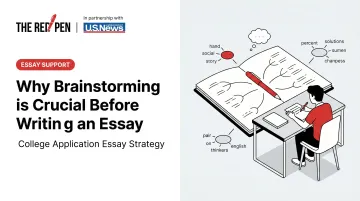
You know the feeling — staring at a blank document, typing a sentence, deleting it, typing it again. That loop almost always traces back to sitting down to write before you've figured out what you actually want to say.
Brainstorming is routinely dismissed as optional, or treated as a quick two-minute jot before the "real" writing begins. But its impact shows up directly in your final essay — in how focused your argument is, how clearly your structure holds, and how persuasively you make your case. This article explains why brainstorming is a non-negotiable first step before any essay — academic, competitive exam, or university application — and what it concretely produces.
Key Takeaways
- Brainstorming turns a broad topic into a clear, defensible thesis before drafting begins.
- It gives you a structural map upfront, so drafting becomes executing a plan rather than building one mid-sentence.
- Essays written after brainstorming are better argued, more cohesive, and easier for admissions readers to follow.
- Skipping brainstorming doesn't save time — it creates mid-draft crises and more revision cycles.
- For high-stakes essays like college application personal statements, brainstorming is where your best story surfaces.
What Brainstorming Actually Is
Brainstorming is the process of freely generating and then organising all possible ideas, angles, and arguments related to an essay topic — before writing begins.
It applies across essay types:
- Academic essays — school assignments, analytical papers, competitive exam responses
- Argumentative essays — where you need a defensible position and supporting evidence
- University application essays — Common App personal statements, UCAS personal profiles, and supplemental essays
The key word is before. Brainstorming is not a creative warm-up activity. It's a thinking tool with a specific output: a clear thesis, an organised structure, and arguments you've already evaluated and ranked.
That output looks different depending on what you're writing. A short academic essay might need 10–15 minutes of focused thinking. A college application personal statement — where you're excavating personal stories and deciding which version of yourself to present — typically requires several structured sessions spread across days or weeks.
Three Advantages of Brainstorming Before Writing
The benefits below aren't abstract. Each one maps directly to observable outcomes in your final essay.
Advantage 1: It Forces You to Clarify Your Central Argument
Brainstorming compels you to figure out what you actually want to argue before you start arguing it. The result is a thesis that's concrete and directional rather than vague or accidental.
Here's how it works in practice: when you dump every possible idea onto paper first, you can identify the strongest, most defensible position — and eliminate weaker tangents before they drift into your draft.
A weak or unclear thesis is the most common reason essays score poorly or require complete rewrites. Harvard's Writing Center defines the thesis as the essay's "central claim" that must be followed by a logically constructed argument. UNC's Writing Center frames it as a road map that tells readers what to expect.
Indiana University's Writing Tutorial Services notes that a well-formed thesis helps writers test and better organise their ideas before committing to a draft.
In exam settings, a pre-clarified thesis is especially valuable. With a defined central claim in place before you begin writing, you can draft quickly and confidently rather than discovering your argument midway through.
In admissions essays, "thesis" becomes your controlling insight — the one perspective or story that ties the entire piece together. Penn Admissions uses the personal statement to understand an applicant's story, experiences, and perspective. Without brainstorming, students often default to the first angle that comes to mind rather than the most authentic or distinctive one.
Essay outcomes impacted: thesis strength, argument focus, logical consistency, evaluator engagement.
Advantage 2: It Builds a Structural Blueprint That Prevents Writer's Block
Brainstorming produces a map of your essay — where the introduction leads, what each body paragraph will argue, how the conclusion ties back — before the pressure of drafting begins.
Techniques like mind mapping, bulleting, or freewriting let you see the shape of the essay in advance. When you sit down to write, you're filling in a structure rather than inventing one under pressure.
That structure directly resolves writer's block. A 2015 study of 428 university students found that only 6% never experienced writer's block — 70% experienced it sometimes or occasionally, and 24% experienced it often or almost always. Writer's block is rarely about having nothing to say. It's almost always about not knowing where to start or where to go next.
Graham and Perin's Carnegie report on adolescent writing instruction identified pre-writing activities — those designed to help students generate or organise ideas before drafting — as one of 11 evidence-backed elements of effective writing instruction, with a measured effect size of 0.32.
A student with a solid brainstorm-derived structure will complete a draft faster and require fewer structural revisions. The structure is already decided — writing becomes execution.
Essay outcomes impacted: essay coherence, paragraph sequencing, drafting speed, number of revision cycles.
Advantage 3: It Produces Richer, More Persuasive Arguments
Brainstorming expands the range of ideas available before you choose which ones to use. When you explore multiple angles — including counterarguments and opposing viewpoints — you produce an essay that feels considered rather than reactive.
By examining all dimensions of a topic before drafting, you can address counterarguments and select the most compelling evidence. Essays that integrate counterarguments consistently signal stronger critical thinking.
Research on argumentative essay quality confirms that essay ratings are better predicted by the relationships among argumentative features — how claims connect to evidence and reasoning — than by simply counting the number of points made.
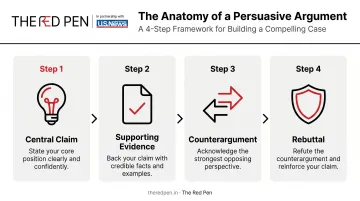
The best brainstorming doesn't just generate more ideas. It helps you sort them into a persuasive chain:
- Start with your central claim
- Layer in supporting evidence
- Acknowledge the counterargument
- Close with your rebuttal
For admissions essays, this matters in a specific way. The Common App 2026–2027 prompts ask students to reflect on background, challenges, beliefs, and personal growth. UBC's admissions guidance explicitly tells applicants to reflect on what they learned rather than simply listing accomplishments. Admissions readers evaluate the depth and maturity of reflection, not just the event described — and that depth only becomes visible through deliberate brainstorming.
This is something The Red Pen's counsellors regularly see in practice. Students who skip brainstorming often describe what happened without articulating why it matters — missing the connection between their experience and their identity or goals, which is precisely what selective admissions committees are looking for.
Essay outcomes impacted: argument depth, use of evidence, counterargument integration, perception of critical thinking.
What Happens When You Skip Brainstorming
The consequences of going straight to drafting are predictable and well-documented.
- Unfocused essays that drift from point to point without a clear argument, leaving readers unsure of your intent
- Mid-draft structural collapse, where you realise halfway through that your argument doesn't hold together and must start over
- Shallow arguments built on the first ideas that came to mind, not the best ones available
- Difficulty finishing, because there's no map to follow once the opening paragraph is written
A 2023 study of 644 undergraduate students found that 42.5% identified planning as a primary area needing improvement in their writing, while significant shares also struggled with thesis clarity (19.3%), paragraph coherence (21.1%), and transitions (20.8%). These aren't separate problems — they're the downstream consequences of skipped pre-writing.
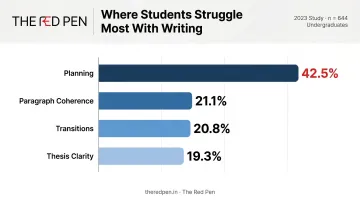
Those statistics point to a practical truth: skipping brainstorming doesn't save time. It creates mid-draft crises that demand more revision, which takes longer than any planning session would have. For students writing college application essays, the cost isn't just time — a structurally weak essay can undermine an otherwise strong application.
How to Get the Most Value from Brainstorming
Brainstorming works best when treated as a structured session with a defined outcome, not a vague mental exercise. Three principles make the difference:
1. Set a clear goal before you start. Before every essay, take 10–30 minutes to brainstorm with a specific outcome in mind — for example: "I want to leave this session with a thesis and three supporting points." For shorter academic essays, 10–20 minutes is usually sufficient. For college application personal statements, plan on multiple sessions across several days.
2. Review and filter, don't just generate. A brainstorm isn't finished when ideas are written down. The most important step is going back through them, identifying the strongest ones, and cutting what doesn't serve the central argument. Listing is not arguing — the ideas still need to be organised by claim, evidence, and sequence.
3. Use a framework for high-stakes essays. For university application personal statements, brainstorming benefits significantly from external structure. A counsellor-led session can help students surface authentic stories and angles they'd otherwise overlook — the kind of specific moments or transferable skills that only become visible when someone helps you look for them.
When structure matters most
This is exactly where The Red Pen's essay support process begins. Counsellors work one-on-one with students before any drafting starts, using their INK (Interactive Narrative Kit) to guide this phase. The INK helps students identify the angle that will anchor a strong personal statement, rather than falling back on a generic narrative. For students working on Common App or UCAS essays, this structured brainstorming is often where the essay's real story first comes into focus.
Conclusion
Brainstorming is the foundation every strong essay is built on. Done well, it produces a clear thesis, a structural roadmap, and richer arguments before the first sentence is written.
That foundation pays off beyond any single essay. Students who practise deliberate brainstorming before every piece they write build faster, more confident habits and produce consistently higher-quality work. The blank page stops being threatening when you arrive at it having already done your thinking.
For college admissions essays in particular, the difference between a good essay and a great one frequently comes down to how much thinking happened before the writing started.
Frequently Asked Questions
How long should I spend brainstorming before writing an essay?
For short academic essays, 10–20 minutes of focused brainstorming is usually enough to establish a thesis and basic structure. For college application personal statements, plan for multiple sessions over several days — reflection takes time, and the best story angles rarely surface immediately.
What is the difference between brainstorming and outlining?
Brainstorming is expansive and non-judgmental — the goal is to generate as many ideas, angles, and examples as possible without filtering. Outlining comes after: it organises the best ideas from your brainstorm into a structured sequence. Both steps are necessary, in that order.
Can brainstorming help with college application essays?
Brainstorming is especially critical for personal statements and supplemental essays. These prompts require you to surface a specific, authentic story from your own life — and without deliberate reflection beforehand, most students default to generic answers that don't distinguish them from other applicants.
What is the best brainstorming technique for essay writing?
There's no single best method. Freewriting works well for open-ended prompts and writer's block; mind mapping suits visual thinkers who need to see connections between ideas; bulleting and listing work for structured analytical essays. The right technique depends on the essay type and how you naturally think.
Is brainstorming necessary even for short essays?
A brief 10-minute brainstorm is especially valuable for short essays (300–500 words), where the most common pitfall is writing vaguely about too many things rather than making one strong, focused argument. The shorter the essay, the more important it is to know exactly what you want to say before you begin.
How do I know when I've brainstormed enough to start writing?
You're ready to draft when you can answer three questions: What is my central argument or thesis? What two or three points support it? How will the essay open and close? Once those are clear, drafting becomes purposeful — not exploratory.