This guide covers 50 common college interview questions across seven categories, with sample answers for the most critical ones in each group. You'll also find practical preparation tips, a list of strong questions to ask your interviewer, and a quick FAQ covering the logistics most students worry about.
Key Takeaways
- College interviews are either evaluative (formally assessed) or informational — treat every one as evaluative regardless of label.
- Interview questions span seven categories, from icebreakers and academics to personal character, future goals, and curveballs.
- Specific, story-driven answers consistently outperform rehearsed, generic ones.
- The questions you ask your interviewer signal genuine curiosity and shape the impression you leave.
- A brief, personalised thank-you email within 24–48 hours is standard professional etiquette.
Why College Interviews Matter
Not all college interviews carry the same weight — and understanding the difference shapes how you prepare.
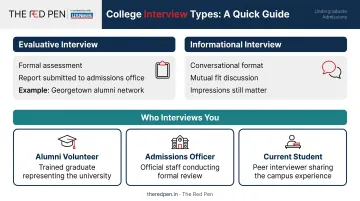
Two types of interviews:
- Evaluative — The interviewer formally assesses you and submits a report to the admissions office. Georgetown, for example, requires interviews and uses a network of over 7,800 alumni volunteers who report directly through its admissions portal.
- Informational — Conversational, non-evaluative meetings focused on mutual fit. These still matter; how you present yourself still influences impressions.
Some highly selective universities conduct no standard interviews at all. Columbia has no undergraduate interview process, and Penn has discontinued alumni conversations entirely. Always verify a school's specific policy before assuming interviews are available.
Who interviews you also matters. Yale uses alumni volunteers and current seniors. MIT relies on alumni Educational Counsellors. Rochester uses admissions representatives and current students. The distinction matters. An alumni interviewer typically reflects on their own undergraduate experience. An admissions officer probes more directly for fit with the institution's current priorities. Adjust your tone accordingly.
NACAC's Fall 2023 admissions data found that only 4.3% of member four-year colleges rated interviews as having "considerable importance," while 54.6% assigned them no importance at all.
At highly selective schools, the picture is more nuanced. Yale rates interviews as "Considered" in its 2024–25 Common Data Set, while MIT states that waived interviews do not negatively affect an application. Interviews rarely make or break an application — but at competitive schools with many equally qualified candidates, a strong interview can tip the balance.
50 Common College Interview Questions by Category
Icebreaker and General Questions
These open the conversation. Interviewers use them to ease into the discussion and get a read on your communication style.
- Tell me about yourself.
- How did you hear about this college?
- What do you know about our school?
- How is your college search going?
- Why do you feel you should be accepted here?
- What are you hoping to get out of college?
- How would you describe yourself in one sentence?
- What's something about you that isn't in your application?
Sample Answer — "Tell me about yourself"
"I grew up in Mumbai, and most of my academic life has been shaped by a genuine obsession with how cities work — why some neighbourhoods thrive while others don't, and what urban policy can actually change. That led me to start a community mapping project in my area, which ended up involving over 40 residents. I'm applying here because your urban studies programme, specifically the community development research lab, is where I want to take that work further."
Notice what this answer does: it's brief, grounded in a specific activity, and ends with a direct connection to the school. It doesn't summarise a CV — it tells a story with a point.
Academic Background Questions
- What is your favourite subject and why?
- What do you plan to major in?
- Describe a class project or paper you're particularly proud of.
- What has been your biggest academic challenge?
- What courses are you taking this year?
- What academic skills are you still working to develop?
- Who is a teacher who has influenced you, and why?
- Describe a time you disagreed with a teacher or a grade.
Sample Answer — "What do you plan to major in?"
"I'm leaning strongly towards environmental science, though I'm keeping options open. What I know for certain is that I want to spend my undergraduate years close to climate policy questions — the science behind them, but also the politics. I've been reading widely on carbon pricing mechanisms this past year, and I want to be in rooms where those decisions get made. I may not have a perfect plan, but I have a clear direction."
This works for undecided students too. The interviewer isn't looking for a locked-in career map — they want intellectual curiosity and honest self-awareness.
Extracurricular and Personal Interests Questions
- What do you do outside of school?
- What extracurricular activities have you been involved in?
- Tell me about your hobbies and interests.
- What are you most passionate about?
- Describe a time you acted as a leader.
- What role do you usually play in a group setting?
- Is there an activity you wish your school offered?
Sample Answer — "Describe a time you acted as a leader"
"In 11th grade, I took over coordination of our school's Model UN conference when the original convenor had to step back two months before the event. We had 200 participants registered and no confirmed venue. I divided responsibilities across a team of six, made the venue calls myself, and we pulled it off. Honestly, I made one call I'd change — I didn't communicate schedule changes to faculty sponsors early enough, and it created unnecessary friction the week before. That taught me that leadership isn't just about getting things done. It's about keeping everyone who's affected in the loop."
The self-reflection at the end is what elevates this answer. It's what separates a candidate who's thought carefully about their experiences from one who's just listing achievements.
Personal Character, Strengths, and Challenges Questions
- What are your biggest strengths?
- What are your biggest weaknesses?
- Describe a challenge you have overcome.
- What are you most proud of?
- Who is your role model and why?
- How would your friends describe you?
- How do you handle stress?
- What is something you would like to improve about yourself?
Sample Answer — "What is your biggest weakness?"
"I have a tendency to take on too much at once because I find it genuinely hard to say no to projects I care about. Last year, I was juggling debate prep, a research internship, and IB coursework simultaneously, and my performance in all three suffered for about six weeks. I've since started blocking time specifically for review and deliberately declining two commitments for every new one I take on. It's an ongoing process, but I'm much more aware of the pattern now."
The "I'm a perfectionist" deflection is recognisable and signals a lack of self-awareness. A real weakness, paired with a real change in behaviour, is far more compelling.
"Why This College" Questions
- Why do you want to attend this college?
- What specific programmes or opportunities drew you here?
- What do you think you will contribute to our community?
- What do you anticipate defining your college experience?
- What seems to fit about this college for you?
- Is there a professor here whose work you've followed?
Sample Answer — "Why do you want to attend this college?"
"Three things brought me here specifically. First, Professor Alvarez's research on informal urban settlements aligns almost exactly with the project I've been running at home. Second, your cross-registration agreement with the law school means I could take property law as an elective without switching departments. Third — and this is less tangible — when I visited campus and sat in on a seminar, the students were pushing back on the lecturer in a way that felt genuinely collaborative, not performative. That's the kind of environment I want to learn in."
Notice what's absent from this answer: rankings, reputation, and vague praise. Interviewers hear those every day. Specific programme names, specific faculty, and specific campus observations stand out.

Future Goals Questions
- Where do you see yourself in 10 years?
- What are your goals for college?
- Do you plan to continue your education after your degree?
- What career fields interest you?
- What skills do you hope to develop in college?
- What will you do to make a difference at this college?
- What does success look like to you?
Sample Answer — "Where do you see yourself in 10 years?"
"Honestly, I hold my plans loosely at this stage — I think anyone who claims certainty about a decade from now isn't being realistic. What I can say is that I want to be working at the intersection of public health and policy, probably in a research or advisory role. The specific job title is less important to me than being in a position where I'm contributing to decisions that affect underserved communities. College is where I want to build the foundation for that, whatever form it ends up taking."
What makes this answer work is the combination of a clear direction and an honest acknowledgement of uncertainty. The interviewer isn't expecting a career blueprint — they want to see that you've thought past the application itself, and that your reasons for attending connect to something real.
Curveball and Creative Questions
These appear occasionally — not universally — and are used to see how you think on your feet rather than recite a prepared answer.
- If you were an animal, what would you be and why?
- If you could give a TED Talk, what would it be on?
- If you could have dinner with any three people, who would you choose?
- What song best describes the past year of your life?
- Describe yourself in three adjectives.
- What's the last thing you changed your mind about?
How to approach these: Don't overthink. Your first instinct is usually your most authentic one. Pick an answer, commit to it, and connect it back to something genuine about who you are or how you think. The interviewer isn't evaluating your answer for correctness. They're watching whether you stay grounded under a question that has no script — and whether your response reveals something real about how you think.
Tips to Ace Your College Interview
Before the Interview
Research specifically, not generally. Knowing a school's name and ranking is the floor, not the ceiling. Before your interview, identify:
- Two or three specific academic programmes, research centres, or faculty whose work connects to your interests
- A campus tradition, initiative, or community feature that genuinely appeals to you
- Any recent news or institutional developments worth acknowledging
This grounds your answers in genuine interest rather than a rehearsed script.
Practice out loud, not just in your head. Run through questions from each category in this article. Record yourself once: you'll immediately notice filler words, pacing issues, and answers that sound fine in your head but fall flat when spoken. Mock interviews with a trusted adult or a structured session with an admissions consultant give you the external feedback that self-review can't.
The Red Pen's interview preparation service — available as a standalone package for undergraduate applicants (₹25,000 for non-Oxbridge institutions, ₹44,800 for Oxbridge) — includes recorded mock interview sessions, real-time feedback from senior consultants, and detailed written reviews that help you spot response patterns under pressure.
During the Interview
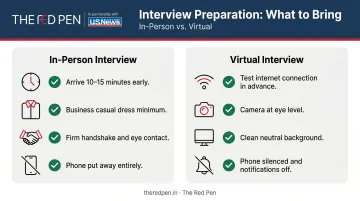
In-person checklist:
- Arrive 10–15 minutes early
- Dress business casual at minimum
- Firm handshake, eye contact, and put your phone away entirely
Virtual interview checklist:
- Stable internet connection tested in advance
- Camera at eye level (not tilted up from a laptop on a desk)
- Clean, neutral background
- Phone silenced and notifications off
One thing students underestimate: pausing to think is fine. Saying "Can I take a moment to think about that?" signals thoughtfulness, not unpreparedness. Yale's own guidance notes that applicants should elaborate rather than give one-word answers — a brief, considered response always beats a fast, vague one.
After the Interview
Send a thank-you email within 24–48 hours. Keep it under 150 words, mention one specific thing from the conversation, and reiterate your interest in the school. College Board's guidance on interview thank-you emails specifically recommends personalising the note with a reference to the discussion rather than sending a generic message.
Questions to Ask Your Interviewer
Your questions matter as much as your answers. Yale explicitly states that interviewers can evaluate candidates based on the quality of questions they bring to the conversation. MIT advises students to ask about the interviewer's personal experience and avoid anything easily answered on the university website.
Strong questions to consider:
- "What aspect of student life here surprised you most when you arrived?"
- "How did your time at this university shape the direction your career took?"
- "What does academic support look like outside the classroom — beyond office hours?"
- "What opportunities exist for undergraduates to get involved in faculty research?"
- "How would you describe the community here for international or first-generation students?"
- "What's one thing you wish you had done differently during your time here?"
- "How has the university changed since you were a student?"
Pick two or three that interest you, and actually listen to the answers. A follow-up question based on what your interviewer says signals curiosity and makes the exchange feel like a real dialogue.
Frequently Asked Questions
What questions are asked at a college interview?
College interview questions typically fall into seven categories: general/icebreaker, academic background, extracurricular activities, personal character, "why this college," future goals, and curveball questions. This article covers all 50 most common ones with sample answers across each category.
How should I prepare for a college admissions interview?
Strong preparation covers three areas:
- Research the specific college well enough to speak naturally about its programmes and community
- Practise answers to questions in each category through mock interviews
- Prepare two or three thoughtful questions to ask your interviewer in return
Do college interviews really matter for admission decisions?
Interviews are rarely the deciding factor. NACAC data shows only 4.3% of colleges rate them as having considerable importance. That said, at selective schools where evaluative interviews are submitted to the admissions file, a strong performance can serve as a meaningful tiebreaker among equally qualified candidates.
How long does a college interview typically last?
Most college interviews run 30–60 minutes, though MIT notes that some can extend up to two hours. A shorter interview doesn't indicate a negative outcome; length varies by institution, format, and interviewer style.
What should I avoid saying in a college interview?
Avoid speaking negatively about other schools, giving vague answers that could apply to any institution, citing rankings or prestige as your main reason for applying, and responding to tough questions with "I don't know" without attempting a thoughtful answer.
Should I send a thank-you note after my college interview?
Yes. Send a brief, personalised thank-you email within 24–48 hours. Mention something specific from your conversation — this helps the interviewer remember you and signals the genuine engagement that top-choice schools notice.