Introduction
Oxford University admits roughly 1 in 6 applicants overall — but for Indian students, the numbers are far more sobering. According to Oxford's 2025 Annual Admissions Statistical Report, only 74 Indian-domiciled students were admitted across a three-year period from 1,757 applications — an admission ratio of approximately 4.2%.
Most rejected applicants weren't underqualified — they were underprepared for a process unlike anything in the Indian education system.
Oxford's admissions process is structurally different from anything Indian students encounter domestically. Strong board exam scores matter, but they're just the entry ticket. Beyond grades, three components carry significant weight — and most applicants underestimate all of them:
- Subject-specific admissions tests (HAT, MAT, TSA, and others depending on course)
- A rigorously academic personal statement focused on intellectual engagement, not achievements
- A tutorial-style interview designed to test reasoning under pressure, not recall
This guide walks through every stage of the Oxford application: requirements, deadlines, what actually strengthens a candidacy, and the mistakes that cost applicants otherwise strong applications.
Key Takeaways
- Indian students face a ~4.2% admission ratio at Oxford UG level (2022–2024 data), making strategic preparation non-negotiable
- CBSE/CISCE applicants must meet specific grade bands; state board and NIOS qualifications are not accepted
- Subject-specific admissions tests (ESAT, TMUA, LNAT, UCAT, TARA) are the primary shortlisting tools — your score determines whether you get an interview
- The UCAS deadline of 15 October at 18:00 UK time is absolute and non-negotiable
- Fully funded scholarships (Rhodes, Chevening) are open to Indian students, but both require a confirmed Oxford offer before you can apply
Oxford Admission Requirements for Indian Students
Requirements vary by course and degree level — and one rule applies across all of them: state board qualifications and NIOS Year XII are not accepted. Only CBSE and CISCE (ISC) boards qualify for undergraduate entry.
Undergraduate Grade Requirements
Oxford's A-level offer bands translate to CBSE and CISCE scores as follows:
| Oxford A-level Band | CBSE Equivalence | CISCE/ISC Equivalence |
|---|---|---|
| A*A*A | A1 in four to five subjects; A1 in course-relevant subjects | Overall 90%+; 95%+ in four subjects including relevant ones; 85%+ in the fifth |
| A*AA | A1 A1 A1 A2 A2; A1 in course-relevant subjects | Overall 90%+; 95%+ in three subjects including relevant ones; 85%+ in the other two |
| AAA | A1 A1 A2 A2 A2; A1 in course-relevant subjects | Overall 90%+; 95%+ in two relevant subjects; 85%+ in the remaining three |
IB Diploma applicants need 38–40 points (depending on the course), including core points, with 6s and 7s at Higher Level. Oxford accepts international A-levels grade-for-grade.
Postgraduate Degree Requirements
Oxford maps Indian degrees to UK honours classifications based on institution type and degree length:
| Oxford Benchmark | 4-year professional degree (Institutions of National Importance) | 4-year professional degree (Other institutions) | 3-year degree (INI) | 3-year degree (Other) |
|---|---|---|---|---|
| Strong upper second-class | 60% | 70% | 65% | 70% |
| First-class honours | 65% | 75% | 70% | 75% |
MPhil and DPhil applicants additionally need a research proposal, two academic references, and a writing sample where required. MBA applicants must submit GMAT (Focus Edition score of 595+ is considered competitive) or GRE (Verbal 160, Quantitative 160).
Admissions Tests
Most Oxford UG courses require a subject-specific test taken in October, registered separately from UCAS. For 2027 entry, the current tests are:
| Test | Courses |
|---|---|
| ESAT | Biomedical Sciences, Engineering Science, Physics, Physics and Philosophy |
| TMUA | Computer Science, Mathematics, and related joint courses |
| TARA | Economics and Management, PPE, History and Politics, Human Sciences, Psychology courses |
| LNAT | Law |
| UCAT | Medicine |
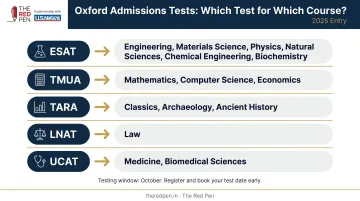
Test booking opens 20 July 2026 and closes 28 September 2026 at 18:00 UK time. Missing this deadline closes the application entirely. No alternative sitting is offered.
English Proficiency Requirements
Most Indian students educated in English may qualify for a waiver, but this is not automatic. To qualify, you must have completed full-time English-medium schooling for at least three recent years, including the two years immediately before applying, through to school completion. Check Oxford's official page to confirm your eligibility before applying.
If a test is required, the score thresholds are:
| Test | UG Requirement | PG Standard | PG Higher |
|---|---|---|---|
| IELTS Academic | 7.5 overall; 7.0 per component | 7.0 overall; 6.5 per component | 7.5 overall; 7.0 per component |
| TOEFL iBT | 110 overall | 100 overall | 110 overall |
| PTE Academic | 76 overall; 66 per component | — | — |
How the Oxford Application Process Works: Step by Step
Oxford's UG admissions run on a fixed, multi-stage timeline from summer through January. Every deadline is hard — there are no extensions.
Step 1: Choose Your Course and College
Course selection determines your required grades, admissions test, and competition level. Oxford has 39 colleges, each with its own culture and subject-specific admission patterns. You can express a college preference or make an "open application" — the latter assigns you to a college with available spaces.
Research historical college-level data for your subject before deciding. Some colleges receive significantly fewer applications for specific courses, which directly affects your odds.
Step 2: Register for Admissions Tests
Register through a UAT-UK account (account creation opens 1 June 2026). Booking opens 20 July and closes 28 September 2026. This step is completely separate from UCAS — many applicants miss this because they assume UCAS handles everything.
Step 3: Submit Your UCAS Application
The UCAS application includes:
- Personal statement (discussed in detail below)
- Predicted grades from your school
- Teacher/counsellor reference
Hard deadline: 15 October 2026 at 18:00 UK time. No exceptions.
Step 4: Submit Written Work (If Required)
Courses like History and English require a sample essay — not your personal statement, but an actual academic essay demonstrating analytical ability. The college must receive this by 10 November. Check your specific course page early to confirm whether this applies.
Step 5: Attend the Interview
Shortlisted candidates are invited to online interviews in December. Oxford interviews function like compressed tutorials, where tutors present unfamiliar problems and assess how you think. Expect to:
- Work through problems aloud as they unfold, not recite prepared answers
- Adapt your reasoning when the tutor challenges or redirects you
- Engage intellectually in real time with ideas you may not have encountered before
Preparation for this style of interview takes months, not days. Starting well before shortlisting — rather than scrambling after the invitation arrives — makes a measurable difference.
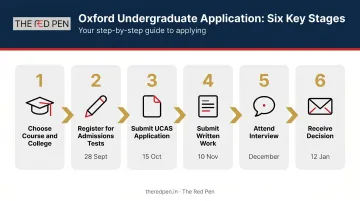
Step 6: Receive Your Decision and Confirm Your Place
Decisions are communicated on 12 January 2027 for 2027 entry. If you receive an offer, the formal process concludes here — but the work continues. Offer holders must meet their grade conditions, with final confirmation following results release in August.
What Really Strengthens Your Oxford Application
Academic Personal Statement
Oxford's personal statement is almost entirely academic. Unlike US college essays, personal achievements and extracurriculars carry minimal weight unless they directly connect to the subject. Tutors want to see:
- Independent reading beyond the school syllabus
- Critical engagement with ideas in the field
- Genuine intellectual curiosity about the subject itself
A personal statement that reads like a CV — listing awards, leadership roles, and community service — signals a fundamental misunderstanding of what Oxford evaluates.
Supercurricular Depth
Oxford describes supercurricular learning as: "exploring the subjects that interest you beyond what you study at school... investigating questions, encountering ideas, and expanding your knowledge."
This means subject-relevant activities that go beyond the classroom:
- Reading academic papers, books, or journals in the field
- Olympiad participation or science competitions
- Independent research or extended projects
- Online university courses in the subject area
- Attending lectures, seminars, or academic events
Breadth across many activities is far less valuable than genuine depth in a few directly relevant ones.
Interview Preparation
This is where many otherwise-qualified applicants fail. Oxford's tutorial-style interview has no real parallel in Indian academic culture — tutors deliberately present problems the applicant has never seen and observe how they reason through uncertainty.
Preparation needs to begin well before shortlisting, because candidates receive very little notice once contacted. The Red Pen offers a dedicated Undergraduate Interview Prep for Oxbridge service built specifically for this format, not standard interview coaching. The Red Pen's President, Namita Mehta, brings hands-on expertise in guiding students through the Oxford and Cambridge interview format — coaching applicants to reason out loud, engage with unfamiliar problems, and meet the standard tutors actually assess.
College Selection Strategy
Oxford's 39 colleges differ in size, subject-specific admission rates, and culture. Some colleges consistently receive fewer applications for particular subjects, which can affect shortlisting odds. Making an informed choice — or deciding strategically to make an open application — requires digging into historical data, not guessing.

Costs and Scholarships for Indian Students
Tuition Fees and Living Costs
For 2026–27 entry, Oxford's annual overseas UG course fees range from £37,380 to £62,820 (approximately ₹41–68 lakh at current rates, though this fluctuates with the exchange rate). Clinical medicine fees sit at the higher end of this range. Oxford publishes postgraduate fees on individual course pages.
Oxford's estimated annual living costs for 2026–27:
| Category | Annual Range (9 months) |
|---|---|
| Accommodation and utilities | £7,425–£8,910 |
| Food | £2,835–£4,905 |
| Personal items | £1,440–£2,790 |
| Social activities | £450–£1,170 |
| Study costs | £315–£810 |
| Total | £12,645–£18,945 |
Combined tuition and living costs for an Indian UG student: approximately £50,000–£82,000 per year (roughly ₹54–89 lakh). Several scholarships can offset a significant portion of these costs — here are the main options available to Indian students.
Scholarships Available to Indian Students
| Scholarship | Coverage | Key Eligibility | Timing |
|---|---|---|---|
| Rhodes Scholarship | Full tuition, £20,400 annual stipend, flights, visa fees | 5 awards for India; undergraduate degree; typically First Class/3.70+ GPA | Applications open June 2026; close 23 July 2026 |
| Chevening Scholarship | Full tuition, living allowance, flights, visa fees | Master's students; work experience required; apply to three eligible UK universities | Opens August 2025; closes October 2025 |
| Oxford-Weidenfeld and Hoffmann | 100% course fees + living grant of £20,780+ | Graduates from developing/emerging economies; must intend to return home | Course deadline (Dec/Jan); interviews April 2026 |
| Reach Oxford Scholarship | Course fees, living grant, return airfare | UG students from ODA-recipient countries; must hold Oxford offer | Deadline 4 February 2026 |
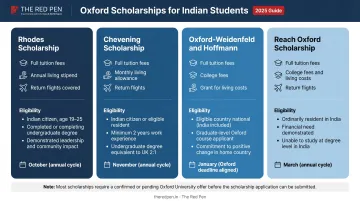
Scholarship applications typically open after receiving an Oxford offer — you cannot apply for most without one first.
Note on application fees: the graduate application fee is £75 (approximately ₹8,600) for taught courses and £20 for research courses, with fee waivers available for eligible low-income country applicants.
Common Mistakes Indian Applicants Make
Writing a Personal Statement That Lists, Not Argues
Indian applicants frequently submit personal statements structured like academic CVs — achievements, positions held, extracurriculars. Oxford tutors are looking for intellectual engagement with the subject: what have you read, what have you questioned, what ideas have you grappled with? A long list of accomplishments, however impressive, does not answer that question.
Treating Admissions Tests as Secondary
Many Indian students invest heavily in board exam preparation while giving Oxford's subject-specific tests only cursory attention. For most Oxford courses, the ESAT, TMUA, LNAT, or UCAT score is a primary shortlisting criterion — applicants who don't clear the benchmark don't reach the interview stage, regardless of their grades.
Missing Registration Deadlines
The UCAS deadline (15 October) and the test registration window (closing 28 September) are separate, firm, and unextendable. Unlike JEE or NEET, there is no re-attempt the same year — a missed deadline means waiting 12 months and starting over.
Frequently Asked Questions
How can you get into Oxford University?
Meeting course-specific grade requirements (CBSE/CISCE or IB), sitting the required subject-specific admissions test, submitting an academic personal statement via UCAS by 15 October, and performing well in the December interview. Each stage filters the applicant pool: strong performance across all four is required.
What is the acceptance rate for Indian students at Oxford?
Oxford's overall UG offer rate is around 16.4%, but the admission ratio for Indian-domiciled students is approximately 4.2% based on 2022–2024 data (74 admitted from 1,757 applications). Focused, early preparation improves a candidate's chances within that pool.
Can I apply to Oxford after Class 12 from India?
Yes — Indian students applying directly after Class 12 via CBSE or CISCE can apply through UCAS. State board and NIOS qualifications are not accepted. Grade requirements depend on the course, ranging from AAA to A*A*A equivalence.
Do Indian students need IELTS to apply to Oxford?
Many Indian students in English-medium schools qualify for a waiver, but it is not automatic. The exemption requires at least three years of recent full-time English-medium education, continuing until school completion. Verify your specific eligibility on Oxford's English language requirements page before assuming you are exempt.
How can I get a fully funded scholarship to Oxford?
Fully funded scholarships for Oxford undergraduates are extremely limited for international students. Oxford's own needs-based Oxford Bursary is available to eligible UK-fee students, but most Indian applicants pay overseas fees and must plan for the full cost. Scholarships like Rhodes and Chevening apply only to postgraduate study — not undergraduate admission.
What is Oxford University's fee in rupees?
Annual overseas UG tuition fees for 2026–27 range from approximately £37,380 to £62,820 — roughly ₹41–68 lakh depending on the exchange rate. Adding living costs brings the total annual estimate to ₹54–89 lakh per year.