Introduction
Over 363,000 Indian students enrolled in US universities in 2024–25, a 10% jump from the previous year — making India the top-sending country for American higher education. That number is only growing.
Yet for most Indian applicants, the US admissions process remains deeply confusing. India's system is built on a single metric: your score. The US system is built on something far harder to pin down — your story, your character, and how you present yourself across a dozen different components simultaneously.
This guide covers everything Indian students need to know about undergraduate admissions: eligibility requirements, the step-by-step application process, what it actually costs, where to find funding, and how to navigate the F-1 visa.
Whether you're a Class 11 student planning ahead or a final-year school leaver ready to apply, this is your starting point.
Key Takeaways
- Academic scores matter, but US admissions are holistic — essays, recommendations, and extracurriculars carry real weight
- UG applicants need strong 10+2 scores, SAT/ACT (at many schools), and TOEFL/IELTS for English proficiency
- Most students target the Fall intake; begin preparing 12–18 months in advance
- Annual costs range from ₹24 lakh to ₹50 lakh+ depending on the university, so exploring scholarships and financial aid early is essential
- Securing the F-1 student visa is a key step after admission — start the process as soon as you receive your I-20
Why Study in the US? What Indian Students Stand to Gain
The US higher education system is both broad and deep. The NCES counted 3,542 degree-granting institutions with first-year undergraduates in 2021–22, and 35 US universities rank in the THE global top 100 as of 2026. That combination — scale plus selectivity — means there's a genuinely strong fit available for students across academic backgrounds and budgets, not just those chasing Ivy League admissions.
That breadth also translates into concrete career advantages — ones that begin before graduation and extend well into your first decade of work.
Career Advantages After Graduation
The career case for studying in the US is specific and measurable.
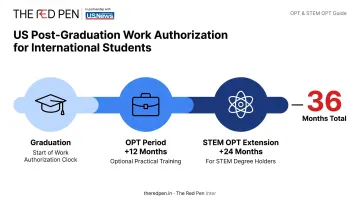
- OPT (Optional Practical Training) allows graduates to work in the US for up to 12 months after completing their programme
- STEM OPT extension adds another 24 months for eligible STEM degrees, totalling up to 36 months of US work experience
- Major global employers in tech, finance, healthcare, and research are headquartered or heavily staffed in the US — proximity matters for career entry
A Different Kind of Education
The shift from India's exam-focused system to the US model is often underestimated by first-time applicants. US universities emphasise critical thinking, interdisciplinary learning, and independent research. Students are expected to question, debate, and contribute — not just absorb and reproduce.
For Indian students entering global careers, this difference has practical weight. The skills employers in competitive markets consistently prioritise — clear communication, analytical reasoning, and the ability to lead through ambiguity — are precisely what a US education is structured to develop.
What US Colleges Really Look For: Admission Requirements for Indian Students
Unlike India's rank-based admissions, US colleges use a holistic review model — evaluating academics, test scores, extracurriculars, essays, and recommendations together, not in isolation.
That means a student with a 95% board score and no compelling narrative can lose out to someone with 82% and a remarkable personal story.
Undergraduate Requirements (After 12th)
Academic baseline:
- Strong 10+2 scores from CBSE, ISC, or state boards — typically 70–80%+ for science and commerce streams, 65%+ for humanities
- Some universities may request a WES credential evaluation; check with each institution's admissions office
Standardised tests:
- SAT or ACT scores are required at many universities, though test-optional policies are widespread — at least 1,825 US four-year colleges will not require ACT/SAT for Fall 2025 admissions
- Competitive SAT ranges vary widely by tier: University of Michigan sits at 1360–1530; Purdue at 1210–1470. Always check each university's published Common Data Set
- Test-optional doesn't mean test-irrelevant — a strong score still helps; a weak score is better left unsubmitted
English proficiency:
- Accepted tests: TOEFL, IELTS, PTE, or Duolingo
- MIT requires a minimum TOEFL of 90 (recommended 100); Cornell requires 100 for exams before January 2026 and an IELTS of 7.5
- Students whose prior schooling was entirely in English may be waived from this requirement — verify with each university
Postgraduate Requirements (After Bachelor's)
PG requirements differ significantly from undergraduate admissions. Here's a brief overview of what most US master's programmes expect from Indian applicants:
Academic eligibility:
- A relevant bachelor's degree with a minimum GPA of approximately 3.0/4.0
- Some US universities do not accept a 3-year Indian bachelor's degree for direct master's admission — Columbia GSAS explicitly does; Cornell and Stanford use "international equivalent" language requiring case-by-case verification. Always confirm with the specific graduate school
Standardised tests:
- GRE for most academic disciplines; GMAT for business programmes
- Many programmes now waive the GRE — verify at the programme level, not just the university level
Written components (for both UG and PG):
These are not formalities. They are where Indian applicants most often differentiate — or disqualify — themselves:
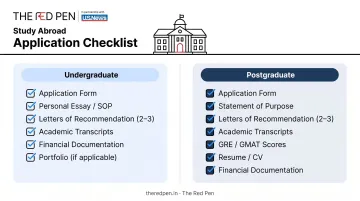
- Statement of Purpose (SOP) or personal essay
- 2–3 Letters of Recommendation (LORs)
- Academic transcripts
- Resume/CV (required for PG; optional for some UG programmes)
- Portfolio (for art, architecture, and design programmes)
How to Apply to US Colleges from India: A Step-by-Step Process
US applications reward students who plan ahead. Most programmes have a Fall intake (August–September), which is the primary entry point for Indian students. Spring intake (January) exists but is limited in availability. Start 12–18 months before your target intake.
Step 1: Research and Shortlist Universities
Build a balanced list — reach schools, match schools, and safety schools — based on:
- Programme fit and academic alignment
- Location and campus culture
- Budget and financial aid availability
- Acceptance rates and admitted student profiles
Avoid the common trap of shortlisting purely by rankings. A university that offers a strong programme, generous financial aid, and a culture that suits you will serve you far better than a prestigious name that doesn't fit.
EducationUSA and official university websites are reliable starting points. Working with an experienced admissions counsellor can sharpen this process.
The Red Pen, based in Mumbai, uses a personalised approach — including their INK Interactive Narrative Kit — to help students identify the right programmes and build applications that go beyond academics to tell a genuine story. Their team has worked on applications to 120+ unique colleges across a single admissions cycle.
Step 2: Prepare and Take Required Tests
| Program Level | Tests Required |
|---|---|
| Undergraduate | SAT or ACT + TOEFL/IELTS/PTE/Duolingo |
| Postgraduate | GRE or GMAT + TOEFL/IELTS/PTE/Duolingo |
- Take tests by October–November if targeting the following Fall intake
- Allow 3–6 months for test preparation — don't rush this
- Retakes are possible but require planning; factor this into your timeline
Step 3: Prepare Application Documents
For undergraduate applications, the primary platform is the Common App (used by 1,000+ US universities). Most PG programs use individual university portals.
Key documents:
- Completed application form
- SOP or personal essay — requires multiple drafts over several weeks
- LORs — request from professors or supervisors at least 6–8 weeks before deadlines
- Official academic transcripts
- Financial documentation (bank statements, loan sanction letters)
- Resume/CV for PG applicants
The SOP is where many Indian applicants lose ground. Generic career-goals statements written in a week rarely succeed — admissions officers read thousands of them. A vague "I want to contribute to the field of X" tells them nothing. Your specific experiences, intellectual journey, and goals need to be clearly, authentically yours.
Step 4: Submit Applications and Handle the Visa
After receiving an admission offer:
- Receive Form I-20 from the university (issued once you're admitted and submit enrollment confirmation)
- Pay the SEVIS fee — currently $350 for F and M visa holders, payable at fmjfee.com
- Complete Form DS-160 online
- Schedule a visa interview at a US consulate in India
F-1 visa requirements:
- Valid passport (at least 6 months beyond your intended stay)
- Form I-20
- DS-160 confirmation
- SEVIS fee receipt ($350)
- Proof of funds
- Visa application fee ($185)
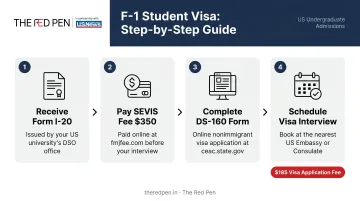
Current F/M/J interview wait times (as of 18 June 2026): Chennai — NA, Hyderabad — 1.5 months, Kolkata — 1.5 months, Mumbai — 1.5 months, New Delhi — 2 months. Check the State Department's global visa wait times page for current figures, as these change frequently.
F-1 visas can be issued up to 365 days before your programme starts, but new students may not enter the US more than 30 days before the programme start date.
Costs, Scholarships, and Funding Options for Indian Students
What Does It Actually Cost?
According to College Board's 2024–25 Trends in College Pricing report:
| Institution Type | Tuition & Fees (Annual) | Housing & Food |
|---|---|---|
| Public 4-year (out-of-state) | $28,360 | $13,120 |
| Private nonprofit 4-year | $42,160 | $15,210 |
At current exchange rates, total annual costs can range from approximately ₹34 lakh to ₹57 lakh+ before personal expenses. This varies significantly by university, city, and lifestyle.
Funding Options Available to Indian Students
Merit-Based University Scholarships
Many US universities offer direct merit awards to international students. Award amounts vary widely — check each university's international student financial aid page for specifics.
Need-Blind Financial Aid
A small number of universities — including Harvard, MIT, Princeton, Yale, Amherst, and Dartmouth — have need-blind admissions policies for international students and meet full demonstrated need. These are highly competitive schools, but the financial aid can be transformational for eligible students.
External Scholarships
Three well-established options for Indian applicants:
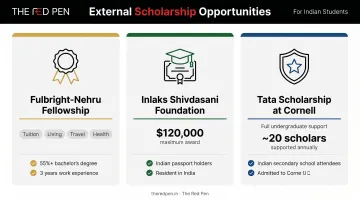
- Fulbright-Nehru Master's Fellowship — covers tuition, living costs, travel, and health insurance; requires a bachelor's equivalent with at least 55% marks and 3 years of professional experience
- Inlaks Shivdasani Foundation Scholarship — awards up to $120,000 covering tuition, living, travel, and health; open to Indian passport holders resident in India
- Tata Scholarship at Cornell — for Indian citizens who attended secondary school in India and are admitted to Cornell undergraduate; supports approximately 20 scholars at any time
Education Loans
Indian banks and NBFCs — such as SBI, HDFC Credila, and Avanse — offer education loans for studying abroad, both with and without collateral. Proof of admission and financial documentation are required. Since proof of funds is also needed for your F-1 visa application, arrange financing early in the process.
Fully funded scholarships for Indian students do exist, but they are extremely competitive with specific eligibility criteria. Apply to a range of universities with varying financial aid policies rather than depending on a single fully funded option.
Common Mistakes Indian Students Make When Applying to US Colleges
Treating It Like a Board Exam
The most damaging assumption Indian students bring to US admissions is that grades and test scores decide everything. US admissions officers are evaluating who you are, not just what you scored.
Students who invest almost all their energy in SAT prep while submitting a generic personal essay and thin extracurricular profile consistently underperform relative to their academic credentials. A student with a 1400 SAT and a compelling, specific narrative will outperform one with a 1550 and nothing interesting to say.
The Red Pen's counsellors regularly see Indian applicants arrive with strong academic profiles but underdeveloped extracurricular depth and no coherent personal story — precisely the areas that US admissions offices weigh heavily. Building that story takes months, not days.
Applying Without a Balanced List
Applying only to Ivy League schools and a few other highly ranked universities without any safety options is a strategy that ends badly for many Indian students every year. The mathematical reality: Harvard's acceptance rate for Fall 2024 was approximately 3.65% — 1,970 admitted out of 54,008 applications.
A well-constructed list has reach schools, match schools, and safety schools. Starting this process 12–18 months out gives you time to research genuinely, not just recognise brand names.
Generic SOPs and Essays
Admissions offices read thousands of statements of purpose. The ones that read like a template — vague career goals, a generic passion for the field, no specific experiences — don't stand out.
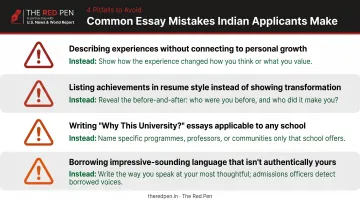
The most common essay mistakes The Red Pen's team identifies:
- Describing experiences without connecting them back to personal growth or values
- Listing achievements in resume style instead of showing transformation
- Writing "Why This University?" essays that could apply to any institution
- Borrowing language that sounds impressive but isn't authentically yours
Strong SOPs and essays require genuine reflection and multiple drafts. Most students need 6–8 weeks of active work to get an essay to a competitive standard — start well before deadlines close in.
Frequently Asked Questions
Can I get a 100% scholarship to study in the USA from India?
Fully funded scholarships exist — the Fulbright-Nehru Fellowship, Inlaks Scholarship, and select university-specific awards cover full costs — but they are highly competitive with strict eligibility criteria. Plan for multiple funding sources: partial scholarships, assistantships, and institutional aid alongside any fully funded application.
Is ₹20 lakhs enough to study in the USA?
At approximately USD $24,000, ₹20 lakhs falls below the average out-of-state public university tuition alone ($28,360), before adding housing and food ($13,120). It is typically not sufficient to cover a full year at most US universities without scholarships, assistantships, or an education loan supplementing the amount.
Can I get into Harvard after 12th from India?
Indian students can apply to Harvard after 12th grade, and CBSE/ISC credentials are recognised. With a Fall 2024 acceptance rate of 3.65%, top board scores are a baseline expectation — essays, recommendations, and extracurricular depth are what differentiate successful applicants at this level.
Is NEET accepted for admission to US medical schools?
No. US medical schools (MD programs) are graduate-level and require a bachelor's degree plus the MCAT exam, administered through AMCAS. NEET scores play no role in the US medical school application process.
How early should I start preparing for US college admissions from India?
Start 12–18 months before your target intake. For UG applicants, this means beginning serious preparation in Class 11. For PG applicants, this means starting in the penultimate year of your bachelor's degree — earlier if you need to build research experience or publications.
Does a 3-year Indian bachelor's degree qualify for US master's programs?
It depends entirely on the university and programme. Columbia GSAS explicitly accepts 3-year Indian bachelor's degrees; Cornell and Stanford require an "international equivalent" that may necessitate credential evaluation. Check each graduate school's admissions policy individually and consider a WES evaluation if eligibility is uncertain.