
This guide covers every stage of the process — from eligibility and UCAS mechanics to postgraduate applications, documents, costs, scholarships, and the student visa.
Key Takeaways
- India ranks as the UK's largest overseas student source country for the third consecutive year
- UG applications go through UCAS (up to 5 choices); PG applications are submitted directly to each university
- Russell Group universities typically require 80–95% in Class 12 for direct UG entry
- IELTS Academic requirements range from 6.0 to 7.0+ depending on university and course
- The main UCAS equal-consideration deadline for 2026 entry is 14 January 2026
Are You Eligible? Entry Requirements for Indian Students
Undergraduate Entry Standards
UK universities accept CBSE, ICSE, and State Board results, but the benchmarks vary considerably by institution. The 75–85% figure circulates widely — treat it as a floor, not a target.
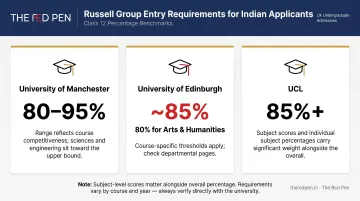
Verified Russell Group requirements for Indian Class 12 applicants:
| University | Class 12 Requirement |
|---|---|
| University of Manchester | 80–95% overall (course-dependent) |
| University of Edinburgh | ~85% overall; 80% for some arts/humanities |
| UCL | 85%+ for many courses; subject-specific thresholds apply |
Subject requirements matter just as much as overall percentage:
- Engineering / Computer Science: Strong marks in Mathematics and Physics are typically required
- Business / Economics: Solid scores in Economics or Accountancy
- Arts and Humanities: More flexible, but check each university's course page individually
Postgraduate Entry Standards
Most UK master's programmes require a recognised bachelor's degree (3 or 4 years) with a strong academic record. There is no universal percentage threshold. To find what applies to you:
- Check each university's country-specific admissions page for India equivalency guides
- Contact the admissions office directly if your board's grading system isn't listed
The Foundation Year Route
Students who don't meet direct entry requirements have a genuine alternative. Foundation or pathway programmes — typically 9–12 months — lead directly into a bachelor's degree programme, with providers such as INTO and Kaplan running them on behalf of UK universities.
Indicative entry requirements by provider:
- Kaplan: Minimum 11 years of high-school study; IELTS equivalent of approximately 4.0–5.5
- INTO Manchester: Completion of 12 years of schooling with good grades
Neither provider publishes India-specific percentage cut-offs, so contact them directly with your board results.
Applying for UG Programmes: The UCAS Route
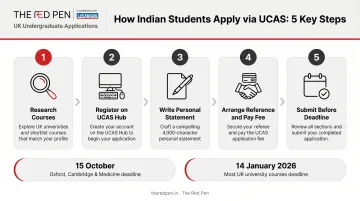
UCAS (Universities and Colleges Admissions Service) is the single platform through which all UK undergraduate applications are submitted. You can apply to up to 5 courses across different universities in one cycle. Medicine, dentistry, and veterinary science have a separate cap of 4 choices within that subject area.
Step 1: Research Courses and Universities
Start 12–18 months before your intended intake. Use UCAS Hub and individual university course pages to check:
- Entry requirements for Indian board qualifications specifically
- Module structure and career outcomes
- Whether predicted grades are accepted (they usually are for Class 12 students awaiting results)
Build a balanced list: ambitious choices, realistic targets, and at least one safer option. Given the 5-choice limit, every slot counts. If you're unsure how to balance your list, The Red Pen's admissions consultants use a structured dream-target-safety framework calibrated specifically for UCAS constraints — their team includes graduates from Oxford, Cambridge, LSE, and Imperial College London.
Step 2: Register on UCAS and Complete the Application Form
Create an account on UCAS Hub and complete each section carefully:
- Enter personal details exactly as they appear on your passport
- List all qualifications, pending results, and English test scores under education history
- Add relevant work experience in the employment section (optional)
The education section is critical — universities use it to assess eligibility before they read anything else.
Step 3: Write the Personal Statement
The UCAS personal statement has a 4,000-character maximum (including spaces, with a 350-character minimum per answer under the new 3-question format introduced for 2026 entry). Unlike US applications, UK universities expect an academically focused statement — subject-specific, intellectually driven, and demonstrating genuine readiness for university-level study.
Common mistakes Indian applicants make:
- Writing a biographical list of achievements rather than engaging with the subject
- Borrowing a narrative structure that works for Common App essays but falls flat for UK admissions
- Failing to connect extracurricular activities to academic interests
The Red Pen's INK (Interactive Narrative Kit) is designed to help students work through exactly this challenge. It guides the brainstorming and narrative development process, turning raw experiences into a structured statement suited to UK admissions expectations.
Step 4: Arrange a Reference and Pay the Fee
One academic reference is required — from a teacher, lecturer, or academic supervisor, not a family member. Approach your referee early and brief them on the specific courses you're applying to. A targeted, course-aware reference is far more effective than a generic one.
The current UCAS application fee for 2026 entry is £28.95 for up to five choices. Verify the latest fee on the UCAS website before applying.
Step 5: Submit Before the Deadline
Two critical UCAS deadlines apply:
- 15 October — Oxford, Cambridge, and most medicine/dentistry/veterinary courses
- 14 January 2026 — Most other undergraduate courses for 2026 entry (13 January 2027 for 2027 entry)
After submission, track your application through UCAS Track. Universities will respond with either a conditional offer (a place secured once you meet stated conditions, typically a grade or English score) or an unconditional offer (a place confirmed immediately with no further requirements).
Applying for Postgraduate Programmes: Direct University Applications
There is no UCAS equivalent for UK master's or MBA programmes. Each university runs its own online application portal, sets its own requirements, and operates on its own timeline. You must check each institution individually.
How Rolling Admissions Work
Unlike UCAS's fixed-deadline model, most UK PG programmes operate on rolling admissions — applications are reviewed as they arrive. This makes timing critically important:
- Apply 9–12 months before your intended start date for the strongest chance of securing a place and scholarship funding
- UCL recommends applying at least 6 months before course start; many universities open applications 12+ months before intake, so early movers have a clear edge
Earlier applications get more attention and more funding options. Waiting until three months before intake leaves you competing for whatever seats and funding remain.
Standard PG Application Components
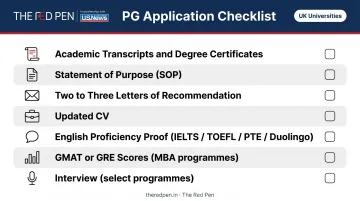
Most UK universities require:
- Academic transcripts and degree certificates
- Statement of Purpose (SOP) or personal statement
- Two to three letters of recommendation (LORs)
- Updated CV
- Proof of English proficiency (IELTS, TOEFL iBT, PTE Academic, or Duolingo English Test)
- For MBA programmes: GMAT or GRE scores where required
- Some programmes also require an interview
Building a Strong Application: Documents, English Tests, and What Admissions Committees Look For
Core Documents to Prepare
Gather these before you begin applying:
- Valid passport (personal details must match all application forms exactly)
- Class 12 or bachelor's degree mark sheets and certificates
- School or college leaving certificate
- English language test scores
- Financial proof (required at the visa stage — funds held for 28 consecutive days)
- TB test certificate (required for the student visa; Indian applicants must use a Home Office-approved clinic)
Prepare both originals and certified copies of all academic documents.
English Language Requirements
Requirements vary by university and course level. General benchmarks:
- IELTS Academic: Typically 6.0–6.5 for undergraduate; UCL graduate programmes range from 6.5 to 8.0 depending on the course
- TOEFL iBT and PTE Academic: Accepted by most universities; Manchester accepts TOEFL iBT from around 72 upward
- Waivers: Edinburgh accepts CBSE or CISCE Class 12 English at 75% as evidence of English proficiency for undergraduate entry — but this varies by institution
Do not assume one score applies everywhere. Check the English language requirements page for each specific course.
What Admissions Committees Actually Look For
UK admissions decisions — especially for competitive programmes — come down to four things:
- Why this subject, why now, why this university — your purpose needs to be clear and specific.
- Demonstrate that you've read beyond the school syllabus and engaged with the subject independently.
- Show you understand what the degree actually involves — not just that you want it.
- The personal statement is evidence of your written English — it proves the skill, not just claims it.
Letters of recommendation matter too. For undergraduate applicants, referees are typically school teachers or the principal. Brief your referee on the programme and your reasons for applying — a vague reference rarely helps your case.
Deadlines, Costs, Scholarships, and the UK Student Visa
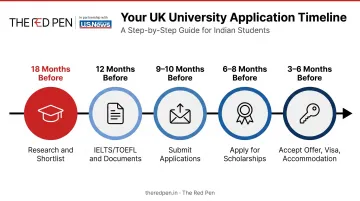
Application Timeline at a Glance
| Timeframe | Action |
|---|---|
| 18 months before intake | Research courses, build university shortlist |
| 12 months before | Take IELTS/TOEFL, gather academic documents |
| 9–10 months before | Submit applications (PG: rolling; UG: UCAS cycle opens September) |
| 6–8 months before | Apply for scholarships (many close October–November) |
| 3–6 months before | Accept offer, apply for student visa, arrange accommodation |
Cost Overview
Tuition fees for international students vary widely:
- Lower-cost institutions (e.g., Salford): £14,400–£21,540/year for 2026/27 international students
- UCL postgraduate taught: £18,400–£65,500 for 2025/26 overseas students depending on programme
- UCL undergraduate example (Pharmacy MPharm): £35,400/year for overseas students in 2026/27
Living costs, per GOV.UK student visa guidance:
- London: £1,529/month (up to 9 months)
- Outside London: £1,171/month (up to 9 months)
Edinburgh estimates postgraduate living costs at approximately £18,504/year for 2026/27.
Scholarships for Indian Students
Three major schemes are worth applying for simultaneously with your university applications:
- Chevening Scholarship: Fully funded one-year master's (tuition, living costs, travel). The 2026/27 cycle opened August 2025 and closed October 2025. Research the next cycle's timeline early to avoid missing the window.
- Commonwealth Master's Scholarships: For eligible Commonwealth country candidates; covers tuition, airfare, and a monthly stipend (£1,452/month, or £1,781/month in London). Requires an upper second-class degree or equivalent
- GREAT Scholarships India: £10,000 toward tuition fees for one-year taught postgraduate courses; offered through the British Council and participating UK universities, with varying deadlines by institution
Scholarship deadlines consistently fall before university offer deadlines — start researching these in parallel with your applications, not after. If you're building your UK shortlist and want to align your application strategy with scholarship eligibility, The Red Pen's undergraduate consulting process factors this into course and university selection from the start.
The UK Student Visa
Once you have an offer, the visa process follows a clear sequence:
- Receive your CAS (Confirmation of Acceptance for Studies) from your university
- Complete TB testing at a Home Office-approved clinic in India — unapproved clinic certificates are rejected
- Demonstrate funds: Show the required monthly maintenance amount held for 28 consecutive days, with the end date within 31 days of your visa application
- Apply online: Processing time outside the UK is typically within 3 weeks
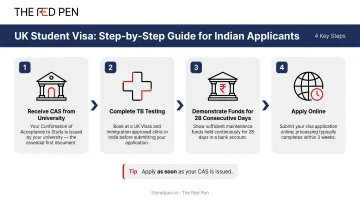
Apply for your visa as soon as your CAS is issued. Delays here risk missing your enrollment date.
Frequently Asked Questions
Frequently Asked Questions
How can Indian students get 100% scholarships in the UK?
Several UK universities offer merit-based scholarships for international undergraduates — for example, the University of Edinburgh Global Scholarship and various Oxford and Cambridge bursaries. Foundations such as Narotam Sekhsaria and Inlaks Shivdasani also fund undergraduate study abroad. Application windows often open well before university deadlines, so research eligibility criteria early and apply in parallel with your university applications.
Do I need IELTS for a UK university?
Most UK universities require IELTS Academic (typically 6.0–7.0) or an equivalent such as TOEFL iBT or PTE Academic. Some universities, including Edinburgh, accept strong Class 12 English scores from CBSE or CISCE students as evidence of language proficiency at the undergraduate level. Confirm the policy for each specific course directly with the university.
Is NEET accepted in the UK?
NEET is an Indian entrance examination and plays no role in UK university admissions. UK medical schools assess applicants on academic qualifications, the UCAT, and in some cases an interview — BMAT was discontinued after 2024. Check each medical school's entry requirements individually, as criteria vary.
How many universities can I apply to through UCAS?
Undergraduate applicants can apply to a maximum of 5 courses in a single UCAS cycle. For medicine, dentistry, and veterinary science, the cap is 4 choices within that subject. Check the latest UCAS guidelines, as rules can be updated between cycles.
What is the difference between a conditional and unconditional offer?
A conditional offer confirms your place once you meet specified requirements — typically a grade percentage or English language score. An unconditional offer confirms your place immediately with no further conditions to fulfil. Most offers for students with pending Class 12 results will be conditional.
Can I apply to UK universities with a gap year after Class 12 or graduation?
UK universities accept gap years, provided you can explain how the time was spent productively — internships, courses, volunteer work, or employment all count. A gap of one to two years is commonly accepted; longer gaps may require stronger justification in your personal statement.