The vast majority of rejected applications don't fail because the students weren't talented enough. They fail because the applications looked identical: strong grades, a long list of extracurriculars, and essays that described achievements without revealing a person. Indian students, who compete in one of the most academically rigorous international applicant pools, are particularly vulnerable to this pattern.
Getting in requires more than high scores. It requires a clear academic identity, genuine depth in one or two areas, and an application where every component — grades, activities, essays, recommendations — points in the same direction. These are learnable skills, not innate gifts.
This guide covers what Ivy League admissions officers actually evaluate, how to build a competitive profile step by step, when to start, and the specific mistakes that cost Indian applicants their spots.
Key Takeaways
- Ivy League schools are selecting intellectually curious, differentiated individuals — not the highest scorers in the applicant pool
- Depth in one or two areas consistently outweighs broad participation across ten clubs
- Your application must tell a single coherent story: academics, activities, and essays should reinforce the same identity
- Starting by Grade 9–10 gives you the most time to build genuine, demonstrable depth
- Most Indian applications fall short because of a weak or absent narrative — not a lack of achievement
What Ivy League Universities Actually Look For in Indian Applicants
Indian applicants enter one of the most competitive international sub-pools in the entire Ivy League process. Grades are assumed to be strong. Academic performance is the floor, not the ceiling. The real evaluation begins where grades leave off.
Columbia's admissions office states explicitly that there is no GPA or test-score cut-off, and that every application is reviewed holistically. Harvard, Yale, Princeton, and Cornell all rate factors like essays, recommendations, extracurricular activities, talent, and character as "very important" or "important" — the same weight as academics — in their Common Data Sets.
For Indian students on CBSE, ICSE, or IB curricula, admissions committees evaluate subject choices and grade trajectory in context. A student who took the most challenging subjects available and earned a 90% is often viewed more favourably than one who optimised for marks in easier courses. Rigor matters.
Academic Excellence as the Baseline
There is no fixed GPA equivalent published for Indian board applicants. Committees assess whether you took the hardest curriculum available to you and performed consistently at a high level — Grade 10 board results, Grade 11 predicted grades, and in-progress Grade 12 marks all factor into the review.
The middle-50% SAT range for enrolled students at Harvard runs 740–800 in Math and 740–780 in Evidence-Based Reading and Writing. At Columbia, the ACT composite range is 34–36. These benchmarks indicate the academic bar — but scores alone have never secured admission.
The "Spike Factor": Depth Over Breadth
Harvard's admissions FAQ states directly that the office is more interested in the quality of involvement than the quantity. Yale's guidance warns students not to choose activities simply because they think colleges want to see them.
A "spike" is one or two areas of genuinely exceptional strength. Examples of what qualifies:
- Published research or co-authored academic paper
- A startup or initiative with measurable community impact
- National or international competition results in a specific field
- A creative body of work with a real audience (not just school recognition)
- A policy brief or advocacy project with documented outcomes
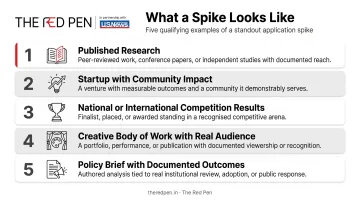
The spike separates applicants. Indian students tend toward broad participation — MUN, debate, music, community service, sports — which signals a well-rounded student but not a distinctive one.
A Cohesive Personal Narrative
Admissions officers read applications looking for a consistent story. When a student's essays claim a passion for environmental science but their activity list shows random involvement with no environmental thread, it reads as manufactured. Coherence signals maturity and intentionality.
Every application component should answer the same underlying question: Who is this person and what do they care about? That coherence extends beyond essays — it shapes how committees evaluate character and fit as well.
Character, Contribution, and Fit
Beyond academics and activities, Ivy League schools want evidence of:
- Intellectual curiosity — engagement that goes beyond what's required in class
- Resilience demonstrated through how you've responded to difficulty or failure
- Leadership shown through influence and initiative, not just titles held
- Genuine fit — specific knowledge of courses, labs, professors, and programmes that connect to your goals
Generic "I've always wanted to attend Harvard" statements are immediately recognisable. Schools want applicants who have done the research.
How to Get Into an Ivy League School: A Step-by-Step Guide
Step 1: Define Your Academic Theme and Core Interest
Before any application work begins, identify the intellectual thread that connects your subject choices, activities, and goals. This is not about picking a career — it's about finding the questions that genuinely draw you in.
Ask yourself:
- What do you read voluntarily, without being assigned?
- Where do you spend unstructured time?
- What problems feel urgent or interesting to you?
This theme becomes the foundation of every application component. Once you've identified it, select the most challenging subjects available in that area — AP, IB Higher Level, or equivalent. Admissions committees notice when course rigour doesn't match stated passion.
Step 2: Build Depth Through Meaningful Extracurriculars
Meaningful means sustained involvement, demonstrated leadership, and verifiable impact — not joining ten clubs. Reduce your activity list to 3–5 high-commitment pursuits that connect to your core theme.
The standard for impact varies by level:
- School: Founded a club, led a project with documented results
- City/regional: Organised an event, won a competition, published work
- National/international: Research published, award recognised beyond school
The single most important question any activity must answer is: What did you create or change? Joining an existing club carries far less weight than starting one.
Step 3: Write Essays That Are Specific and Human
Essays are the one place where your voice is unfiltered. They should reveal how you think — not restate the achievements already listed elsewhere in the application.
Avoid these common traps:
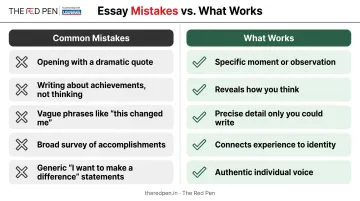
- Opening with a dramatic quote
- Writing about sports as a metaphor for life
- Describing a mission trip without deeper reflection
- Using phrases like "this experience changed me" without showing how
Strong essays zoom in on a specific moment or observation and connect it back to who you are becoming. A precise detail — a single conversation, an unexpected finding, a moment of confusion that opened a new question — does more work than a broad survey of your accomplishments.
The Red Pen's INK (Interactive Narrative Kit) offers Indian students a structured, personalised process for uncovering and articulating exactly this kind of story. Through storyboarding, students work with counsellors to map experiences to a central narrative theme — the same technique that has helped applicants identify a coherent identity even when their profile doesn't follow a conventional path.
Step 4: Choose Recommenders Strategically
The most effective letters describe one or two vivid, specific moments that the admissions committee cannot learn from the rest of your application. A generic "top student in my class" letter adds little value.
Request letters from teachers who have witnessed genuine intellectual growth — not simply the teacher of your highest-scoring subject. Give them specific prompts:
- A classroom moment where you showed curiosity beyond the syllabus
- Evidence of initiative or independent thinking
- An example of how you responded to challenge or failure
Step 5: Research Schools and Write Strong Supplemental Essays
Each Ivy League school has a distinct culture, and admissions offices can tell immediately when a student hasn't done the research. For every target school:
- Identify specific courses, professors, or research labs that connect to your interests
- Name programmes or initiatives that don't exist at other schools
- Explain why this school — not just any top university — serves your goals
Early Decision vs. Early Action
Binding ED is available at Brown, Columbia, Cornell, Dartmouth, and Penn. Harvard, Yale, and Princeton offer non-binding Early Action. Applying ED to a genuine first-choice school can improve your chances, but only if the application is fully ready. A rushed ED submission is worse than a polished Regular Decision one.
When to Start: The Ivy League Preparation Timeline
Grade 9–10: Exploration and Foundation
This phase is for genuine discovery, not manufactured profile-building. Experiment broadly — try academic competitions, summer programmes, independent projects — to surface real interests. The activities and subject choices made in these years have downstream consequences for application rigor.
The Red Pen's Pre-College Advising Team works with students from Grade 8 onwards, helping identify strengths early and building authentic depth well before the demands of Grade 12 set in.
Grade 11: Focus and Profile-Building
Grade 11 is when exploration narrows. The shift looks like this:
- Extracurricular commitment intensifies in 2–3 areas of depth
- First real achievements take shape: research placements, leadership roles, competition results
- SAT/ACT preparation begins in earnest
- Early essay ideas are drafted to identify narrative threads
- University list research starts taking shape
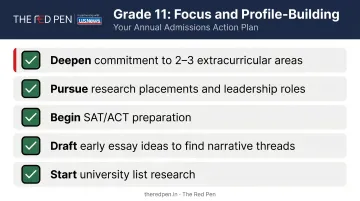
Students who wait until Grade 12 to begin this process consistently struggle — not because they lack ability, but because genuine depth takes time to develop and document.
Grade 12: Application Execution
By Grade 12, the profile should already exist. This year is for presenting it clearly:
- July–August: Finalise school list and begin Common App
- September: Complete personal statement drafts (for November ED deadlines)
- September–October: Write supplemental essays school by school
- November: Submit ED applications
- January: Submit Regular Decision applications
Students who begin building their profile in Grade 12 face a structural problem: there is simply not enough time to create the depth that competitive applications require.
The most effective Grade 12 intervention is strategic clarity: identifying which existing experiences to foreground and how to connect them into a coherent narrative.
Key Factors That Determine Your Ivy League Admission Outcome
Ivy League admissions committees weigh multiple dimensions of each application simultaneously — and a weakness in one area can rarely be offset by strength in another alone.
Academic Rigor and Performance
A student with a 95% average in standard courses is typically weaker in this dimension than a student with a 90% average in the most challenging curriculum available. Committees evaluate the grade and the context in which it was earned. They also look at trajectory — is the student improving?
Standardised Test Scores
Testing policies have shifted significantly for the Class of 2030 cycle:
| School | 2025–2026 Policy |
|---|---|
| Harvard | Required |
| Yale | Required (test-flexible) |
| Princeton | Test-optional |
| Columbia | Test-optional (required from 2027–28) |
| Penn | Required |
| Brown | Required |
| Dartmouth | Required |
| Cornell | Required |
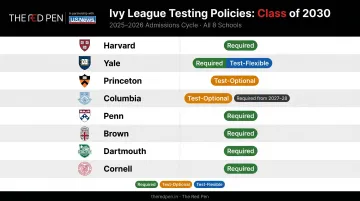
Competitive score ranges sit at SAT 1500–1600 or ACT 33–36. Strong scores won't secure admission, but low scores create a hurdle that other application components must compensate for. For Indian students in a highly competitive sub-pool, a high score is often a baseline expectation.
Extracurricular Depth and Achievement
Admissions committees are experienced at distinguishing genuine passion from manufactured profile-padding. Achievement at the level these schools expect typically looks like:
- Regional or national recognition in a specific domain
- Tangible output — a published paper, a product, a performance record
- Measurable impact on a community, organization, or field
Participation certificates don't move the needle. Depth and distinction do.
Essay Quality and Narrative Coherence
When grades and test scores are similar across many Indian applicants, essays become the primary differentiating factor. Admissions readers look for specificity, reflection, and a voice that feels genuinely individual. Essays are also evaluated for how well they tie together the full application narrative.
Common Mistakes Indian Students Make in Ivy League Applications
Indian applicants are rejected from Ivy League universities for predictable reasons — and most of them are avoidable.
Too Many Activities, Too Little Depth
The pattern: 10–12 clubs and competitions, no meaningful leadership or sustained impact in any of them. Admissions officers are trained to spot this. It signals that the student was building for college rather than pursuing genuine interests — which is the profile that doesn't get in.
What stands out instead:
- Two or three activities pursued consistently over multiple years
- A leadership role or initiative that had visible impact
- Work that connects to a broader theme in the application
- Evidence the student would have done it regardless of college
Generic and Impersonal Essays
The most common essay failure is writing about achievements rather than thinking. Overused constructions — "I want to make a difference," "this experience changed me," "I realised that..." — appear in thousands of applications. Specificity is what makes an essay memorable: a precise moment, a distinct observation, an unusual angle that only you could have written.
This is also the most correctable weakness in most Indian applications — it requires not better writing, but clearer thinking about what actually matters to the student.
Applying Without a Clear Narrative or Direction
The shotgun approach — applying broadly with impressive but unconnected components — is one of the most common strategic errors. Even strong achievements fail to leave an impression when there's no clear identity running through the application.
This is the most fixable mistake — but fixing it requires stepping back from individual components and asking: What is this application, as a whole, saying about who I am? That kind of strategic thinking is where The Red Pen's profile-mapping and narrative counselling is most useful — helping students with strong raw material turn disconnected achievements into a coherent application story.
Conclusion
Getting into an Ivy League university as an Indian student in 2026 is genuinely difficult — but it is not arbitrary. The students who succeed are not always the most decorated; they are the most intentional. Every component of their application connects to a clear, authentic narrative that makes a specific person visible to an admissions committee.
Two factors separate the students who get in from those who do not:
- Starting early — building genuine depth in activities, academics, and interests before Grade 12
- Thinking in stories, not checklists — framing every application component around a coherent personal narrative
Students who struggle most arrive in Grade 12 with a strong résumé but no thread connecting it. That thread is what admissions committees are actually looking for. If you are still figuring out how to find yours, The Red Pen works with students at every stage — from early profile-building through final submission — to help that narrative take shape.
Frequently Asked Questions
How can I increase my chances of getting into an Ivy League undergraduate program?
Build genuine depth in one or two areas, and craft a personal narrative that runs consistently through your academics, activities, and essays. Write essays that are specific and authentic — Indian applicants especially need to differentiate from a strong peer pool, which makes early, strategic preparation critical.
Is a 3.7 GPA competitive for Ivy League admissions?
GPA alone is never the deciding factor — context matters enormously. A 3.7 in the most rigorous curriculum available is viewed more favourably than a 4.0 in easier courses; essays, activities, and recommendations must also be strong.
How can a student from India get into an Ivy League undergraduate program?
Indian students compete in a highly academic international sub-pool, so strong grades are a baseline — not a differentiator. What sets applicants apart is a clear spike or area of genuine depth, paired with essays that reveal intellectual identity rather than a list of achievements.
What is the easiest Ivy League school to get into?
Cornell has the highest acceptance rate among the eight Ivy League schools, at 8.41% for the Class of 2029. Every school receives tens of thousands of applications from academically strong candidates — selective by any measure.
When should Indian students start preparing for Ivy League admissions?
Meaningful exploration and profile-building should begin by Grade 9–10, with a focused strategy taking shape in Grade 11. Grade 12 is too late to build a profile from scratch — though students who start late can still make strong applications if they execute with discipline and strategic clarity.
Do Ivy League universities offer financial aid to international students?
Harvard, Yale, Princeton, and Dartmouth are need-blind for international applicants and meet 100% of demonstrated financial need — Harvard's average aid package is approximately $75,000 (USD), and Yale's average scholarship exceeds $60,000 (USD). Brown, Columbia, Penn, and Cornell are need-aware for international students, so funding availability varies across the eight schools.