The most competitive undergraduate programmes are reviewing your entire high school record. MIT admitted just 4.6% of applicants for the Class of 2029, with only 136 international students offered places from nearly 7,000 international applicants. Oxford received over 23,000 applications and made fewer than 3,800 offers. Meanwhile, Common App reported a 79% increase in applicants since 2015-16, with over 1.49 million students submitting applications in 2024-25 alone.
This guide gives you a practical, year-by-year roadmap — from 9th grade through applications — covering academics, extracurriculars, testing, university research, and essays.
Key Takeaways
- Start profile-building in 9th or 10th grade — not 12th
- Course rigour matters as much as grades; challenge yourself strategically
- Depth in a few activities beats a long list of surface-level involvement
- A balanced college list — reach, target, and likely schools — reduces risk and keeps options open
- Your application essay is your only direct voice; invest in multiple drafts and a clear personal narrative
Why College Preparation Should Begin Early in High School
Selective universities don't evaluate a snapshot — they read a story. Your transcript, activity list, and recommendations together tell admissions committees who you are, what you care about, and how you've grown. That narrative cannot be constructed in three months.
Starting in 9th or 10th grade gives you time to:
- Explore genuine interests before committing to a major or extracurricular direction
- Recover from setbacks — a difficult semester in 10th grade looks very different if 11th grade shows a strong upward trend
- Build meaningful activities that span multiple years rather than padding a list in 12th grade
- Develop real relationships with teachers who will write your recommendation letters
Students who begin early also make better decisions about course selection, summer programmes, and standardised testing — choices that directly affect the strength of their eventual application.
Structured guidance during this early phase helps students make those decisions with clarity rather than guesswork. The Red Pen's Pre-College Advising team has supported over 1,000 applicants on their way to universities in the US, UK, Canada, and beyond — and in the majority of successful cases, that support began well before Grade 12.
Building a Strong Academic Profile Year by Year
NACAC data shows that 63.8% of four-year colleges rate strength of high school curriculum as considerably important — not just your GPA, but what you studied and how hard you pushed yourself.
The goal isn't to take every AP or IB course available. MIT explicitly states there is no minimum number of AP courses. The right approach is strategic: choose advanced options in areas aligned with your genuine academic interests, and perform well in them.
Freshman and Sophomore Year: Laying the Foundation
Strong foundations now prevent scrambling later. Focus on:
Academic priorities in 9th and 10th grade:
- Develop a consistent note-taking system and weekly study routine
- Build organisational discipline — track assignments, deadlines, and test dates proactively
- Aim for a strong GPA that can sustain momentum as coursework becomes more demanding
- Take one or two advanced courses to test your capacity, but don't overload
Beyond grades, build genuine relationships with your teachers. The ones who know you well in 10th grade may be writing your recommendation letters two years later — so show up, ask questions, and engage beyond the minimum.
Junior Year: Raising the Intensity
11th grade is the most critical academic year of high school. It's the most recent full year of grades universities will see before application deadlines, and admissions committees weight it heavily.
This is the year to:
- Take your most challenging course load to date
- Aim for your strongest academic performance
- Sit for the SAT or ACT (with time to retake if needed)
- Begin exploring universities seriously
That said, overloading on advanced classes can backfire — a lower GPA and a gutted extracurricular profile won't serve you. Finding the right balance between rigour and sustainability is worth getting right, ideally with guidance from someone who knows the admissions landscape.
Senior Year: Maintaining Momentum
Universities review final transcripts, and a significant grade drop after admission can lead to an offer being rescinded. It happens more often than students expect.
Keep your focus through 12th grade. The effort you've built over three years deserves a strong finish — and universities are watching.
Crafting a Compelling Extracurricular Profile
Admissions committees at selective universities have moved past counting club memberships. What they're looking for is depth — students who committed to something meaningful and created real impact over time.
Harvard describes admitting both "well-rounded" and "well-lopsided" students — meaning a student with one extraordinary passion pursued intensely can be just as compelling as someone with broad but moderate involvement.
What Makes an Activity Profile Strong
Depth over quantity:
- 3-4 activities pursued consistently over multiple years outperform 10 surface-level involvements
- Leadership matters: founding a club, leading a team, or organising something meaningful shows initiative
- Measurable impact strengthens any activity — quantify where you can (students taught, funds raised, participants engaged)
The "spike" concept: A distinctive area of focus — often called a "spike" — gives your application a defining thread. It might be competitive debate, a sustained research project, or a self-started community initiative. What matters is that it's genuinely yours and pursued over time.
Community service and social impact: Selective universities want to see service as a genuine expression of values — not a line added to pad a list. Students who will contribute on campus and in broader communities stand out.
Summers Matter
Productive summers signal initiative. Consider:
- University pre-college or research programmes
- Internships or shadowing in a field of interest
- Independent projects (writing, building, creating)
- Skill-building courses that connect to your stated interests
Note: attending a summer programme at a university does not guarantee admission there. The value lies in genuine learning and the story it adds to your profile — not as a ticket to acceptance.
Start tracking your activities from Grade 9. Keep a running log — your role, hours committed, key achievements, and what each experience meant to you. This directly feeds into the Common App activities section, and the details are easy to forget by 12th grade if you haven't recorded them.
Standardised Testing: SAT, ACT, and What You Need to Know
The testing landscape has shifted significantly. Several major US universities reinstated standardised testing requirements after the test-optional experiment:
- MIT, Harvard, Yale, Dartmouth, Brown, Cornell, and Caltech all require the SAT or ACT
- MIT's middle 50% SAT range for enrolled students is 1520–1570; Yale's is 1480–1560
- Many other universities remain test-optional, but a strong score can still strengthen an application
For Indian students competing in a global applicant pool, a high score is a concrete, comparable data point. At test-optional schools, submitting a strong score is almost always worth it.
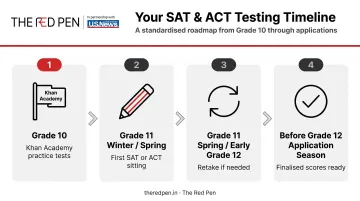
Planning your testing around this timeline gives you enough room to prepare, sit the exam, and still have time to retake if needed.
Recommended Testing Timeline
- Grade 10: Use official SAT practice tests on Khan Academy to benchmark your performance and identify gaps
- Grade 11 (winter/spring): Sit for the SAT or ACT for the first time
- Grade 11 (spring) or early Grade 12: Retake if needed to reach your target score
- Before Grade 12 application season: Have finalised scores ready
How to Prepare
Consistent, structured preparation over several months is far more effective than last-minute cramming. Use official College Board or ACT practice materials as your baseline. If your school's resources are limited, a structured prep programme can help bridge the gap. An experienced admissions counsellor can also advise on realistic score targets and build the right preparation timeline for your specific profile.
Researching Universities and Building a Balanced College List
A high ranking does not make a university the right fit for you. A school that lacks your intended major, clashes with your learning style, or sits outside your financial range is the wrong choice — no matter where it places on a list.
What to Evaluate When Researching Schools
| Factor | What to Look For |
|---|---|
| Academic programmes | Is your intended major strong? Who are the faculty? |
| Campus culture | Large research university vs. small liberal arts college? |
| Location and cost | Urban vs. suburban; living costs relative to budget |
| Opportunities | Research access, internships, co-ops, industry connections |
| Outcomes | Graduate employment data, further study pathways |
The US Department of Education's College Scorecard provides official comparison data on cost, graduation rates, test scores, and post-college earnings across US institutions — a useful research tool.
Once you know what to look for, the next step is translating that research into a structured list.
Building a Balanced List
A well-constructed college list includes three tiers:
- Reach schools — aspirational; admission is possible but competitive given your profile
- Target schools — strong fit; realistic odds based on your academic and extracurricular record
- Likely schools — high confidence of admission; schools where you'd genuinely be happy attending
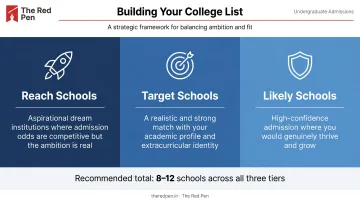
Most students applying to the US should have 8–12 schools across these tiers. Applying only to dream schools is a real risk — the data on acceptance rates makes this clear.
Demonstrated Interest
Some institutions track whether applicants have engaged with them — campus visits, virtual info sessions, meetings with admissions representatives. NACAC data shows 15.7% of four-year colleges rate demonstrated interest as considerably important. Tufts, for instance, lists it as "considered," while Yale and Cornell report it as "not considered." Check each school's Common Data Set to understand their policy before investing time in these interactions.
The college list stage is where expert guidance makes a measurable difference. A counsellor who understands what different schools genuinely look for — and how your profile compares to their typical admits — helps you build a list that's both ambitious and realistic. The Red Pen's advisors work with students at exactly this stage, combining knowledge of institutional preferences with an honest read of each student's profile.
Mastering Applications, Essays, and Financial Aid
Application Timeline for Senior Year
Key application deadlines across top universities fall as follows:
- Early Action / Early Decision: November 1 (Harvard, Yale, Princeton, Dartmouth, MIT)
- Regular Decision: January 1–5 depending on the school
- MIT: Not on Common App — requires a separate application
Request transcripts and recommendation letters at least 4–6 weeks before deadlines. Teachers have multiple students to support; give them adequate notice and a clear brief on what the letter should highlight.
Understand the difference between Early Decision (binding), Early Action (non-binding), and Regular Decision before committing to an application strategy.
The College Application Essay
The essay is the only place in an application where your voice comes through. It's not a summary of your resume — it's a window into who you are, how you think, and what matters to you.
Start brainstorming topics the summer before 12th grade. Write multiple drafts. Seek feedback from someone who can distinguish between generic writing and something genuinely memorable.
The Red Pen's INK (Interactive Narrative Kit) is built for exactly this stage. It helps students identify their most compelling personal stories, build a narrative arc, and move from blank page to polished draft — particularly useful for students who find the "what should I write about?" question paralyzing.
Their essay support spans Common App personal statements, UCAS personal statements, and supplemental essays, with multiple editing rounds from content specialists focused on preserving your authentic voice — not replacing it.
Financial Aid and Scholarships
Start financial aid planning in Grade 11 — not after admission decisions arrive. Deadlines for aid applications often run parallel to (or earlier than) admissions deadlines, and missing them can cost you significant funding.
Key points for Indian students:
- Harvard and MIT meet 100% of demonstrated financial need for international students, including Indians; Harvard families earning under ₹83 lakhs (~$100,000) typically pay nothing
- Most US universities offer merit aid to international students, not need-based aid — academic achievement and test scores drive eligibility
- CSS Profile: Many US schools require this for need-based aid; it carries its own deadlines, separate from admissions
- University of Toronto's Lester B. Pearson International Scholarship covers tuition, books, fees, and full residence for four years; requires high school nomination
- Oxford's Reach Oxford Scholarship covers course fees, living costs, and annual airfare for eligible international students
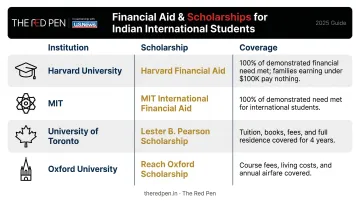
Build aid application dates into your calendar alongside admissions deadlines from the start of Grade 12.
For students who need help navigating this — The Red Pen builds scholarship eligibility into its application strategy from day one. Sheetal Vora, Associate Director of their undergraduate team, has secured over ₹50 crores in scholarships and financial aid across 1,500+ applications globally.
Frequently Asked Questions
When should I start preparing for college in high school?
The ideal starting point is Grade 9 or 10. This gives you time to build your academic record, explore genuine interests, and shape your profile gradually, with enough runway to develop a coherent narrative before applications open.
How many extracurricular activities do colleges look for?
Quality matters far more than quantity. Most successful applicants to selective universities have committed deeply to a few activities over several years, often showing leadership or measurable impact, rather than listing a large number of scattered, surface-level participation.
Do Indian students need to take the SAT or ACT for US college admissions?
Several top universities — including MIT, Harvard, Yale, and Cornell — have reinstated mandatory SAT or ACT requirements. Even at test-optional schools, a strong score can benefit Indian applicants competing in a global pool, so check each university's current policy and weigh whether your score adds to your application before deciding to submit.
How important is the college application essay?
The essay is one of the few elements where your personality and perspective come through directly. For competitive universities, a compelling, authentic essay can meaningfully differentiate an otherwise strong application when academic profiles among shortlisted applicants are closely matched.
When should I start working with an admissions counsellor?
Grade 10 or 11 is ideal. A counsellor engaged early can shape your overall profile, advise on course selection, and build a college list strategy well before Grade 12 — giving you far more than just last-minute application support.
What is a balanced college list and how do I build one?
A balanced list includes reach schools (aspirational, lower odds), target schools (realistic fit), and likely schools (high confidence of admission). This approach ensures you have genuine options across the admissions cycle while still applying to competitive institutions that match your ambitions.