The gap is rarely about intelligence or achievement. It is about preparation, narrative clarity, and alignment. A student with a strong academic record but a generic essay will lose to a student with a slightly weaker record and a sharply focused story.
As UC Davis Financial Aid notes, the personal statement is "perhaps the most critical piece" of many scholarship applications — it is the committee's primary window into who you are beyond your transcripts and test scores.
This guide covers what scholarship committees actually evaluate, how to prepare before you write a single word, a step-by-step writing framework, and the most common mistakes that sink otherwise strong applications.
Key Takeaways
- A scholarship personal statement must align with the specific award's values — not just tell your general story
- Concrete, specific examples build credibility — broad personality claims undermine it
- Preparation — researching the award, reflecting on your experiences, and identifying a central theme — matters as much as writing skill
- The strongest statements follow a clear arc: past → turning point → present → future
- Revision is non-negotiable — plan for at least three drafts with external feedback
What Is a Scholarship Personal Statement?
A scholarship personal statement is a written response — typically 500 to 1,000 words, though length varies — in which you make the case for why you deserve the award by connecting your background, achievements, and ambitions to the scholarship's purpose.
Unlike a general university personal statement — which focuses on demonstrating fit with a course and institution — a scholarship essay must directly address the award's selection criteria. Those criteria might include academic excellence, leadership potential, community impact, financial need, or research ambition. The distinction matters: a strong UCAS or Common App essay will not automatically transfer into a strong scholarship statement.
What Committees Are Actually Evaluating
When a scholarship committee reads your statement, they are asking six questions:
- Does this applicant communicate ideas clearly and with purpose?
- Do their motivations feel genuine, or rehearsed?
- Is there real evidence of achievement, resilience, or relevant experience?
- Will this applicant contribute meaningfully to the programme they're entering?
- Do their goals align with what this scholarship was created to support?
- What makes this application memorable in a pile of 200?
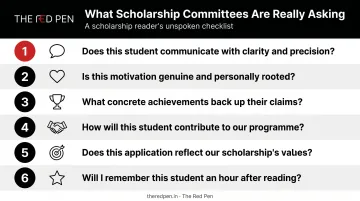
These are the filters through which every sentence gets evaluated. Before you write a single word, knowing which of these questions your application is weakest on tells you exactly where to focus your energy.
Before You Write: Research and Self-Reflection
The preparation phase directly determines the quality of your final statement. Students who skip it produce generic, unfocused essays that read like they could belong to anyone.
Research the Scholarship Thoroughly
Before drafting a single sentence, you need to understand:
- The funding organisation and its history
- The scholarship's stated mission and values
- Past recipients, if profiles are publicly available
- The exact wording of the selection criteria
Syracuse University's scholarship advising team explicitly tells applicants to research the scholarship's goals before writing — because a statement that does not reflect the committee's priorities will not survive the first round.
Conduct a Structured Self-Reflection
Answer these questions in writing before you open a blank document:
- What is the defining experience that pointed me toward this field?
- Who or what has most shaped my intellectual direction?
- What challenge have I faced, and what did it reveal about my character?
- What specific goals do I want to achieve with this scholarship's support?
If you find it difficult to identify which narrative threads are worth developing, structured tools like The Red Pen's INK (Interactive Narrative Kit) can help you organise your answers into a coherent story before a single draft word is written.
Identify Two to Three Core Themes
The best personal statements are not lists of achievements. They are built around two or three central themes — such as intellectual curiosity and research potential, or resilience and community impact — that run consistently through the statement and make it feel coherent rather than episodic.
Gather Concrete Supporting Examples
Themes only hold weight when grounded in evidence. For each theme, identify a specific, verifiable example: a project, an internship, a moment of challenge or discovery. "I am passionate about sustainability" tells the reader very little without the field research placement or community initiative that created that passion.
Check Format Requirements
Before writing, confirm:
- The word or page limit (and respect it exactly)
- Whether the scholarship asks one open question or multiple sub-questions
- The submission deadline and any supporting document requirements
How to Write a Scholarship Personal Statement: Step-by-Step
Writing a strong personal statement means executing a clear structure across multiple drafts. This is not a document you can produce the night before a deadline and expect to be competitive.
Step 1: Craft a Strong Opening Hook
Your first two sentences need to earn the reader's attention. Effective openings include:
- A brief, vivid scene related to your field
- A specific moment of realisation or discovery
- A precise, unexpected question your work seeks to answer
Avoid: "Ever since I was a child, I have been fascinated by..." and "Education is the most powerful tool..." — these could belong to any applicant and signal immediately that the essay is generic.
Step 2: Establish Your Background and Motivation
Explain what led you to this field, what experiences shaped your direction, and what problem genuinely drives your ambition. This section should feel personal and specific — not like a résumé read aloud.
The key test: could any other applicant have written this paragraph? If yes, rewrite it.
Step 3: Demonstrate Achievement Through Specific Examples
Present your two or three core themes, each supported by a concrete example. For each example, follow this pattern:
- Situation — brief context (one or two sentences)
- Action — what you specifically did
- Insight — what you learned or achieved as a result
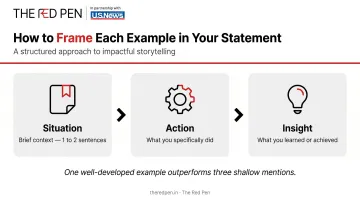
Keep examples tight. A single well-developed example is far more persuasive than three shallow mentions.
Step 4: Connect Your Goals to the Scholarship's Mission
This is the step most applicants underexecute. You must explicitly answer three questions:
- Why this scholarship?
- Why now?
- How will this funding enable a specific outcome that aligns with the award's purpose?
The difference between a weak answer and a strong one comes down to specificity. Compare:
Weak: "This scholarship will help me pursue my dreams."
Strong: "This award's focus on climate policy research directly supports my goal of conducting field-based water security studies in South Asia."
Committees notice that distinction immediately.
Step 5: Close With a Forward-Looking Conclusion
Your conclusion should not summarise what you just said. It should leave the reader with a clear sense of who you will become and what you intend to build. The strongest closings circle back to the opening image or question, giving the essay a sense of deliberate, cohesive purpose.
What Makes a Scholarship Personal Statement Stand Out
Technical competence — clear structure, correct grammar, meeting the word limit — is the baseline. What separates a good statement from a winning one involves qualities that can be practised deliberately.
Authenticity Over Impressiveness
Committees read hundreds of applications and can immediately identify essays written to impress rather than to reveal. The most compelling statements sound like the actual applicant: they use a real voice, acknowledge genuine uncertainty, and make claims that feel earned.
NACAC's guidance on college applications is clear: writing what you think others want to hear, rather than being yourself, produces the most forgettable essays.
Specificity as the Engine of Credibility
UC Davis's scholarship guidance makes the point directly: thousands of statements mention initiative, but far fewer actually show it through concrete examples.
The principle is simple. Compare these two sentences:
- "I am a natural leader."
- "I grew our school's debate programme from 8 to 45 members over two years by redesigning the recruitment process and securing a dedicated practice space."
The second earns credibility. The first loses it.
A Clear Narrative Arc: Past, Present, Future
The strongest scholarship essays follow a four-part arc:
- Starting point — who you were before
- Turning point — what changed your understanding or direction
- Present — who you are as a result
- Forward projection — what you intend to do with this scholarship's support
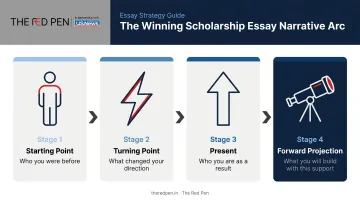
This structure gives the essay momentum. It reads as a coherent story, not a list of credentials.
Tailoring for Each Scholarship
Resist the temptation to submit the same statement everywhere. Core material can carry over, but framing and language must be adjusted for each award:
- Merit-based academic scholarships — emphasise intellectual achievement, research potential, and academic rigour
- Need-based awards — foreground personal context, resilience, and what access to opportunity has meant in your circumstances
- Community impact awards — centre your contribution to others, your sense of responsibility, and the social goals driving your work
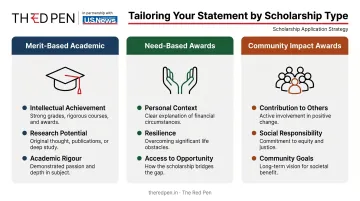
Spend twenty minutes per application reviewing the award criteria and adjusting your framing accordingly — it is one of the highest-return investments you can make in the process.
Common Mistakes to Avoid
Even well-prepared students undermine strong applications with avoidable errors.
Writing a biography instead of a focused statement. Attempting to narrate your entire life story is one of the most common mistakes. A tightly focused essay covering two or three experiences in depth will always outperform a wide-ranging essay that covers everything superficially.
Using clichés and vague language. The following phrases weaken every statement they appear in:
- "I have always been passionate about..."
- "I am a highly motivated individual..."
- "I am a team player who..."
Replace every cliché with a specific detail. If you cannot point to an example that earns the claim, cut the claim.
Ignoring the prompt or criteria. Failing to directly address the scholarship's stated question is a disqualifying error. After completing your draft, re-read the prompt and check that every section answers what was actually asked. If the scholarship asks about community leadership and you spend 400 words on academic achievement, you have missed the brief.
Submitting without thorough revision. Syracuse's advising team notes that successful scholarship applications often go through many drafts — sometimes more than a dozen. Before you submit, work through these steps:
- Write at least three full drafts, treating each as a distinct revision pass
- Read the essay aloud to catch awkward phrasing and unnatural rhythm
- Ask a trusted reader — a teacher, mentor, or admissions counsellor — to review for clarity, tone, and accuracy
Conclusion
The students who write winning scholarship personal statements share one quality: they connect their story to the scholarship's purpose with clarity and specificity. Getting there requires preparation, a focused narrative built on real evidence, and revisions driven by honest self-assessment rather than defensiveness.
That skill is entirely learnable with the right support. Students who want expert, personalised guidance through this process can work with The Red Pen's experienced admissions consultants, who help applicants across India develop compelling narratives, refine their essays through multiple drafts, and build stronger applications for competitive universities worldwide.
Frequently Asked Questions
How long should a scholarship personal statement be?
Word limits vary by scholarship — official examples range from around 150–250 words per question (UBC International Scholars) to 600 words or less (BU Trustee). Always treat the limit as exact: both under-writing and over-writing signal poor attention to detail.
Can I use the same personal statement for multiple scholarships?
Your core story and examples can serve as a foundation, but the framing, specific language, and connections to the scholarship's mission must be adjusted for each award. A generic statement is easy for committees to identify and unlikely to win.
How is a scholarship personal statement different from a university personal statement?
A university personal statement focuses on demonstrating fit with a course and institution. A scholarship personal statement must also make the case for why you specifically deserve financial or merit recognition — directly addressing criteria such as leadership, community impact, financial need, or research potential.
What should I NOT include in a scholarship personal statement?
Avoid a chronological life story, unsubstantiated personality claims, clichés, anything already covered in the application form like grades or activity lists, and humour or irony that may not land with an unfamiliar reader.
How do I write a compelling opening?
Open with a specific scene, moment, or question that connects to your core theme. Your goal is to make the reader curious about what comes next within the first two sentences — avoid generic statements about childhood dreams or the universal importance of education.
How many drafts should I write?
Plan for at least three drafts: one to get ideas down, one to refine structure and clarity, and one to tighten language and tone. Get feedback from a mentor or counsellor before submitting.