What many applicants don't realise is that Cambridge actually requires two separate personal statements. The UCAS application now uses a new three-question structured format (from September 2025, for 2026 entry). Then there's an additional, Cambridge-specific statement in My Cambridge Application — about 1,200 characters — that most serious applicants complete, even though it's technically optional.
Treating these as interchangeable is one of the most common and costly mistakes. This guide covers both: what Cambridge is looking for, how each statement works, and how to write them well.
Key Takeaways
- Cambridge reads personal statements to assess academic potential and intellectual engagement — not extracurricular achievements alone
- The new UCAS format (September 2025 onwards) has three structured questions, each with a 350-character minimum
- The My Cambridge Application statement (~1,200 characters) is separate from UCAS and should be Cambridge-specific
- Keep non-academic content to 20% or less of any section — Cambridge prioritises academic and intellectual focus
- Two well-developed intellectual points carry more weight than five shallow observations
Understanding Cambridge's Personal Statement Requirements
The New UCAS Format (2026 Entry Onwards)
UCAS announced in July 2024 that from September 2025, the personal statement changes from a single free-form essay to three separate structured questions. The total character limit remains 4,000 characters (including spaces), with each section requiring a minimum of 350 characters.
The three questions are:
- "Why do you want to study this course or subject?"
- "How have your qualifications and studies helped you to prepare for this course or subject?"
- "What else have you done to prepare outside of education, and why are these experiences useful?"
Cambridge reads all three answers as a whole, so avoid repeating the same point across sections. Cambridge does not give personal statements a formal score, using the statement alongside grades, admission test results, references, written work, and interview performance.
The My Cambridge Application Personal Statement
This is a separate, optional statement of approximately 1,200 characters (~170–200 words) submitted through My Cambridge Application — a portal you'll receive instructions for within 48 hours of submitting your UCAS application.
Key distinctions from the UCAS statement:
- It is Cambridge-specific and will not be sent to your other UCAS choices
- It should explain why Cambridge specifically — its course structure, teaching approach, supervision system — not restate subject passion already covered in UCAS
- Cambridge advises against using it to explain why you chose a specific college (applications can be pooled across colleges)
While officially optional, most competitive applicants complete it. Use the space to address something the UCAS questions don't directly ask: why Cambridge's specific academic environment fits how you think and learn.
Before You Start: Research and Preparation
Strong Cambridge personal statements don't begin with writing — they begin with genuine subject research. Before drafting anything, spend time on:
- The official Cambridge course page: Understand the year-by-year structure, the distinction between Part I and Part II, and which paper options exist in later years
- The supervision system: Cambridge's hallmark teaching method involves weekly one-to-one or small-group sessions with subject experts — nearly unique to Cambridge and Oxford. Referencing this meaningfully signals you've done your homework
- Department research areas: Even if you won't specialise immediately, knowing what Cambridge's faculty works on shows serious engagement
Finding Your Cambridge-Specific Angle
For the My Cambridge Application statement, look for one or two course features that genuinely align with how you think about your subject. Some examples:
- The interdisciplinary breadth of Natural Sciences before specialisation
- Engineering's broad base-before-specialism structure
- A particular historical or theoretical emphasis in your subject's Cambridge Tripos
Connect these to your own intellectual experiences — not to Cambridge's reputation. Vague prestige statements ("Cambridge is world-leading in my field") signal a lack of research, not admiration.
Build Your Narrative First
Before writing a single sentence, identify the through-line of your academic story. Ask yourself:
- What question or problem drives your curiosity?
- How have your experiences built on each other?
- What does your subject mean to you beyond grades and achievement?
Working through these first prevents the most common mistake: drafting before knowing what you're actually trying to say. Tools like The Red Pen's INK (Interactive Narrative Kit) are built for exactly this stage — helping students shape their academic narrative clearly before a single word hits the page.
How to Write Each Section of the Cambridge Personal Statement
Section 1: Why Do You Want to Study This Subject?
This section should show specific, intellectually rooted motivation — not career goals or generic enthusiasm.
What works:
- A defining moment: a book, problem, experiment, or concept that shifted your thinking
- A connection between two ideas that surprised you
- A question your studies raised that you haven't been able to stop thinking about
What doesn't:
- "I have always been fascinated by..."
- Career-driven framing ("I want to become a doctor because...")
- Broad subject love without any intellectual specificity
Aim to open with something concrete. An admissions tutor reading their fiftieth statement that week will notice immediately when an applicant has a real idea versus performed enthusiasm.
Section 2: How Have Your Qualifications Helped You Prepare?
Once your intellectual motivation is clear, the next step is showing how your studies have developed it. Don't summarise your transcript.
Cambridge already has your predicted grades — what they want here is evidence of intellectual development.
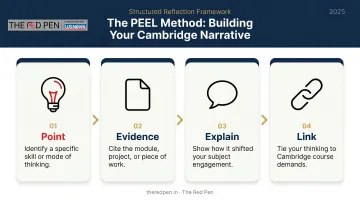
Use the PEEL method (Point, Evidence, Explain, Link) to structure each point:
- Point — identify a specific skill or mode of thinking you developed
- Evidence — cite the module, project, or piece of work where it emerged
- Explain — show how it shifted the way you engage with the subject
- Link — tie it directly to what Cambridge's course demands at undergraduate level
For example: rather than "I studied Further Mathematics," write about how grappling with proof by induction changed how you think about mathematical rigour, and why that matters for the Cambridge Maths course structure.
Section 3: What Have You Done Outside Formal Education?
This section is for super-curricular activity — reading beyond the curriculum, competitions, online courses, independent research, or subject-relevant work experience. Not sport, not volunteering (unless directly relevant to the subject).
The 80/20 rule applies directly here: if you mention a non-academic activity, spend no more than one-fifth of the section on describing it. The remaining four-fifths should focus on what you learned, how it changed your thinking, or what question it raised.
Depth beats breadth here:
- Two or three experiences with genuine reflection outperform a list of eight
- For each experience, answer: what did I actually think about this?
The My Cambridge Application Personal Statement
Separate from your main UCAS personal statement, the My Cambridge Application portal asks for a short additional statement — roughly 1,200 characters. Think of it as a targeted addendum, not a summary of what you've already written. Follow this structure:
- Open with one specific Cambridge course feature that genuinely connects to your academic interests
- Develop by linking that feature to something you've actually read, researched, or thought about
- Close by looking forward — how does Cambridge's particular approach serve where you want to go academically?
Use Cambridge-specific language naturally where it fits: "supervisions," "Part I," "Tripos." Don't force it, but don't avoid it either — it signals familiarity, not name-dropping.
What Cambridge Really Looks For in a Personal Statement
Academic Depth Over a Well-Rounded Profile
Cambridge explicitly states that personal statements should focus mostly on academic detail throughout. Unlike US university applications, extracurricular breadth carries very little weight. The goal is not to appear well-rounded — it's to appear genuinely engaged with one subject.
What "academic depth" means in practice:
- You've read something beyond the school syllabus and have an actual opinion about it
- You've made a connection between two ideas that isn't obvious
- You've encountered a problem or argument that challenged your assumptions
Intellectual Connections
Cambridge's supervision system demands students who can think independently, push back on ideas, and make unexpected links. Your personal statement is the first evidence of whether you can do this.
That means showing how one interest led to another. Explain how a question in one area illuminated something in a different part of the subject. This kind of intellectual threading — more than any individual achievement — signals the thinking Cambridge values.
Why Specificity Beats Enthusiasm
Admissions tutors read hundreds of applications. They can tell the difference between genuine curiosity and performed enthusiasm.
Two practical rules:
- Only discuss books, papers, or experiences you actually engaged with — interviewers often ask about personal statement content directly
- Be specific. A precise account of one idea that genuinely fascinated you is more persuasive than broad enthusiasm for the entire field
Common Mistakes to Avoid in Your Cambridge Personal Statement
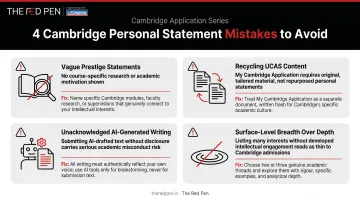
These four patterns consistently weaken Cambridge applications — and most are easy to avoid once you know what reviewers are looking for.
- Saying Cambridge is "world-leading" without naming what specifically draws you to the course structure or supervision model tells reviewers you haven't researched the programme
- Recycling your UCAS personal statement in the My Cambridge Application wastes the 1,200-character limit — Cambridge expects new, Cambridge-specific material, not a paraphrase of what admissions tutors already read
- Writing a statement with AI assistance without acknowledgement — Cambridge's own guidance classifies unacknowledged AI-generated content as academic misconduct and false claims as application fraud; AI can help with brainstorming or grammar, but the ideas and voice must be genuinely yours
- Packing in five surface-level observations instead of two fully developed arguments — depth wins every time
Frequently Asked Questions
What is the 80/20 rule for a Cambridge personal statement?
Cambridge advises that non-academic activities should not occupy more than 20% of any section in which they appear. The remaining 80% of every section should focus on academic interests, intellectual motivations, and subject engagement — even in Section 3, which is nominally about outside activities.
Can I get into Cambridge with A* A* A?
AAA meets the standard offer for many Cambridge courses, including Medicine, Engineering, and Natural Sciences. Grades are necessary but not sufficient — the personal statement, admission test, and interview all carry weight, and the statement must still demonstrate the academic depth Cambridge expects.
Can I use ChatGPT to help write my Cambridge personal statement?
Cambridge's guidance treats AI-generated application content as academic misconduct if unacknowledged; false claims in applications are treated as fraud. Students may use AI for brainstorming or light grammar editing, but the substance, ideas, and voice must be genuinely their own.
Does Cambridge have a preference for how I split content across the three UCAS sections?
Cambridge states it has no preference on how applicants divide content across the three sections. However, academic detail should dominate all three sections regardless of the split — the 80/20 rule on non-academic content applies to each section individually.
What is the My Cambridge Application personal statement, and is it really optional?
It's a separate ~1,200-character statement in the My Cambridge Application portal where applicants explain Cambridge-specific reasons for their course choice. Technically optional, but most competitive applicants complete it — it provides academic context that the UCAS statement isn't designed to cover, and leaving it blank is a missed opportunity.
How important is the personal statement compared to other parts of the Cambridge application?
Cambridge reads the personal statement in full but does not give it a formal score. It sits alongside grades, admission test results, a school reference, written work, and interview performance. Of all these components, it is the one that most directly shows how you think about your subject.