Introduction
For students applying to law at Oxford, Cambridge, UCL, or LSE, the personal statement is rarely just one factor among many. At Oxford, only around 9% of applicants receive an offer. UCL Law sees roughly 22.8 applications per available place. LSE doesn't interview undergraduates at all — meaning the personal statement is your only direct line to the admissions team.
For Indian students applying to these programmes, the gap is steeper. You're competing in an international pool against UK applicants who have often had school-level law exposure through mooting clubs, work experience with solicitors, or dedicated legal studies curricula. A strong personal statement bridges that gap by showing admissions tutors you already think analytically about law — not just that you're interested in it.
This guide covers what admissions tutors actually screen for, what belongs in each section, and a fully annotated example using the new UCAS 3-question format. By the end, you'll have a clear plan for writing your own statement.
Key Takeaways
- The 2026 UCAS format replaces the old single essay with three structured questions (combined maximum: 4,000 characters)
- Admissions tutors want proof of academic curiosity, not just career ambition
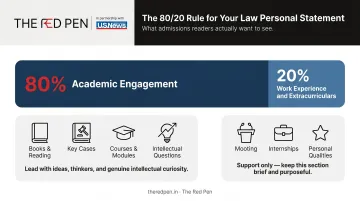
- Follow the 80/20 rule: 80% academic engagement, 20% extracurriculars and personal qualities
- Every claim in your statement must be something you can **defend and discuss in an interview**
- Indian and international applicants can reference non-UK legal cases, provided each example is paired with specific legal reasoning — not just a summary
What Law Admissions Tutors Are Really Looking For
Academic Curiosity, Not Career Goals
Cambridge is direct on this point: general statements about "always wanting to study the subject" aren't enough. Cambridge wants specific academic reasons and evidence of engagement beyond school — books read, questions raised, ideas explored. The Faculty of Law makes the point even more plainly: wanting to become a lawyer is not sufficient motivation. Admissions tutors want to see that you find law intellectually compelling as a discipline, including its tensions and moral ambiguities.
Oxford looks for reasoning ability, good written communication, and genuine interest in law as a subject. UCL and LSE echo this — LSE explicitly says at least 80% of the personal statement should focus on critical engagement with the programme, not general life ambitions.
The New UCAS 3-Question Format (2026 Entry)
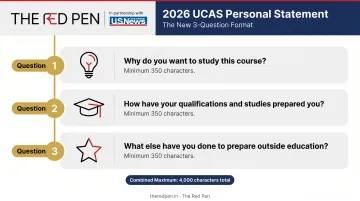
The old single 4,000-character essay is gone. From 2026 entry, UCAS requires applicants to answer three structured questions:
- Why do you want to study this course or subject?
- How have your qualifications and studies prepared you?
- What else have you done to prepare outside of education?
Each answer requires a minimum of 350 characters. All three together must stay within 4,000 characters total. This guide addresses all three.
What They're Screening For
Across Oxford, Cambridge, UCL, and LSE, admissions tutors are looking for consistent signals:
- Critical analysis — evaluating an argument, not just describing it
- Constructed reasoning — building a position and defending it with evidence
- Precision in writing that reflects attention to detail
- Awareness of how law operates outside the classroom, not just in theory
These must be demonstrated through examples. Claiming you have "strong analytical skills" means nothing without showing it.
A Note for Indian Applicants
Students applying from India can reference Indian legal developments — landmark Supreme Court judgments, constitutional law debates, significant legislation — alongside global legal trends. This signals breadth when done well.
Analysis is what makes it count. Connect those references to the intellectual questions they raise and to why you want to study law in the UK. A case name dropped without context adds nothing; a thoughtful observation about what a judgment reveals about the tension between rights and state authority shows real engagement.
What to Include in Your Law Personal Statement
Academic Exploration
This is the core of your statement. Relevant wider reading includes:
- Legal texts and jurisprudence — H.L.A. Hart's The Concept of Law, Tom Bingham's The Rule of Law
- Case law and court reports (Oxford's super-curricular hub specifically encourages following these)
- Legal podcasts, academic journals, and specialist publications
- Online courses — Cambridge's Corpus Christi College lists FutureLearn's "Exploring Law: Studying Law at University" as a recommended resource
- EPQs with a legal focus, or law taster sessions and summer schools
The benchmark is engagement, not exposure. Show what the book made you question and how that connects to what you want to explore at degree level.
Practical and Extracurricular Experience
UCAS explicitly recognises a range of law-adjacent experiences, including:
- Mini-pupillages and shadowing at legal aid organisations or Citizens Advice
- Visiting a magistrates' court
- Work experience at a law firm
- Debating societies and mooting
Indian applicants can reference moot court competitions, internships at law firms or courts, or community legal awareness work. Whether in Mumbai or Manchester, the principle holds: explain what you learned, not just what you did.
A useful benchmark: roughly 80% of your statement should cover academic engagement — books, cases, courses, and the intellectual questions they raised. The remaining 20% covers work experience, extracurriculars, and personal qualities.
If you spent 300 characters describing a moot court competition and 50 reflecting on what it taught you about legal argumentation, flip that ratio. Admissions tutors want to see your thinking, not your schedule.
Law Personal Statement Example (Annotated)
This sample uses the new UCAS 3-question format. It's an illustrative model — not a template to copy, and not suitable for submission. UCAS similarity detection screens all statements; anything over 30% similarity is reviewed.
Question 1: Why Do You Want to Study Law?
Sample answer (~150 words):
Reading the Supreme Court of India's judgment in K.S. Puttaswamy v. Union of India changed how I understood the relationship between the individual and the state. The majority's recognition of privacy as a fundamental right was less striking to me than the reasoning itself — nine judges, nine separate concurrences, all arriving at the same outcome through different philosophical paths. That divergence made me want to understand how law constructs, rather than simply reflects, our understanding of rights. I began reading Tom Bingham's The Rule of Law, which deepened my interest in constitutional and human rights law — particularly the tension between judicial authority and democratic legitimacy. I want to study law at degree level because these questions don't have clean answers, and I want to learn how to engage with that complexity rigorously. I'm especially drawn to public law, jurisprudence, and the legal theory underpinning rights frameworks.
Why this works: It opens with a specific case and a specific observation. It connects to wider reading, names a particular intellectual question, and identifies areas of law the student wants to pursue. The motivation is framed as curiosity rather than career — which is exactly what admissions tutors look for in a law applicant at this stage.
Question 2: How Have Your Studies Prepared You?
Sample answer (~120 words):
Studying History at A-Level has shaped how I read legal arguments. Evaluating conflicting historical accounts — deciding which sources are credible, identifying what a document doesn't say — mirrors the skills needed to analyse case law and statutory interpretation. My History coursework on partition-era constitutional debates in South Asia required me to engage with primary legal documents and assess competing scholarly interpretations, which introduced me to constitutional law before I formally encountered it. I also completed FutureLearn's "Exploring Law" course independently, which gave me a clearer sense of how common law reasoning builds through precedent — and raised questions about judicial discretion that I want to explore further at university.
Why this works: Rather than listing subjects and grades, this answer makes explicit interdisciplinary connections. The History coursework example is specific and shows legal thinking in a non-law context. The online course reference demonstrates self-directed study and ends with a genuine question — a strong signal of academic curiosity.
Question 3: What Have You Done Outside Education to Prepare?
Sample answer (~100 words):
I participated in a national moot court competition, arguing a case involving freedom of expression and press regulation. Preparing the arguments forced me to engage with legislation and precedent in a way that felt different from classroom study — I had to anticipate the other side's reasoning, not just construct my own. What I found most valuable was discovering how much depends on framing: the same facts can support opposite conclusions depending on which principles you foreground. That experience confirmed that law requires building arguments under pressure, and that's the skill I want to develop at degree level.
Why this works: The experience itself is described briefly. Most of the word count goes to reflection — what was learned, what surprised the student, and how it connects to degree-level study. The prestige of the competition is irrelevant; the thinking it prompted is what matters.
How to Write Your Law Personal Statement: A Section-by-Section Guide
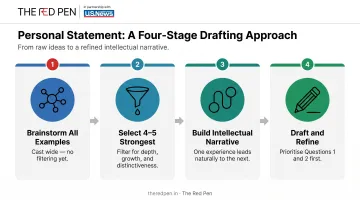
Before drafting anything, brainstorm without filtering: every book you've read, every case you've followed, every experience that sharpened your interest. Then select the four or five most substantive examples to build a coherent narrative. The statement should feel like intellectual progression — not a list of things you did.
Question 1: Your Motivations for Studying Law
Anchor this in something specific. A case, a book, a legal debate that genuinely engaged you. Then explain what intellectual question it raised — something you don't yet fully understand and want to explore at degree level.
Avoid:
- "I've always wanted to help people"
- Opening with a famous quote or a definition of law
- Vague references to "the justice system" without specificity
Do:
- Name 1–2 areas of law you're genuinely drawn to (public law, contract, human rights, criminal)
- Explain the intellectual tension or question within that area that interests you
- Connect your reading or coursework to that question
Question 2: Academic Preparation
Pick 2–3 subjects and draw explicit links to legal skills. History develops source evaluation and handling conflicting accounts. English Literature builds close reading and argument construction. Politics connects directly to constitutional and public law thinking.
Then mention one independent course, EPQ, or project — and explain what you learned, not just that you completed it. What question did it answer? What new question did it open?
Question 3: Experiences Outside Education
Describe the experience in one or two sentences. Spend the rest on reflection:
- What did you observe or encounter that surprised you?
- How did it confirm, challenge, or deepen your understanding of law?
- What does it suggest about your readiness for degree-level legal study?
Formal legal work experience isn't required. Debating, journalism, community work, or any activity that developed analytical or argumentative skills is valid — as long as you make the connection explicit.
Crafting a Narrative, Not a List
Cambridge describes what they're looking for as a "super-curricular journey" — a progression where one experience leads to the next, where a book raises a question, a course deepens it, and a case in the news forces you to reconsider it. That sense of development is what separates a compelling statement from a CV in prose form.
If you're struggling to find the thread between your experiences, it often helps to work backwards: start with the intellectual question you want to explore at university, then identify which readings, activities, or moments brought you to it. The Red Pen's consultants help students map exactly this structure — finding the connections that aren't obvious until someone asks the right questions.
Common Mistakes, Dos and Don'ts
Common Mistakes
- Too vague: Phrases like "I want to make a difference" tell admissions tutors nothing
- Listing without analysis: Naming five books without engaging with any of them is worse than discussing one book well
- Over-relying on criminal law: It's one module in a broader degree; a statement that's entirely about crime signals you haven't researched what law degrees actually cover
- Copying online examples: UCAS similarity detection flags statements with over 30% similarity — and AI-generated content is explicitly prohibited under UCAS policy
- Interview exposure: Cambridge notes that personal statements are often used as a basis for interview discussion; only include what you can confidently expand on
Dos
- Research each university's course structure so nothing in your statement contradicts what they actually teach
- Show what questions law has raised for you, not just what you've read
- Ask teachers and trusted advisors to review drafts
- Start early — Oxbridge applicants face a mid-October deadline
- Ensure every claim can be expanded in an interview
Don'ts
- Avoid opening with a definition of law or a famous quote
- Skip extracurriculars that have no clear connection to legal skills
- Proofread across multiple drafts before submitting
- Never exaggerate or fabricate experiences
- Resist spreading your word count evenly — Questions 1 and 2 deserve the most space
Format and Length
The new UCAS format requires a minimum of 350 characters per question, with a combined maximum of 4,000 characters. Recommended distribution:
| Question | Focus | Characters |
|---|---|---|
| Question 1 | Motivation for law | 1,600–1,800 |
| Question 2 | Academic preparation | 1,200–1,400 |
| Question 3 | Outside education | 600–800 |
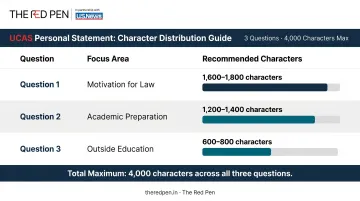
This weighting keeps the emphasis where admissions tutors spend the most time — your reasons for choosing law and the intellectual work behind that choice.
Frequently Asked Questions
How long should a law personal statement be?
From 2026 entry, UCAS uses a three-question format with a combined maximum of 4,000 characters and a minimum of 350 characters per question. The old single-essay format no longer applies. Plan your character budget carefully across all three questions.
What is the 80/20 rule for a law personal statement?
Around 80% of your statement should demonstrate academic engagement with law — through reading, courses, and analytical thinking. The remaining 20% covers work experience, extracurriculars, and personal qualities — a split widely endorsed by UK law school admissions guidance.
What if I haven't studied law before or have no legal work experience?
Neither is required — admissions tutors look for intellectual curiosity and transferable skills from other subjects and activities. A strong History coursework project or independent reading of Hart is more useful than an unfocused legal internship with no reflection.
Can I reference Indian or international legal cases in a UK law personal statement?
Yes — and it can strengthen your application by showing global legal awareness. The condition is genuine analysis: explain what the case reveals intellectually and why it deepened your interest in law. Connect the reference to why you want to study in the UK and what questions you want to explore further.
How do I make my law personal statement stand out for Oxford or Cambridge?
Oxbridge values applicants who engage with law as an academic discipline, not a profession. Build what admissions tutors call a "super-curricular journey": reading that raised new questions, experiences that sharpened your thinking, and a willingness to interrogate the law's foundations rather than simply admire them.
Should I focus on a specific area of law in my personal statement?
Mention one or two areas of genuine interest to show intellectual focus. Avoid making criminal law your entire frame, though. It forms one module within a broader degree at most UK law schools, and over-focusing on it suggests you haven't looked closely at what the course covers.