Here's the complication — "SOP" means different things depending on where you're applying. UK universities use a UCAS personal statement. US applications run through the Common App essay and school-specific supplements. Canadian and Australian programmes each have their own requirements. The writing challenge is identical across all of them: tell the admissions committee who you are academically, why economics specifically, and what you intend to do with the degree.
This guide covers exactly that — what the statement needs to do, how a UG economics statement differs from other applications, a section-by-section writing breakdown, an annotated sample, and the mistakes that consistently sink strong applicants.
Key Takeaways
- Intellectual curiosity about economic ideas matters more than listing grades — admissions committees already have your transcripts.
- Credibility comes from maths performance, relevant coursework, competitions, and self-directed reading — not research experience alone.
- Every section should answer one specific question — motivation, preparation, intellectual engagement, fit, or future direction.
- "I've always been fascinated by the economy" is the fastest way to lose an admissions officer's attention — specificity wins.
What Is a Statement of Purpose for Undergraduate Economics Admissions?
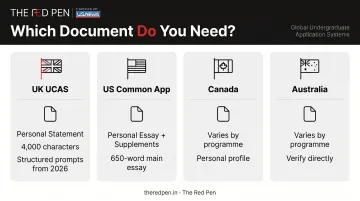
The term "SOP" is used loosely, but the format depends entirely on where you're applying:
| Application System | Document Name | Key Details |
|---|---|---|
| UK — UCAS (LSE, UCL, etc.) | Personal Statement | 4,000 characters total; from 2026 entry, structured around three questions with 350-character minimum each |
| US — Common App | Personal Essay + Supplements | 650-word main essay; school-specific supplemental prompts vary |
| Canada — U of T, McGill | Varies by programme | Some programmes request a personal profile; check each university's checklist individually |
| Australia — Melbourne, ANU | Varies by programme | Undergraduate economics pages at Melbourne and ANU do not list a standalone SOP — verify directly |
Regardless of format, the underlying purpose is the same: it is the one document written entirely in your voice. Transcripts prove you can perform academically. The written statement proves you can think, communicate, and articulate a clear answer to the question admissions readers care about most: why economics.
That question has a structure. UCAS guidance for 2026 entry organises the personal statement around three direct prompts: why you want to study this subject, how your qualifications have prepared you, and what you have done outside education to prepare. That framework is worth following even if you're applying through Common App or a Canadian portal — the underlying logic applies across all three systems.
What Makes a UG Economics SOP Different from Other Applications
Mathematics Is Not Optional Background — It's a Threshold Signal
Economics at the most competitive universities is a quantitative discipline, and admissions pages say so directly. LSE requires an A* in A-level Mathematics and lists Further Mathematics as desirable. UCL requires both an A* in Mathematics and a TMUA score, and explicitly advises students unlikely to achieve A* not to apply.
Your statement cannot treat maths as incidental. It should show genuine comfort with quantitative thinking — strong performance in calculus or statistics, competitive mathematics, or any project involving data. A statement that reads like a social science essay signals misalignment with what these programmes demand.
You Don't Have Research Experience — Here's What Replaces It
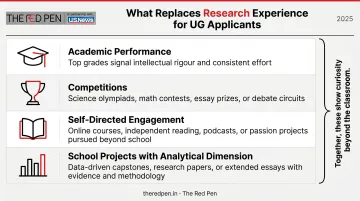
Graduate applicants lean on research publications and faculty alignment. You don't have those, and admissions committees know it. The substitute is a combination of:
- Academic performance in economics and maths at school
- Competitions — the International Economics Olympiad, national-level olympiads, business case competitions
- Self-directed engagement — books you've read, policy debates you've followed, economic questions you've tried to work through independently
- School projects with an analytical or quantitative dimension
The goal isn't to fake depth you don't have. It's to show that your curiosity has driven you beyond the classroom.
The "Fascinated by the Economy" Problem
Generic motivation is the single most common failure in economics statements. Admissions committees read thousands of statements that open with sweeping claims about economics governing everything. UCAS's own economics personal statement guide is direct: applicants need more than a subscription to The Economist and should demonstrate genuine engagement with economic theory and real issues.
The fix is specificity. Did India's 2022 inflation spike prompt you to read about monetary transmission mechanisms? Did a demonetisation conversation at home make you curious about how cash economies respond to policy shocks? A school project on income inequality that left you with more questions than answers counts too. Concrete moments like these are what separate a memorable statement from one that disappears into the pile.
How to Write Your Economics SOP: A Section-by-Section Guide
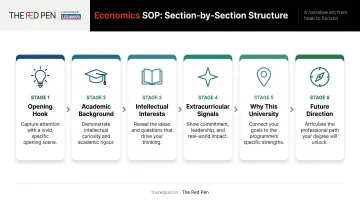
Opening Hook — 1 Paragraph
Open with a specific, grounded moment — not a sweeping claim about the discipline. Think about watching a family member navigate a loan decision, reading about a currency crisis and not understanding why exchange rates moved the way they did, or noticing a price disparity that made no intuitive sense.
The hook has one job: signal immediately that you engage with economic ideas actively, not aspirationally.
Avoid: "Economics is the foundation of all human society." Try instead: A concrete observation or question that made you want to understand the mechanism behind it.
Academic Background and Preparation — 1–2 Paragraphs
Walk the committee through your relevant academic preparation:
- Mathematics and economics performance at school (specific grades or results, not vague claims)
- Advanced coursework — IB HL Economics and Maths, A-levels, AP courses
- Any standardised test results where required (TMUA for UCL, for instance)
Select only what directly demonstrates readiness for the intellectual demands of an economics degree. An LSE admissions reader will notice a strong IB Higher Level Maths result — a full subject list tells them nothing useful.
Intellectual Interests — 1 Paragraph
This is where you show you think like an economist. Identify one or two specific economic ideas or debates you've genuinely engaged with:
- A book you read and what it changed about how you think (Daron Acemoglu's Why Nations Fail, Tim Harford's The Undercover Economist, or something more technical)
- A policy debate you followed closely — GST reform or RBI rate decisions are strong Indian examples; post-pandemic fiscal expansion works well for a globally oriented argument
- An economic concept you encountered in class that raised further questions
The standard here isn't expertise. It's demonstrated curiosity and the ability to reflect, rather than simply restate what you've read.
Extracurricular Signals — 1 Paragraph
For undergraduate applicants, this replaces the professional experience section in graduate SOPs. Relevant activities include:
- Economics or mathematics olympiads and competitions
- Investment clubs, MUN committees with economic themes, school debate on policy topics
- Statistics or data projects, even at the school level
- Leadership roles that demonstrate analytical or organisational thinking
Tie each activity back to what it reveals about your suitability for economics — not just that you participated, but what it showed or developed in you.
Why This University — 1 Paragraph
This section is the most commonly done poorly. Ranking citations don't work. What works:
- A specific faculty member whose research connects to an interest you've described earlier in the statement
- A course or specialisation that doesn't exist elsewhere
- A student research or policy programme unique to that institution
- Something about the pedagogical approach that matches how you want to learn
Critical: This paragraph must be rewritten for every university you apply to. LSE's quantitative programme and a liberal arts economics department are genuinely different environments. Treating them identically signals you haven't done the research.
Future Direction and Closing — 1 Paragraph
Close with a realistic and specific sense of direction. You don't need a fully formed career plan at 17, but you should be able to articulate a direction — public policy, development economics, finance, research, entrepreneurship — and connect the degree to it in a way that shows you've thought about the choice, not just defaulted to it.
The strongest closings don't declare ambition — they demonstrate it through the specificity of what the applicant wants to learn and why that requires this particular degree.
Sample Statement of Purpose for Undergraduate Economics
The following sample (~650 words) demonstrates all six structural elements covered above. Read it alongside the annotations below.
When my father's small textile business nearly collapsed during the 2016 demonetisation, I was twelve years old and understood very little about why the government's decision had emptied the local market overnight. Three years later, when I studied demand-supply models in school, I went back and tried to reconstruct what had actually happened — the cash crunch, the liquidity shock, the asymmetric effect on informal versus formal businesses.
The model explained part of it. But it also raised questions the model didn't answer, and that gap has driven most of my academic choices since.
At Dhirubhai Ambani International School, I have pursued the IB with Higher Level Mathematics, Economics, and Chemistry. My predicted grades reflect genuine strength in quantitative subjects: a 7 in HL Maths and a 7 in HL Economics. My Extended Essay examines the relationship between India's GST implementation and small enterprise formalisation rates, drawing on RBI working papers and MSME census data. Writing it taught me more about economic measurement — and its limitations — than any classroom unit. I also scored in the 89th percentile on the TMUA, which I sat in preparation for UK applications.
Independent reading has shaped how I think about economic institutions. Daron Acemoglu and James Robinson's Why Nations Fail fundamentally changed how I approach the relationship between institutions and economic outcomes — the India-Pakistan comparison in particular made something click that pure growth models had not.
Since then, I've followed debates around India's industrial policy with much more critical attention, including the arguments for and against Production Linked Incentive schemes as a development instrument. These aren't academic exercises for me; they're attempts to understand forces I have watched operate on real businesses in my immediate environment.
Outside the classroom, I placed third in the national round of the Indian Economics Olympiad in 2024, which required working through problems in game theory, welfare economics, and international trade — areas well outside the IB syllabus. I have also served as research coordinator for my school's economics journal, where I edit student submissions and contribute analysis on current policy issues. Both roles have pushed me to be rigorous rather than just interested — to back claims with evidence and identify the assumptions underneath every argument.
I am applying to LSE's BSc Economics because the programme's structure reflects what I want from an undergraduate education: a rigorous quantitative foundation in the first year, followed by the flexibility to specialise in development and public economics in later years. Professor Oriana Bandiera's research on labour markets and economic development in lower-income contexts connects directly to the questions my Extended Essay raised but could not fully answer. The fact that LSE does not treat economics as a social science elective but as a mathematically demanding discipline is exactly the environment I need to develop properly as an economist.
My longer-term direction is towards economic policy research, likely through a combination of graduate study and work in a policy institution — the kind of role where the gap between economic models and on-the-ground reality gets taken seriously. The undergraduate years are where I need to build the technical foundations that make that work credible. LSE's programme is where I believe I can do that.
Annotations: What Each Paragraph Is Doing
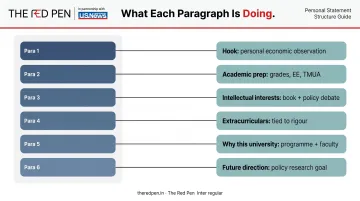
- Hook (Paragraph 1): Opens with a personal economic observation — demonetisation's effect on a family business — not a general statement. Establishes intellectual engagement before aspiration.
- Academic preparation (Paragraph 2): Names specific subjects, predicted grades, Extended Essay topic, and TMUA score. All direct signals of quantitative readiness. Specific, not generic.
- Intellectual interests (Paragraph 3): Cites a specific book with a named observation, then connects independent reading to a live policy debate. Shows active thinking, not passive consumption.
- Extracurricular signals (Paragraph 4): Two activities, each tied to what they developed — rigour and evidence-based reasoning, not just participation.
- Why this university (Paragraph 5): Names the programme structure, a faculty member, and a research connection to the applicant's own Extended Essay. Entirely specific to LSE.
- Future direction (Paragraph 6): Realistic and grounded — policy research, graduate study, the bridge between models and reality. Closes with purpose, not grandiosity.
A note on using this sample: This is a reference point, not a template. Your statement must reflect your story, your observations, and your intellectual history — borrowed narratives are recognisable, and UCAS similarity detection flags statements with over 30% similarity. The Red Pen's undergraduate admissions team guides students through a structured brainstorming process to identify the personal details and intellectual threads that make each statement genuinely individual, rather than adapted from someone else's.
Common Mistakes to Avoid in Your Economics SOP
Generic Openings That Signal Nothing
Statements that open with "Economics governs every aspect of our lives" or "I have always been fascinated by how markets work" tell the admissions committee nothing about you specifically. LSE's own guidance says the personal statement should show fit for the programme — a generic opening does the opposite.
Fix: Open with a specific observation, question, or moment. The hook exists to establish your relationship with economic ideas, not economics as a field.
Treating the Statement as an Extended Resume
Listing achievements without reflection is one of the most consistent weaknesses in undergraduate statements. Every item you mention should answer an implicit question: what does this reveal about my thinking and suitability for economics?
- ❌ "I participated in MUN and was awarded Best Delegate."
- ✅ "Chairing MUN's economic security committee required me to model policy trade-offs under incomplete information — the same constraint I encounter in economics problem sets."
Same achievement, but the second version earns its place by connecting experience to economic thinking.
Sending the Same Statement to Every University
This is particularly damaging for economics applicants because programmes vary significantly — and those differences matter at the application stage:
- LSE: heavily mathematical, expects comfort with formal models and quantitative reasoning
- US liberal arts colleges: value broader intellectual curiosity, interdisciplinary thinking, and less technical depth
- Canadian policy programmes: emphasise applied analysis, often with a public-interest lens
A one-size-fits-all statement signals you haven't researched the programme — a costly misstep when applying to oversubscribed departments where fit is actively evaluated.
Frequently Asked Questions
What is the statement of purpose for undergraduate admission?
An undergraduate SOP (or personal statement) is a written essay in which the student explains their academic interests, motivation for choosing the programme, and future goals. It gives the admissions committee a direct view of who the applicant is beyond grades and test scores — and for programmes that don't interview, like LSE, it carries significant weight.
How long should an SOP for undergraduate economics be?
Word and character limits vary by institution. UCAS allows 4,000 characters total; the Common App main essay has a 650-word limit. Always follow each university's specific guidelines. When no limit is specified, aim for concise and focused over long and comprehensive.
How is a UG economics SOP different from a graduate SOP?
A graduate SOP centres on research experience, publications, and faculty alignment. An undergraduate SOP focuses on intellectual curiosity, mathematical preparation, extracurricular engagement with economic ideas, and future direction — without requiring professional or research experience.
What should I highlight in my economics SOP if I have no work experience?
Strong mathematics and economics coursework, competition results (economics olympiads, case competitions), independent reading on economic topics, and any analytical or quantitative projects are the most credible signals for undergraduate applicants.
Do all universities require an SOP for undergraduate economics admissions?
No. UK universities use a UCAS personal statement; US universities use Common App essays plus school-specific supplements. Canadian and Australian programmes vary — some request a personal profile or statement of interest, others do not. Check each university's admissions page before preparing your documents.