The challenge is that most students treat it as an afterthought — a formality dashed off in an hour. Admissions committees notice.
This guide covers exactly what an undergraduate application letter is, how it differs from a personal statement, its 7 essential parts, a step-by-step writing process, a full annotated sample, and the mistakes that most commonly sink otherwise strong applications.
Key Takeaways
- An undergraduate application letter is a formal, one-page document — distinct from a personal statement or recommendation letter
- It follows a 7-part structure: header, salutation, opening, academic background, motivation/fit, closing, and sign-off — in that order
- Every letter must be tailored to the specific university and programme — generic letters are easy to spot
- The body (academic background + motivation/fit) should occupy roughly 60% of the letter
- Keep it to 300–400 words; admissions officers value precision over padding
What Is an Undergraduate Application Letter (and Why Does It Matter)?
An undergraduate application letter is a formal, one-page document addressed to a university's admissions committee. It introduces you, explains your academic motivation, and makes the case for your admission — in your voice, directly.
It is not the same as a personal statement. A personal statement — such as the UCAS component for 2026 entry, which uses three structured questions with a 4,000-character total limit — is a longer reflective piece embedded within the application portal.
An application letter is different: a standalone formal document, formatted like professional correspondence, that some universities and programmes request as a separate upload — particularly for specialised or competitive programmes.
It also differs from a recommendation letter, which is written by someone else (a teacher or counsellor) on your behalf.
In practice, some universities ask for it as a distinct upload; others fold a version of it into additional application materials. Either way, admissions committees use it to assess three things grades cannot show:
- Communication skills — how clearly and precisely you write
- Motivation — whether your interest in the programme is genuine and specific
- Academic fit — whether your background and goals align with what the programme offers
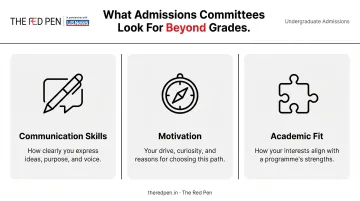
Admissions committees read these letters alongside transcripts and test scores — and a well-written one can be the deciding factor for a competitive applicant.
The 7 Key Parts of an Undergraduate Application Letter
Strong undergraduate application letters follow a consistent structure. Deviating from it risks appearing informal — and in competitive admissions, perception matters.
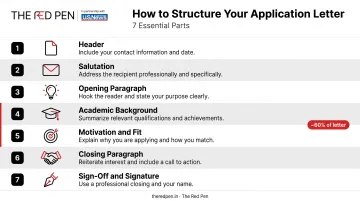
1. Header
Your header should include:
- Full name, phone number, email address, and city/country
- Date (month spelled out — e.g., 15 July 2025)
- Recipient's full name, title, department, and university address
A complete header helps admissions staff file your letter and follow up quickly.
2. Salutation
Address the letter to a specific person wherever possible — "Dear Dr. Smith" or "Dear Professor Jones" — using a colon after the name in formal correspondence. If no named contact is available, "Dear Admissions Committee" is appropriate. Avoid "To Whom It May Concern": it signals that you didn't bother to look.
3. Opening Paragraph
State the programme and university you're applying to. Introduce your strongest qualification or most relevant academic identity. Include a specific hook — a formative experience or a specific academic interest that reveals genuine curiosity. Do not start with "My name is."
4. Academic Background Paragraph
Highlight your most relevant academic achievements, coursework, or projects — but as a narrative, not a list. Connect your performance to intellectual curiosity. Reference specific subjects, distinctions, or research that directly relate to the programme.
5. Motivation and Fit Paragraph
This is where you answer: Why this university? Why this programme? Specificity is what separates a strong letter from a generic one. Reference particular faculty research, curriculum features, labs, or resources that align with your goals. Oxford's careers guidance explicitly warns against generic cover letters — and admissions committees at top universities think the same way. "World-class faculty" and "excellent reputation" tell them nothing.
6. Closing Paragraph
Restate your interest, express availability for an interview if applicable, and direct the reader to your accompanying documents (transcripts, CV). End with a confident, professional sentence that invites further engagement — avoid trailing off with something vague like "I hope to hear from you."
7. Sign-Off and Signature
Choose your sign-off based on how you addressed the letter:
- Named recipient (e.g., Dear Dr. Smith): use "Yours sincerely"
- General committee (e.g., Dear Admissions Committee): use "Yours faithfully"
Type your full name below the sign-off. For printed submissions, add a handwritten signature above your typed name.
How to Write an Undergraduate Application Letter: Step-by-Step
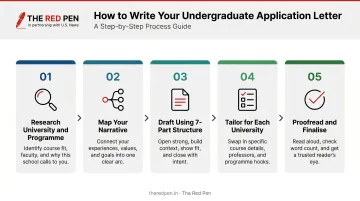
Step 1: Research the University and Programme
Before writing a single line, understand the programme — its curriculum structure, faculty expertise, unique resources, and institutional values. This research becomes the raw material for your motivation and fit paragraph, and it's what separates a tailored letter from a generic one.
Also confirm the admissions office's submission requirements before you start:
- Format and word count limits
- Submission method (portal upload vs. email attachment)
- Any specific naming or file format instructions
Following these instructions precisely signals attention to detail — before the reader even opens your letter.
Step 2: Map Your Narrative Before You Draft
Effective application letters are planned as unified narratives, not assembled paragraph by paragraph. Before drafting, identify:
- One core academic theme or strength that runs through your background
- One or two specific achievements that illustrate that strength concretely
- One clear connection between your background and the target programme
This narrative-first approach prevents the letter from reading like a CV summary. If you find it difficult to identify your through-line, working with an admissions counsellor before you start drafting can help — The Red Pen, for instance, begins each engagement with a profile analysis and storyboarding session to identify the strongest narrative before any writing begins.
Step 3: Draft Using the 7-Part Structure
With your narrative mapped, draft each section using the 7-part structure. The body — academic background plus motivation and fit — should occupy approximately 60% of the letter, with each paragraph flowing logically into the next.
Keep the letter to one page: 300–400 words, formal first-person tone throughout. George Mason University's Writing Center and MIT's CAPD both recommend one page at 10–12 point font as the professional standard.
Step 4: Tailor for Each University
Submitting the same letter to multiple universities is a critical error. Each version should update:
- The salutation (correct name and title)
- The opening hook (relevant to this programme specifically)
- The motivation/fit paragraph (specific faculty, curriculum, or resources)
- Any other institution-specific references
Create a checklist of university-specific details to swap in for each version.
Step 5: Proofread, Get Feedback, and Finalise
- Read the letter aloud to catch awkward phrasing
- Verify the programme name and university spelling are correct throughout
- Seek feedback from a teacher, counsellor, or trusted adult
- Save as a PDF to preserve formatting
- Use a professional file name:
FirstName_LastName_ApplicationLetter_UniversityName.pdf
Sample Undergraduate Application Letter
The sample below shows the 7-part structure in action, written for a student applying to a BSc Economics programme at a UK university. Read it as a reference model — not a fill-in template — then use the annotations to understand why each section works.
Arjun Mehta Mumbai, Maharashtra, India | +91 98765 43210 | arjun.mehta@email.com
15 September 2025
Dr. Sarah Collins Admissions Committee, Department of Economics University of Bristol Bristol BS8 1TH, United Kingdom
Dear Dr. Collins, (Salutation — named individual, formal)
(Opening — specific hook, no "My name is") During my research project on informal credit markets in rural Maharashtra, I encountered a question that formal economic models couldn't answer: why do rational households consistently choose high-interest informal lenders over accessible microfinance products? That gap between theory and observed behaviour drew me to development economics — and to Bristol's BSc Economics programme, which combines rigorous quantitative training with a strong emphasis on applied field research.
(Academic Background — narrative, not a list) At Cathedral and John Connon School, I completed the IB Diploma with a score of 42/45, with Higher Level Economics, Mathematics, and Geography. My Extended Essay examined price elasticity in Mumbai's unorganised retail sector, earning an A grade and commendation from my supervisor for its use of primary survey data. Beyond formal coursework, I completed an online certificate in econometrics through the University of London and have been independently studying Abhijit Banerjee and Esther Duflo's work on randomised controlled trials in development policy.
(Motivation and Fit — specific, not generic) Bristol's emphasis on empirical methods — particularly the third-year Research Methods module and the opportunity to work with the Centre for Global Finance — aligns directly with my goal of applying econometric tools to development finance questions. Professor Rajiv Patel's published research on household financial decision-making in emerging markets is work I have followed closely, and I would welcome the chance to engage with it at an undergraduate level.
(Closing — confident, professional, action-oriented) I am enthusiastic about the possibility of contributing to Bristol's academic community and would welcome the opportunity to discuss my application further. Please find my academic transcripts and CV enclosed. I look forward to hearing from you.
Yours sincerely,
[Handwritten signature]
Arjun Mehta
What makes this sample work:
- The opening names a specific research experience and poses a real intellectual question — giving the reader an immediate sense of how this student thinks.
- The academic background paragraph ties IB scores and the Extended Essay to a coherent intellectual direction, framing credentials within a story rather than reciting them.
- The fit paragraph names a specific module, a research centre, and a faculty member's published work. Every detail is Bristol-specific — nothing here transfers to a generic application.
- The closing is confident and action-oriented, directing the committee to supporting documents without overclaiming or sounding passive.
Common Mistakes to Avoid
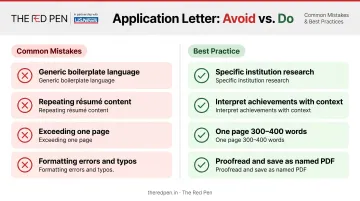
Sending a Generic Letter
The most damaging mistake. Admissions officers read hundreds of letters and recognise boilerplate immediately — phrases like "I have always been passionate about this field" or references to a university's "renowned faculty" appear in nearly every underprepared submission. Every letter must demonstrate that you have done genuine research into that specific institution and programme.
Repeating the Résumé
The application letter is not a summary of your grades and activities. Those are communicated through transcripts and CVs. The letter should interpret and contextualise achievements — not list them. Instead of writing "I received an A in Economics," explain what that coursework revealed about your thinking, or what question it left you determined to answer. The grade is already on your transcript — the letter is where you give it meaning.
Tone, Length, and Formatting Errors
Common formatting failures include:
- Exceeding one page without a compelling reason
- Inconsistent fonts or missing headers
- Grammatical errors or incorrect programme/university names
- A tone that's either too casual or stiff and stilted
A single formatting error or mismatched university name can signal carelessness to a committee reading hundreds of applications in a single cycle. Students applying to competitive programmes often find it worthwhile to have their letter reviewed by an expert before submission. The Red Pen's undergraduate admissions counsellors offer personalised letter review and application strategy support, working closely with each student's profile and target universities.
Frequently Asked Questions
What are the 7 parts of an application letter?
The 7 parts are: header, salutation, opening paragraph, academic background paragraph, motivation and fit paragraph, closing paragraph, and sign-off with signature. Each serves a distinct function — from establishing professionalism (header) to making the admissions case (body paragraphs) to inviting next steps (closing).
What is a sample application letter?
A sample application letter is a model document that demonstrates correct format, tone, and structure for a specific purpose. The annotated sample in this guide illustrates how each of the 7 parts works in practice for a BSc Economics application.
How is an undergraduate application letter different from a personal statement?
A personal statement is a longer, reflective piece — the UCAS version uses structured questions within a 4,000-character limit. An application letter is shorter and more formal, typically 300–400 words, focused specifically on academic fit and programme suitability, formatted as professional correspondence.
How long should an undergraduate application letter be?
One page — approximately 300–400 words. Conciseness signals that you respect the reader's time, and exceeding one page without explicit instruction to do so works against you.
Should I write a different application letter for each university?
Yes, without exception. At minimum, the salutation, fit paragraph, and all institution-specific references must be customised. Admissions readers spot a generic letter immediately — and it undermines everything else you've written.
Can I mention extracurricular activities in my undergraduate application letter?
Briefly, if they directly reinforce your academic interests or relevant personal qualities. But keep them in service of the academic argument — a full accounting of activities belongs in your CV or activities section, not here.