Introduction
Picture this: a student with strong grades, genuine curiosity, and real potential — yet somehow scrambling to finish essays the night before a deadline, realising in mid-October that a recommender needs six weeks' notice, and discovering only then that a target university's financial aid deadline had already passed.
This scenario plays out every year, not because students lack ability, but because they lack a plan.
A university application roadmap changes that. It converts what feels like a simultaneous wall of demands (academics, standardised tests, essays, recommendations, financial aid) into a sequenced, milestone-driven journey where no deadline gets missed.
According to a 2023 NACAC-commissioned Harris Poll of more than 1,000 young adults aged 16–22 — including many applying to US universities — over half ranked college applications as their most stressful academic experience. The fix isn't working harder under pressure. It's planning early enough that pressure never becomes the driver.
This article covers what a university application roadmap is, its key components, a six-step framework for building one, and the most common mistakes to avoid.
Key Takeaways
- A university application roadmap is a personalised, deadline-anchored plan — not a to-do list
- Early deadlines (October–November) arrive faster than most students expect
- Essays, recommendations, and extracurriculars each need their own planning track
- Starting in Grade 9–11 gives students the time to build a compelling, well-rounded profile
- Regular review checkpoints keep the roadmap useful as circumstances change
What Is a University Application Roadmap?
A university application roadmap is a personalised, timeline-driven strategic plan that maps every critical step of the admissions process against specific deadlines — from initial self-assessment and university research through to final submission.
The key word is strategic. A roadmap is different from a to-do list.
| Feature | To-Do List | Application Roadmap |
|---|---|---|
| Structure | Unordered tasks | Sequenced milestones |
| Scope | Single component | All components simultaneously |
| Time horizon | Day/week | Months to years |
| Adaptability | Static | Living document |
| Focus | Completion | Narrative coherence |
A roadmap is proactive and holistic. It treats academics, standardised tests, essays, recommendations, and financial aid as interconnected tracks — not separate tasks to tackle one at a time.
The structure varies by destination: applying to US universities through the Common App looks different from a UCAS application for UK programmes or a Canadian university portal submission. But the underlying logic stays the same — reverse-engineered planning anchored to hard deadlines.
Why You Need an Application Roadmap
Selective universities evaluate applicants across multiple dimensions at once. A strong GPA means little if the essays feel rushed, or if a recommender submitted a generic letter because they had two weeks' notice instead of two months.
A roadmap ensures no single component is neglected because another one consumed all available time.
The Deadline Calendar is Less Forgiving Than Students Assume
Most students think of January as "application season." The reality is sharper:
- October 15 — UCAS deadline for Oxford, Cambridge, medicine, dentistry, and veterinary courses (UCAS)
- November 1–15 — Most US Early Decision and Early Action deadlines, including Harvard and MIT financial aid forms
- January 13–15 — UCAS standard equal-consideration deadline; University of Toronto, UBC, and McGill final deadlines
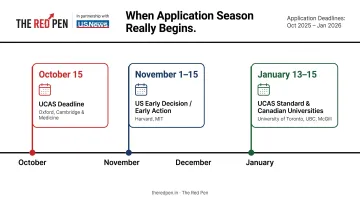
For Indian students applying simultaneously to US, UK, and Canadian universities, the first hard deadlines arrive in October — not January. Without a roadmap built around that calendar, students are already behind by the time most of their peers start thinking about applications.
Early Planning Directly Impacts Quality
The NACAC Guide to the College Admission Process recommends laying groundwork in freshman and sophomore year, with serious college research beginning in Grade 11. Starting structured preparation in Grade 9 gives students years to build genuine depth in extracurriculars, develop academic breadth, and understand what top universities actually look for.
A student who starts in Grade 9 has time to explore and course-correct. One who starts in Grade 12's first term is already in execution mode — and authentic work is harder to produce under deadline pressure. The Red Pen's Undergraduate Preparation service is built around this earlier starting point for exactly that reason.
Key Elements of an Effective Application Roadmap
University and Programme Shortlist
The university list is the foundation everything else builds on. A well-constructed list is balanced across three tiers:
- Reach schools (highly selective institutions where admission is uncertain but realistic)
- Match schools (universities where the student's profile aligns closely with the admitted cohort)
- Safety schools (strong institutions where admission is highly likely)
For Indian students targeting US, UK, and Canadian universities, the shortlist should factor in programme strength, location, available financial aid, course structure, and admission requirements. The College Board recommends narrowing to 5–10 schools before fall of Grade 12.
Getting this right early matters because every subsequent decision (which essays to prioritise, which tests to take, which recommenders to ask) flows from the school list.
Standardised Test Timeline
Test preparation cannot be treated as a sprint. Build it into the roadmap early, with retake windows built in.
Key benchmarks:
- SAT: College Board recommends taking the SAT in spring of Grade 11, with a possible retake in fall of Grade 12; allow 2–3 months of focused preparation
- ACT: Most students take it in Grade 11; ACT data shows students average 2–3 attempts to reach their target scores
- TOEFL: ETS advises scheduling at least 2–3 months before the earliest admissions deadline to allow time for score reporting
- IELTS: Results arrive in 1–13 days depending on format, but booking windows fill quickly — plan well in advance
A test score that arrives after an application deadline, or one that didn't have time for a retake, is a costly consequence of poor timeline management.
Essay and Personal Statement Plan
Essays deserve their own planning track — one that starts months before any deadline.
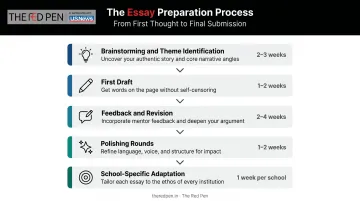
The process has multiple stages, each requiring time:
- Brainstorming and identifying themes
- Drafting a first version
- Gathering feedback and revising
- Polishing across multiple rounds
- Adapting the core narrative to each school's specific prompts
For UCAS applicants, the 2026-entry personal statement format changed to three structured questions with a combined limit of 4,000 characters , requiring more targeted responses than a traditional narrative essay.
NACAC's admission-factor data shows essays carry moderate importance at 37% of four-year colleges and considerable importance at nearly 19%. That's a significant proportion of schools where a strong essay can make a meaningful difference — and where a rushed one can undermine an otherwise competitive profile.
Starting early is what separates a considered narrative from a last-minute draft. Tools like The Red Pen's INK (Interactive Narrative Kit) help students structure their thinking before the drafting phase begins, moving from scattered ideas to a clear, cohesive story.
Recommendation Letter Coordination
Strong letters of recommendation require context. A teacher who receives a request two weeks before a deadline will write a different letter than one who was briefed months earlier with specific talking points about the student's goals and achievements.
Timeline guidance from universities:
- Common App recommends requesting letters at least three weeks before a deadline
- Harvard advises asking teachers about a month before recommendations are due
- MIT requires two teacher recommendations and encourages early requests
For October and November Early Decision deadlines, recommenders need to be identified by summer , not September. Late requests almost always produce generic results, regardless of how well the student knows the teacher.
Financial Aid and Scholarship Deadlines
This is the element most students treat as an afterthought. It shouldn't be.
Financial aid deadlines frequently align with or precede application deadlines:
- CSS Profile opens October 1 each year
- Harvard financial aid: November 1 (Restrictive Early Action), February 1 (Regular Decision)
- MIT financial aid: November 30 (Early Action), February 15 (Regular Action)
- Princeton: November 9 (Early Action), February 1 (Regular Decision) — note: Princeton does not use CSS Profile
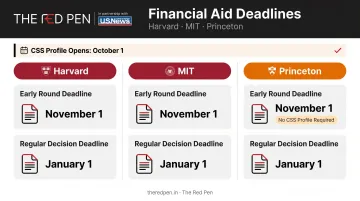
These forms require separate documentation: financial statements, additional essays, and institutional forms. Treating financial aid as a distinct planning track, not a checkbox after the application is submitted, is critical. Missing these deadlines can close off funding options entirely, even at schools that would otherwise have been accessible.
How to Build Your University Application Roadmap Step by Step
This six-step framework works regardless of where a student currently is in the process. The earlier the start, the more flexibility each step allows.
Step 1: Conduct a Thorough Self-Assessment
Before researching universities, a student needs to understand themselves clearly. This includes:
- Academic strengths and genuine areas of interest
- Career directions (even loosely defined ones)
- Preferred learning environments — large research university vs. small liberal arts college
- Non-negotiables: location, funding requirements, course structure, campus culture
A roadmap built on unclear goals produces a mismatched school list. That's why The Red Pen's onboarding process begins by mapping each student's strengths, interests, and profile before any strategic decisions are made — the application strategy follows the student's story, not the other way around.
Step 2: Research Universities and Their Requirements
For each target university, consolidate the following into a single tracker:
- Application type available (Early Decision, Early Action, Regular Decision)
- Hard deadlines for all rounds
- Required materials (essays, test scores, portfolios, interviews)
- Programme-specific criteria that differ from general admission requirements
- Financial aid availability for international applicants
Doing this research systematically — rather than school by school as deadlines approach — reveals patterns and conflicts early, while there's still time to adjust.
Step 3: Work Backwards From Deadlines to Create a Master Timeline
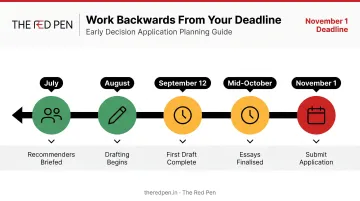
Take the earliest deadline on the list (likely an October UCAS deadline or a November Early Decision date) and map backwards:
- When do essays need to be finalised?
- When do test scores need to be submitted?
- When do recommendations need to be sent?
- When do financial aid forms need to be completed?
This reverse-engineering approach converts an abstract future deadline into concrete present-day tasks. A student targeting a November 1 Early Decision deadline, for instance, realises essays need to be polished by mid-October and drafting should begin in August. Recommenders need to be briefed by July at the latest.
Step 4: Break the Timeline Into Monthly and Weekly Action Items
A master timeline tells students what needs to happen. Weekly action items tell them what to do today.
Convert the master timeline into monthly goals, then weekly tasks. At every point in the cycle, a student should be able to answer: "What am I working on this week?" without having to consult a complicated plan.
Vague goals like "work on essays in September" create paralysis. Specific ones like "complete first draft of Common App personal statement by September 12" create momentum.
Step 5: Build in Buffer Time and Regular Review Checkpoints
Unexpected events happen: a recommender becomes unavailable, a test score comes in lower than expected, a school adds an interview round, or the student decides to add a new university late in the cycle.
Two structural protections prevent these from becoming crises:
- Buffer windows: Schedule 2–3 weeks of buffer before every major deadline. This time absorbs surprises without collapsing the entire timeline.
- Monthly review checkpoints: A dedicated session each month to assess progress, reprioritise tasks, and update the roadmap based on new information.
Working with an admissions consultant during these checkpoints helps catch issues before they become setbacks. The Red Pen's counsellors stay involved throughout the entire cycle: reviewing application components in detail, adjusting strategy when circumstances shift, and keeping the overall narrative consistent as individual pieces come together.
Common Mistakes to Avoid When Building Your Application Roadmap
Starting in September of Grade 12
This is the most common and most costly mistake. Students who begin in September of their final year find they have almost no time for:
- Multiple essay revision rounds
- Test retakes if initial scores fall short
- Meaningful recommender briefings before October/November deadlines
- Financial aid form completion alongside application materials
The Red Pen's Undergraduate Preparation service is structured for Grades 9–12 precisely because building a compelling application isn't just about completing forms: it's about developing the profile, activities, and narrative over time. The Pre-College Advising Team begins mentoring students from Grade 8 onwards.
For undergraduate applicants, Grade 10–11 is the ideal time to begin structured roadmap planning. By Grade 12, the roadmap should be in execution mode — not planning mode.
Treating the Roadmap as Fixed
A roadmap built in June should not look identical in October. Circumstances change: interest shifts, test scores improve (opening up new options), teachers become unavailable, and admission requirements get updated mid-cycle.
The roadmap is a living document. Monthly review checkpoints exist precisely to keep it current. Students who treat it as fixed often miss the window when a small adjustment — a school added, a deadline shifted — would have changed the outcome.
Watch for these triggers that signal it's time to revisit your roadmap:
- A significant score improvement that opens stronger-fit schools
- A teacher or counsellor becoming unavailable to write a recommendation
- A shift in academic interest that reframes your course selection narrative
- Updated admission requirements at a target school
Confusing Tasks With Narrative
The subtlest mistake is treating the application as a checklist of tasks to complete rather than a coherent story to tell.
Every component of the application — essays, activity descriptions, recommendation letters — should reinforce a consistent picture of who the student is. This narrative thread doesn't emerge by accident. Identify it early, then map it deliberately across every component before a single word is written.
The Red Pen's approach involves storyboarding sessions where counsellors help students surface the most compelling and authentic through-line across their experiences.
In one case, a student with limited formal extracurricular credentials was admitted to a competitive US undergraduate programme because the team identified a consistent narrative across academic writing, editorial leadership, and community advocacy — experiences that looked unrelated on a task list but told a coherent story together.
Frequently Asked Questions
What is an application roadmap?
A university application roadmap is a personalised, timeline-driven plan that organises every stage of the admissions process — from self-assessment and test prep through to final submission — against deadlines aligned to the student's target institutions.
What is a roadmap example?
A Grade 11 student targeting US Early Decision might structure their roadmap like this:
- SAT in spring of Grade 11, with a retake window in October of Grade 12
- University shortlist finalised by summer
- Essay drafting from July through September
- Recommenders briefed by July
- Final submissions by 1 November
What are the key stages of the university application process?
The core stages are:
- Self-assessment and goal-setting
- University research and shortlisting
- Standardised test preparation
- Essay writing and revision
- Recommendation coordination
- Financial aid applications and final submission
How early should I start building my application roadmap?
Grade 10–11 is the ideal starting point for most undergraduate applicants. The Red Pen works with students from Grade 8–9 onwards for profile building and extracurricular planning, because starting in Grade 12 leaves time only for execution, not the iterative development that produces the strongest applications.
What should a university application roadmap include?
A complete roadmap includes:
- A balanced shortlist with reach, match, and safety tiers
- Standardised test timelines with retake windows
- An essay planning and revision schedule
- A recommendation letter coordination timeline
- Financial aid and scholarship deadlines tracked separately
- Monthly review checkpoints to stay on course