Introduction
Harvard's acceptance rate sits below 4%. So does MIT's. Yet every year, Indian students with near-perfect grades get rejected while others with slightly lower GPAs get in. Grades get you to the table. Skills and character determine whether you get a seat.
According to NACAC's Fall 2023 data, 76.8% of colleges rated grades in college-prep courses as considerably important, but only 4.9% said the same about ACT/SAT scores. Character attributes, by contrast, were rated considerably important by 28.3% of colleges.
At Harvard, Yale, Princeton, and MIT, essays, extracurriculars, and personal qualities are all rated Very Important in official admissions data — on par with your transcript.
What follows breaks down which academic and personal skills matter most, where to demonstrate them in your application, and why Grade 11 is a better time to start than Grade 12.
Key Takeaways
- Colleges evaluate applicants holistically — grades matter, but skills like curiosity, leadership, and critical thinking carry real weight at selective institutions.
- Academic skills include rigorous course selection, analytical thinking, and demonstrated depth of engagement in a chosen subject area.
- Personal skills — initiative, resilience, teamwork, and open-mindedness — signal how you'll contribute to campus life.
- These skills must be actively demonstrated across essays, extracurriculars, recommendations, and interviews.
- Building a compelling profile requires intentional planning that starts from Grade 9, not the final year.
Why Colleges Look Beyond Grades and Test Scores
Over 2,085 US colleges are now test-optional or test-free for Fall 2026, according to FairTest. That shift has pushed admissions officers to look harder at everything else in a file.
But this doesn't mean grades have become irrelevant. Strong academics remain the baseline. What's changed is how much everything surrounding those grades now matters.
How Holistic Review Actually Works
Selective colleges aren't just admitting students into academic programmes. They're assembling a community — one that will debate ideas in seminars, lead student organisations, support peers through difficult moments, and eventually represent the institution in the world. That's why admissions committees ask: who is this person, and what will they bring?
At Harvard, Yale, and Princeton, the application essay, recommendations, extracurricular activities, and character are all rated Very Important in the 2024–25 Common Data Set filings. MIT goes further: it rates character and personal qualities at the highest level, even above several academic factors.
Different Colleges Weigh Things Differently
Not every institution uses the same rubric. Admissions priorities vary by institution:
- Highly selective US colleges tend to place the greatest emphasis on skills and character once baseline academic requirements are met
- UK universities (especially Oxford and Cambridge) focus heavily on subject depth and analytical thinking, assessed through interviews and the personal statement
- Canadian universities vary significantly — University of Toronto uses grades for most programmes, while UBC and Waterloo use supplemental profiles that assess a broader range of qualities
Research each college's Common Data Set to understand exactly what they weight and how heavily.
Academic Skills That Colleges Prioritise
Intellectual Curiosity and Love of Learning
Colleges don't want students who are good at following instructions. They want students who are genuinely curious — who read outside the syllabus, ask questions their teachers haven't considered, and pursue ideas because they find them interesting, not because they're on the exam.
Stanford explicitly identifies intellectual vitality — curiosity, openness, and imagination — as a core admissions factor. Cambridge encourages applicants to pursue super-curricular activities that explore subjects beyond school requirements. Oxford's super-curricular hub for students over 16 is designed precisely for this.
What intellectual curiosity looks like in practice:
- Independent reading in your area of interest
- Self-initiated research projects or science experiments
- Writing for school publications or starting a blog on a subject you care about
- Enrolling in online courses out of genuine interest, not just to add a line to a CV
- Reaching out to experts or academics in a field you want to understand better
Critical and Analytical Thinking
Admissions officers want evidence that you can evaluate information, challenge assumptions, and build well-reasoned arguments — not just recall facts. This matters because college coursework demands it from the first week.
Oxford describes its interviews as academic conversations designed to explore how applicants think, not just what they know. Yale notes that teacher recommendations often speak to a student's intellectual curiosity, energy, and reasoning — not just classroom performance.
For US applications, analytical thinking tends to show up through essay quality, course selection, and how students discuss their academic interests. For UK applicants, it's directly tested in the interview.
Academic Rigour and Subject Passion
The strength of your curriculum — not just your GPA — is among the first things admissions officers examine. Choosing challenging courses (IB HL, AP, A-levels, honours) in subjects aligned with your intended field sends a clear signal about academic seriousness.
The distinction that matters: taking difficult courses to build genuine depth versus taking them purely to impress.
Consider what each profile communicates. A student who has taken Physics HL, Math AA HL, and CS HL under the IB and has also independently built a project in that space signals real subject passion. A student who has maxed out on every available AP across unrelated subjects, without any coherent focus, signals grade-chasing — ambition without direction, which selective admissions offices recognise quickly.
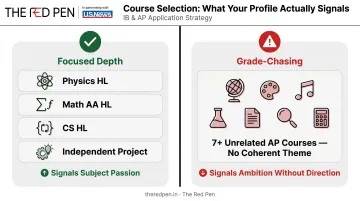
This is why course selection strategy at The Red Pen centres on identifying a student's genuine academic strengths first — then building a curriculum that reflects focused depth, not just a long list of credentials.
Personal and Interpersonal Skills Colleges Value
Leadership and Initiative
Leadership doesn't require a title. Colleges value students who see a problem and do something about it — whether that's founding a club, organizing a community initiative, mentoring younger students, or building something from scratch with no institutional backing.
Several students The Red Pen has worked with have demonstrated this effectively. One student founded two nonprofits distributing medicines to hundreds of patients and raising funds for homeless shelters, and was admitted to Northeastern University, King's College London, and UCL. Another conducted self-funded robotics research and published findings independently — earning offers from Imperial College London and UCLA.
What made these applications stand out was the impact itself: measurable, specific, and self-initiated — not the titles attached to the work.
Teamwork and Collaboration
MIT specifically names "collaborative and cooperative spirit" as a quality it looks for in applicants. And it makes sense — a campus is a community, and admissions officers want to know you can work effectively within one.
Listing team memberships isn't enough. Colleges want to understand:
- What your specific role was
- What you contributed to the group's outcome
- What you learned about collaboration — especially when navigating disagreement or difference
Resilience and Perseverance
Resilience shows up in how you respond to difficulty — not whether you've had a perfectly smooth academic journey. Colleges know students will face challenges; they want evidence you'll push through rather than disengage.
Perseverance can be demonstrated through:
- Sustained commitment to an activity over multiple years
- An essay that honestly discusses a setback and what followed
- Context from a counsellor or teacher recommendation that speaks to grit
Creativity and Open-Mindedness
Creativity isn't only for artists. It refers to approaching problems from new angles, generating ideas that aren't obvious, and thinking beyond conventional frameworks. Open-mindedness complements it: colleges want students who will engage seriously with perspectives different from their own.
Both qualities surface throughout an application:
- Essays that tackle unconventional topics or honest intellectual shifts
- Extracurriculars that blend disciplines or cross into unexpected territory
- Reflections that show your thinking evolved, not just that you participated
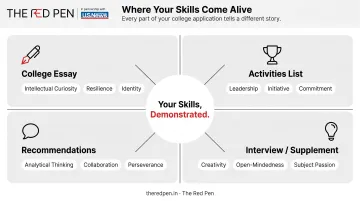
Where to Showcase These Skills in Your Application
The College Essay and Personal Statement
The personal statement is your primary opportunity to demonstrate skills that don't appear in a transcript. A strong essay doesn't list qualities — it tells a specific story that makes the reader see them in action.
The Red Pen uses two core frameworks for this. The first is the INK (Interactive Narrative Kit) — a proprietary tool that helps students navigate the essay brainstorming process in a structured way. The second is storyboarding: a counsellor-led process of identifying the experiences from a student's background that best reflect their identity, skills, and goals, then building those into a coherent narrative.
The result is an essay grounded in what actually matters to the student — which is precisely what admissions officers respond to.
Supplemental essays ("Why This College?" questions, activity-specific prompts) are equally important. These are opportunities to connect specific skills with a college's particular values — which requires genuine research into each school's mission and culture.
The Activities List and Extracurricular Profile
Extracurricular involvement demonstrates skills like commitment, leadership, and initiative in a concrete, verifiable way. The guiding principle: depth over breadth.
MIT asks applicants to list up to four activities that are most important to them — not twenty. This signals exactly what colleges value: meaningful engagement, visible growth, and genuine impact over a long list of surface-level participation.
Every description on the activities list should convey not just what you did, but the scale, impact, or leadership involved. Space is limited; every word has to earn its place.
Letters of Recommendation
Teacher and counsellor recommendations allow third parties to confirm what your application describes — and add context you can't provide yourself. The best letters include specific anecdotes that illustrate qualities like intellectual curiosity, perseverance, or collaboration. Generic letters that simply confirm attendance and good grades add little.
To get the most out of recommendations:
- Build genuine relationships with teachers in subjects relevant to your intended studies
- Share your goals and application narrative so their letters reinforce your story
- Brief recommenders on the specific experiences you're writing about — so nothing contradicts or duplicates
The Red Pen's Mentorship Year 2 programme covers recommendation strategies directly — including personalised guidance on selecting recommenders and how to brief them effectively. That kind of coordination across essays, activities, and recommendations is what makes an application feel like a single, unified story rather than a collection of separate documents.
Tips to Develop These Skills Before You Apply
Don't wait until Grade 11 to start thinking about this. The students with the strongest applications built them gradually, over years — not in a frantic final sprint.
Grade 9–10 priorities:
- Join a debate team, Model UN, or writing club to build analytical thinking and communication
- Start a small project or initiative in something you genuinely care about
- Explore independent reading or online learning in an area of real interest
- Take on a mentorship or tutoring role, even informally
Grade 11–12 priorities:
- Deepen existing commitments rather than adding new ones
- Take on leadership or organisational responsibility within activities you're already involved in
- Begin reflecting on what you've learned — and keep notes on meaningful experiences
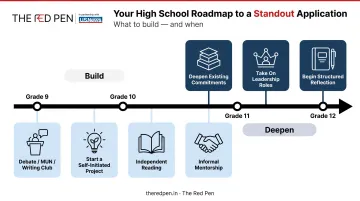
That last point matters more than most students realise. Reflection is what turns experiences into essays. Students who can articulate what they learned and how they grew — not just what they did — will write far stronger applications.
Authenticity isn't optional. Colleges read thousands of applications every cycle and are experienced at distinguishing genuine interests from résumé-padding. Students who invest in what they actually care about build more compelling, coherent profiles, because that passion shows up in ways that can't be manufactured.
Frequently Asked Questions
What skills do colleges look for?
Colleges look for a combination of academic skills — intellectual curiosity, critical thinking, subject passion, and course rigour — and personal skills including leadership, initiative, teamwork, resilience, and creativity. Together, these qualities signal that a student is ready to contribute meaningfully to a college community.
What is Gen Z looking for in college?
Today's applicants prioritise purpose-driven programmes, mental health support, diverse and inclusive communities, and flexibility. Research from Inside Higher Ed's 2024 Student Voice survey found nearly two in five students reported stress or mental health affecting their academics.
Do all colleges look for the same skills in applicants?
No. Highly selective institutions tend to weight essays, character, and extracurriculars most heavily once academic thresholds are met. Less selective and public universities may rely more heavily on grades and test scores. Reviewing each college's Common Data Set — specifically Section C7 — gives you a clear picture of exactly what that institution prioritises.
Are academic skills more important than soft skills?
Strong academic performance is typically the foundational requirement: you need to meet the threshold to be considered. But at highly selective colleges where most applicants have excellent grades, personal qualities and soft skills often become the deciding differentiators between otherwise similar candidates.
How can I demonstrate leadership without a formal title?
Through self-initiated projects, informal mentorship, community contributions, or taking ownership of group efforts. Colleges care about demonstrated impact: specifically, what you did and what changed as a result, not the title of a position you held.
How do I highlight skills in my college essay?
Use the "show, don't tell" principle. Rather than writing "I am a leader," tell a specific story in which leadership is visible through your actions, decisions, and the outcomes that followed.