Yet the path to a Canadian university is rarely straightforward. Between academic eligibility, English proficiency tests, document requirements, multiple application portals, and significant 2025 policy changes to study permits, the process demands careful planning.
This guide covers everything Indian and other international students need to know: what you need academically, how English tests are evaluated, what documents to prepare, and what changed in 2025 that could affect your study permit application.
Key Takeaways
- Canadian universities assess CBSE, CISCE/ISC, and state board Class 12 results directly — no standardised SAT/ACT required for Indian applicants
- Typical English proficiency scores: IELTS 6.0–7.0, TOEFL iBT 80–100, or PTE 58–65+
- Canada's 2025 study permit cap of 437,000 (a 10% cut) makes early applications more critical than ever
- Most applicants, including master's and doctoral students, now require a Provincial Attestation Letter (PAL)
- Start the full process 12–15 months before your intended intake
Why International Students Choose Canada for Higher Education
For Indian students weighing study-abroad options, Canada offers a combination of manageable costs, post-study work opportunities, and academic variety that the US and UK don't always match.
Tuition is a practical starting point. Statistics Canada reports average international undergraduate tuition of CAD 41,746 for 2025/2026. That figure has risen over the past decade. Even so, US public universities averaged USD 28,244 in nonresident tuition in 2022–23, and UK international fees can reach GBP 38,000 annually. Canadian institutions remain notably competitive — particularly for engineering, business, and social sciences.
The cost advantage isn't the only draw. Canada also offers:
- Multicultural campuses — over 572,000 international enrolments across public colleges and universities in 2023/2024
- Post-study work through the Post-Graduation Work Permit (PGWP), which lets eligible graduates from Designated Learning Institutions gain Canadian work experience (eligibility depends on program type, full-time status, and applying within 180 days of completion)
- A wide range of programs — from three-year undergraduate degrees to one-year postgraduate diplomas — across institutions at different price points
The range of institutions matters too. Canada's public college system — Seneca, George Brown, Humber, and others — offers career-focused diploma and certificate programs at significantly lower tuition than universities, giving students more than one route into the country.
Academic Admission Requirements by Program Level
Canadian institutions don't use a single national minimum. Requirements vary by program, level, and institution — and knowing the distinctions before you apply saves time and avoids missteps.
Undergraduate Admission Requirements
For Indian students applying at the undergraduate level, Canadian universities assess Class 12 results directly from CBSE, CISCE/ISC, and state boards. There is no universal requirement for SAT or ACT scores from Indian applicants — those tests are primarily relevant for students on US-patterned curricula.
What matters is your Class 12 performance and subject prerequisites:
- University of Toronto: senior-level subject prerequisites apply, with benchmarks set by program
- UBC: accepts the Senior School Certificate from Central or State Boards, with "high standing" required
- McGill: needs Class X results, Class XI marks, and mid-year or final Class XII certificates with numeric grades
- McMaster: accepts CBSE (All India Senior School Certificate); State Board results with "excellent" grades may also qualify
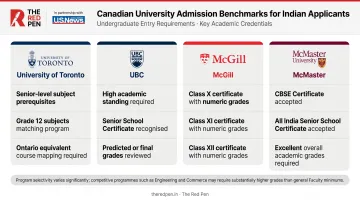
One practical note: a blanket "60–70% minimum" is not a verified standard across major Canadian universities. Official pages consistently use terms like "high standing" and "excellent results," with competitiveness depending heavily on the program. Engineering and health sciences programs at top institutions are far more selective.
Postgraduate/Master's Admission Requirements
For master's programs, most universities require:
- A four-year bachelor's degree (or equivalent) in a relevant field
- Academic standing at roughly First Class / 65% or a mid-B GPA. UBC's graduate school requires First Class/Division 1 or 65% for Indian applicants; UofT sets a mid-B minimum
For MBA and specialist master's programs, GMAT or GRE scores may be required, but benchmarks vary significantly:
| Program | GMAT Requirement | GRE Requirement |
|---|---|---|
| UBC Sauder MBA | 515 (min. 50th percentile) | 155 (verbal & quant) |
| Smith School MIB | 600 | 315 |
| Smith MBA | Recommended, no hard minimum | Recommended |
Work experience of 2–3 years is expected for most MBA programs, and thesis-based programs often require a research proposal.
Diploma and Certificate Programs
Postgraduate diploma and graduate certificate programs at Canadian colleges offer more flexible entry. George Brown, Seneca, and Humber are among the most popular choices for Indian students. Requirements include:
- A bachelor's degree for postgraduate diploma programs
- Specific academic and backlog limits (Humber specifies maximum backlog attempts based on whether the bachelor's is three or four years)
- Program-specific English proficiency thresholds
These programs typically run one to two years, cost less than full master's degrees, and feed directly into sectors where Canada actively recruits skilled workers.
English Language Proficiency Requirements
Canadian universities accept several standardized English proficiency tests, though minimum score requirements vary by institution and program. Most schools recognize:
- IELTS Academic
- TOEFL iBT
- PTE Academic
- Duolingo English Test
- CAEL
If you're applying to French-language institutions such as Université Laval or Université de Montréal, French proficiency tests (TEF/TEFAQ) are required instead.
Score Benchmarks by Test
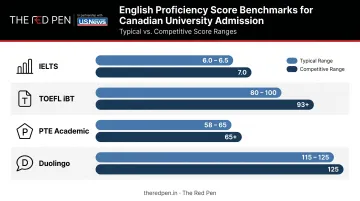
The ranges below are drawn from published requirements at UofT, UBC, and McGill. There is no single national standard, so always confirm directly with each university:
| Test | Typical Range | Competitive Programs |
|---|---|---|
| IELTS Academic | 6.0–6.5 overall | 7.0 (UofT graduate) |
| TOEFL iBT | 80–100 | 93+ (UofT graduate) |
| PTE Academic | 58–65 | 65+ (UBC graduate) |
| Duolingo | 115–125 | 125 (UBC undergraduate) |
Exemptions may apply if you have completed four or more consecutive years of full-time education in English — UBC and McGill both reference this threshold. Citizenship from a majority English-speaking country may also qualify. Indian students from English-medium schools (CBSE, ICSE, or IB) may qualify for an exemption at some universities, but policies differ — check each institution's admissions page directly before assuming you're exempt.
Required Documents for Canada College Applications
Core Documents (All Programs)
Most Canadian institutions require:
- Completed application form
- Official academic transcripts (translated into English if issued in another language)
- Valid passport copy
- Statement of Purpose (SOP) or personal statement
- Letters of Recommendation — typically 2 for undergraduate programs
- CV or résumé (for programs that request one)
Transcripts must be official or attested copies. UBC and McGill both specify requirements for how documents are uploaded or sent directly from issuing institutions.
Program-Specific Documents
Depending on your program, you may also need:
- Portfolio (required for Arts, Design, and Architecture programs)
- Supplemental application or short essays (required at select undergraduate programs)
- Audition recordings or creative samples (for Music and Performing Arts programs)
Financial Documentation
Applicants must demonstrate sufficient funds to cover tuition, living costs, and return transportation. IRCC's current proof-of-funds requirement sets the living-cost minimum for a single applicant (outside Quebec) at CAD 22,895, on top of one year's tuition.
Acceptable documents include:
- Bank statements (typically covering the past 3–6 months)
- Education loan sanction letters
- Sponsorship letters with supporting financial evidence
The same documents are typically required for your study permit application.
How to Apply to Canadian Colleges as an International Student
Application Portals
Canada does not have a single national application system. The main portals are:
- OUAC — Ontario universities
- ApplyAlberta — 26 publicly funded Alberta institutions
- EducationPlannerBC — British Columbia public postsecondary institutions
- Direct portals — most other institutions, including many Quebec universities
Applying through multiple portals simultaneously is standard practice and strongly recommended.
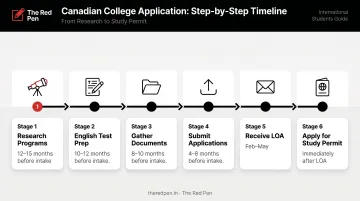
Application Timeline
| Stage | When to Act |
|---|---|
| Research programs and institutions | 12–15 months before intended intake |
| English test preparation and sitting | 10–12 months before intake |
| Gather and translate documents | 8–10 months before intake |
| Submit applications | 4–8 months before intake (Jan–Apr for Fall) |
| Receive Letter of Acceptance (LOA) | Varies; typically Feb–May |
| Apply for study permit | Immediately after LOA — allow up to 3 months |
Key deadlines: UBC's general undergraduate deadline is January 15; McGill's undergraduate deadline is also January 15, with supporting documents due March 1; UofT advises applying early in the fall of the final school year.
What Makes a Strong Application
A competitive Canadian application goes beyond grades. Admissions teams look at:
- A clear, specific SOP that connects your academic history to program choice and career direction
- Strong LORs from credible academic or professional referees who can speak to your capabilities
- Error-free documents submitted ahead of deadlines
Managing multiple portals, varying deadlines, and institution-specific document requirements at the same time is one of the trickiest parts of the process — and where many strong candidates lose ground.Managing multiple portals, varying deadlines, and institution-specific document requirements at the same time is one of the trickiest parts of the process — and where many strong candidates lose ground.
The Red Pen's undergraduate admissions consulting covers this end-to-end: college list building, SOP development, LOR strategy, and submission management across Canadian, US, and UK institutions. The INK (Interactive Narrative Kit) tool supports students through the essay stage, from brainstorming through to final drafts.
MM, a Mumbai-based student with a 43/45 IB predicted score, received offers from UBC, CMU, and Georgetown after The Red Pen helped her sharpen her narrative through targeted extracurricular depth and a research paper.
Study Permit Requirements and 2025 Key Updates
Core Study Permit Process
After receiving a Letter of Acceptance from a Designated Learning Institution, you must apply for a study permit through IRCC. Core documents required:
- Valid passport
- Letter of Acceptance from a DLI
- Proof of sufficient funds (tuition + CAD 22,895 living costs + return travel)
- Biometrics (ages 14–79; CAD 85 individual fee, submitted within 30 days of instruction letter)
Processing times vary and are not fixed — check IRCC's live processing-time tool for current India-specific estimates. Allow at least three months from application submission.
2025 PAL Requirement
IRCC's January 24, 2025 notice requires most applicants — including master's and doctoral students — to obtain a Provincial Attestation Letter (PAL) or Territorial Attestation Letter (TAL) before a study permit application can be processed.
Exemptions are limited and include:
- Primary and secondary school students
- Exchange students
- Certain priority or vulnerable groups
- Students extending an existing permit at the same DLI and same level
If you're applying for a new program at a new institution at any level, you need a PAL. Check with the province where your institution is located for current availability and process.
2025 Study Permit Cap
IRCC has set a 2025 study permit target of 437,000 — a 10% reduction from the 2024 cap. Combined with provincial PAL allocations, this means permit availability is limited. Apply for your LOA and PAL as early as possible. Waiting until summer to apply after a late acceptance puts your intake at risk.
Frequently Asked Questions
What are the requirements to go to college in Canada?
For undergraduate programs, you need a completed Class 12 from a recognised board with strong academic standing, along with English proficiency scores, core documents (transcripts, SOP, LOR, passport), and a valid study permit. Some programs add requirements like portfolios or standardised test scores.
Do Canadian universities only look at 12th grade?
For undergraduate admissions, Class 12 marks are the primary academic criterion. However, universities also weigh the SOP, letters of recommendation, and extracurriculars — and for some programs, additional components like portfolios or standardised test scores may apply.
Can a US student go to college in Canada?
Yes. US citizens must meet the same general admission requirements as other international students. For programs longer than six months, a study permit is required — though US citizens may be able to apply at a port of entry. They are often exempt from English proficiency tests.
Is college in Canada free for US citizens?
No. International students — including US citizens — pay significantly higher tuition than domestic Canadian students. Statistics Canada reports domestic undergraduate tuition averages approximately CAD 7,734 compared to CAD 41,746 for international students in 2025/2026. Scholarships can reduce this gap.
What English language test scores are required for Canadian college admission?
Most programs require IELTS 6.0–6.5, TOEFL iBT 80–100, or PTE 58–65+, with higher scores expected for competitive programs. Duolingo (115–125) and CAEL are also accepted at many institutions. Score requirements vary by university and program level.
How early should I apply to Canadian colleges as an international student?
Start preparing 12–15 months before your intended intake and submit applications 4–8 months in advance. Given the 2025 study permit cap and PAL requirement, securing your LOA and PAL early is critical — provincial allocations are limited, and delays can prevent your permit from being processed altogether.