This guide is for Class 11 and 12 students (and their parents) who are seriously considering undergraduate education abroad. Competitive international universities receive thousands of applications and evaluate students holistically. Starting early is not optional — it is the single biggest advantage you can give yourself.
What follows is the complete roadmap: eligibility requirements, standardised tests, application steps, country comparisons, and funding options.
Key Takeaways
- Most foreign universities require Class 12 completion with a minimum percentage ranging from 60% to 90%+, depending on the institution and programme
- Standardised tests like SAT/ACT and English proficiency exams like IELTS/TOEFL are required by most English-medium universities
- SOP, Letters of Recommendation, and extracurricular achievements carry as much weight as your academic marks
- Starting 12–18 months before your target intake gives you the best shot at competitive programmes
- Scholarships, education loans, and institutional financial aid can meaningfully reduce the cost burden
What Are the Eligibility Requirements to Study Abroad After 12th?
Eligibility criteria vary by country and institution, but most international undergraduate programmes share a common baseline:
- Valid Class 12 completion certificate from a recognised Indian board (CBSE, ICSE, or state boards)
- Minimum percentage thresholds (varies by institution tier — detailed below)
- Must be 18 or older at the time of enrolment
- Valid Indian passport
Academic percentage is where requirements diverge most sharply — here's what different institution tiers expect.
Academic Percentage Requirements
There is no single global cutoff. Requirements differ significantly by university tier and subject stream:
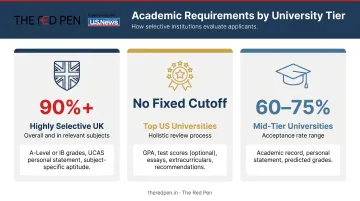
- Highly selective UK institutions: Imperial College officially requires 90% overall across five subjects and 90% in relevant subjects for CBSE/ISC applicants. Cambridge guidance references A1 grades in five relevant subjects for certain courses
- Top US universities: MIT and Michigan do not publish fixed Indian percentage cutoffs — they evaluate curriculum rigour, subject preparation, and the overall application holistically
- Mid-tier universities: Many accept 60–75%, particularly when standardised test scores and essays are strong
Subject prerequisites matter as much as overall percentages. Engineering programmes typically require four units of mathematics (including trigonometry or pre-calculus) and three units of science. Business programmes require calculus-level mathematics.
If your board percentage falls slightly short, a strong SAT score, compelling SOP, or standout extracurricular record can sometimes compensate.
Academic Documents Required
| Document | Notes |
|---|---|
| Official transcripts | From your board or school |
| Predicted grade letter | Required if applying before final results |
| Subject prerequisites proof | Maths/Science for Engineering; Calculus for Business |
| WES credential evaluation | Institution-specific; not required by all universities for Class 12 applicants |
WES evaluations are not a blanket requirement for first-year Indian applicants. Whether you need one depends on the specific university — check each institution's requirements individually.
Non-Academic Eligibility Components
Beyond academics, selective universities evaluate:
- Statement of Purpose (SOP) or personal essay
- Letters of Recommendation (LORs) from teachers or mentors
- Student CV/résumé — recommended for UG applications even when not mandatory
- Portfolio — required for Design, Architecture, and Fine Arts programmes
Conditional vs. Unconditional Offers
Many Indian students receive conditional offers based on predicted grades. These typically require meeting a minimum final board score and submitting a language proficiency test result before converting to an unconditional offer. A conditional offer only converts to confirmed admission once you submit final results and meet every stated condition — treat it as a milestone, not a finish line.
How to Apply to Foreign Universities After 12th: A Step-by-Step Guide
Start this process 12–18 months before your target intake, meaning Class 11 for a Fall intake the following year. Students beginning in Class 12 can still succeed, but every deadline becomes more urgent.
Step 1: Research and Shortlist Universities
Build a shortlist of 6–8 universities using the Dream/Target/Safety framework:
- Dream schools: aspirational picks where admit rates may be low relative to your current profile
- Target schools: strong alignment between your profile and typical admitted students
- Safety schools: reliable backups where you are a genuinely competitive applicant
This is not purely a rankings exercise. The factors that matter when choosing programmes include:
- Programme reputation in your intended field
- Annual tuition fees and available financial aid
- Campus culture and interdisciplinary flexibility
- Post-study work opportunities (OPT in the US, Graduate visa in the UK, PGWP in Canada)
- Application deadlines, specifically Early Action/Early Decision vs. Regular Decision for US universities
Application platforms by country:
- USA: Common App (used by more than 1,100 colleges worldwide), plus university-specific supplements
- UK: UCAS (up to five choices, single personal statement); UCAS application fee for 2026 is £28.95
- Canada: OUAC for Ontario universities; direct institutional applications elsewhere
- Germany: Direct university portals or uni-assist (evaluates applications for 180 German universities; fee is €75 for the first course, €30 for each additional course in the same semester)
Read each university's requirements page individually. Do not assume uniform processes across countries.
Step 2: Build a Strong Application
Provide context: your grades in their subject, key achievements, intended programme, and career direction
- Specific, personalised letters outperform generic praise every time
Step 3: Submit Applications and Respond to Offers
Before submission, work through this checklist:
- Transcripts properly labelled and formatted
- Standardised test scores sent directly from the testing body (not self-reported)
- SOP and LORs within word/character limits
- Scholarship deadlines noted separately, as these are often earlier than admission deadlines
- Application fees paid (US university fees vary; Canadian fees include University of Toronto at C$192 and UBC at C$173.25)
- Everything tracked in a single spreadsheet
After offers arrive, evaluate them carefully. Formally accept one offer and decline others promptly. Pay the enrollment deposit to secure your place. In the US, this triggers the I-20 document, your gateway to the student visa process. In the UK, your CAS number from UCAS confirmation serves the same function.
Standardised Tests and Language Proficiency Requirements
Most countries require two distinct test categories from Indian students:
- Academic aptitude tests — SAT or ACT for the US; subject-specific tests like UCAT for UK Medicine or LNAT for Law
- English language proficiency tests — IELTS, TOEFL, or PTE, required by nearly all English-medium universities globally
SAT/ACT is not required for UK, Canada, Australia, or Germany applications. Those countries assess Indian students through Class 12 marks, language test scores, and application essays.
SAT and ACT: What You Need to Know
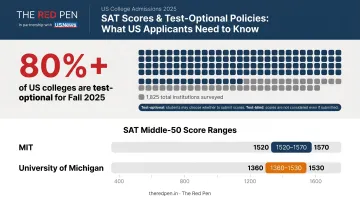
According to FairTest, over 80% of US four-year colleges were ACT/SAT-optional or test-blind for Fall 2025 — at least 1,825 institutions. Test-optional does not mean scores are irrelevant, however. At MIT, the SAT middle range for admitted students is 1520–1570; at Michigan, it is 1360–1530. A strong score still strengthens an application at competitive schools, even when submission is not mandatory.
IELTS, TOEFL, and PTE: Score Benchmarks
| University | IELTS Minimum | TOEFL iBT Minimum |
|---|---|---|
| ASU | 6.0 | 61 |
| University of Toronto | 6.5 (no band below 6.0) | 89 |
| University of Michigan | 7.0 (sections 6.5+) | ~100 |
| Cambridge | 7.5 overall, 7.0 each element | Not published |
Most undergraduate programmes require a minimum IELTS of 6.0–6.5. Top-tier institutions often expect 7.0 or above.
Keep these logistics in mind as you plan:
- IELTS and TOEFL scores are valid for 2 years from the test date
- SAT scores remain on record for 5 years, though College Board notes they may be considered less predictive after that period
- Register early — popular test centres fill up months in advance
Which Country Is Best to Study Abroad After 12th?
The right destination depends on your field of study, budget, post-graduation plans, and personal preferences. Here is a concise comparison of the most popular options for Indian students:
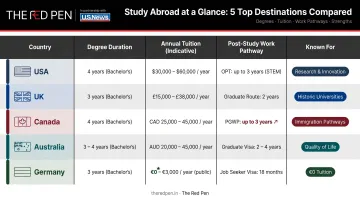
| Country | Known For | Degree Duration | Annual Tuition (Indicative) | Post-Study Work |
|---|---|---|---|---|
| USA | Technology, liberal arts, research, breadth | 4 years | USD 30,000–75,000+ | OPT (1 year) + STEM extension (24 months) |
| UK | Finance, law, accelerated degrees | 3 years (England) | GBP 11,400–38,000 | Graduate visa (2 years) |
| Canada | Immigration pathways, research | 4 years | CAD 30,000–45,000 | PGWP (up to 3 years) |
| Australia | Environmental science, business | 3–4 years | Varies by programme | Post-Higher Education Work stream (2–3 years) |
| Germany | Engineering, sciences, affordability | 3–4 years | Often €0 tuition (public universities) | 18-month job-seeker residence permit |
Intake Timing by Country
- USA: Primary Fall intake (August/September); Spring intake (January) available at many universities
- UK: September intake via UCAS; Oxford/Cambridge/Medicine deadline is 15 October 2025 for 2026 entry; most others by 14 January 2026
- Germany: Winter semester (October) and Summer semester (April); many programmes use 15 January and 15 July as common application deadlines
- Australia and Canada: Institution-specific; check individual university calendars
Total Cost of Attendance
Tuition is only part of the equation. Factor in accommodation, food, transport, and personal expenses when comparing destinations.
The gap between sticker tuition and true annual cost can be significant:
- Germany: Near-zero tuition at public universities, but living costs in major cities run EUR 900–1,200 per month
- USA: NYU's published 2026–27 cost of attendance — tuition, housing, and fees combined — reaches USD 107,748 for one year
- Canada: The recommended minimum living budget is at least CAD 23,000 per year on top of tuition fees
Germany may be the cheapest on paper, but the USA and Canada offer stronger post-study work pathways that can offset higher upfront costs. Always model the full four-year picture before deciding.
How to Fund Your Studies Abroad After 12th
Funding an international undergraduate degree typically requires combining multiple sources.
University Scholarships and Need-Blind Admissions
A small but significant group of US universities offer need-blind admissions for international students — meaning financial need does not affect the admission decision, and demonstrated need is met with institutional aid. These include:
- Harvard, MIT, Princeton, and Yale
- Dartmouth, Amherst, and Bowdoin
The Cornell Tata Scholarship, backed by a USD 25 million Tata Group endowment, supports approximately 20 Indian undergraduate scholars at any given time — one of the few merit-plus-need awards directly targeting Indian undergrad applicants at a US university.
External Scholarships for Indian Students
| Scholarship | Undergraduate Eligible? | Notes |
|---|---|---|
| Cornell Tata Scholarship | Yes | ~20 scholars at any time |
| Inlaks Scholarship | No (postgraduate) | For young Indian graduates; up to USD 120,000 |
| JN Tata Endowment | No | Master's, PhD, postdoctoral only |
| Aga Khan Foundation ISP | No | Postgraduate; 50% grant / 50% loan |
Most widely cited Indian scholarships target postgraduate study. For undergrads, institutional need-based aid at need-blind US universities and merit scholarships from specific universities are your strongest levers. One practical note: scholarship deadlines often fall before admission deadlines — confirm timelines early and treat them as separate tracks.
Education Loans
Indian banks and NBFCs offer education loans covering tuition and living expenses, with a moratorium period during the course and flexible repayment after graduation.
- SBI Global Ed-Vantage covers up to INR 3 crore for overseas education
- HDFC Credila starts at 9.95% p.a. (floating) with repayment tenure up to 15 years
- Avanse goes up to INR 1.25 crore; Base Rate 14.55% (effective 01.12.2024)
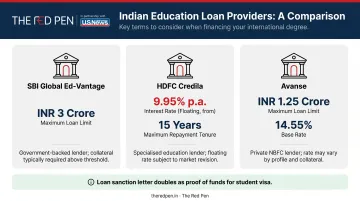
Lenders require the university admission letter, cost of attendance breakdown, and financial documents. Your loan sanction letter also serves as proof of funds for the student visa application — do not treat these processes as separate.
Is ₹20 Lakhs Enough?
Honestly, it depends entirely on the destination. For Germany's public universities (near-zero tuition, EUR 900–1,200/month living), ₹20 lakhs per year may cover a significant portion of costs. For the US or UK — where annual costs routinely exceed the equivalent of ₹35–50 lakhs — it is well short of what is needed. Always calculate the full cost of attendance for your specific target countries using current exchange rates before making a decision.
Frequently Asked Questions
How can I get a 100% scholarship to study abroad after 12th?
Full scholarships are rare but achievable — need-blind financial aid at universities like Harvard, MIT, and Princeton covers full costs for qualifying students, while select institutions offer merit-based awards. Both require exceptional academics, strong extracurriculars, and separate, earlier application deadlines than standard admissions.
Is ₹20 lakhs enough to study abroad after 12th?
₹20 lakhs per year is generally insufficient for the US or UK, where total annual costs often exceed the equivalent of ₹35–50 lakhs. It may be adequate for public universities in Germany or certain Canadian institutions when combined with scholarships. Always calculate full cost of attendance — tuition plus accommodation, living, and travel — for your specific targets.
What are the minimum 12th marks required to study abroad?
Top-ranked universities, particularly in the UK, typically expect 80–90%+ for competitive programmes like Engineering or Medicine; mid-tier institutions generally accept 60–75%. A strong SAT/ACT score, compelling SOP, and solid extracurriculars can offset a lower board percentage.
Which country is best for study abroad after 12th?
The right country depends on your priorities. The US offers academic breadth and research depth; the UK offers shorter three-year degrees; Germany offers near-zero tuition; Canada offers strong post-study immigration pathways. Let your field of study, budget, and long-term goals lead — not rankings alone.
Is SAT mandatory to study abroad after 12th from India?
SAT is relevant mainly for US applications — and even there, over 80% of colleges are now test-optional. For UK, Canada, Australia, and Germany, SAT is not required; those systems rely on Class 12 marks, IELTS/TOEFL scores, and application essays.
What documents are required to apply to foreign universities after 12th?
Core documents include: official Class 12 transcripts (or predicted grade letter), SOP/personal essay, 2–3 Letters of Recommendation, standardised test score reports (SAT/IELTS/TOEFL as applicable), a valid passport, and a student CV. Some programmes additionally require a portfolio or university-specific supplemental forms.