Introduction
Over 1.88 million Indian students are currently studying abroad, according to India's Ministry of External Affairs — a number that has grown steadily as students and families recognise the limits of competing solely within the domestic system.
The domestic landscape has no shortage of talent — only seats. With JEE Advanced 2024 data showing just 17,760 IIT seats available against 250,284 eligible candidates, many qualified students face a gap between aspiration and opportunity that the domestic system cannot close.
Studying abroad addresses that gap — but the case goes further than access. Internationally educated graduates enter the workforce with a differentiated profile: global networks, cross-cultural fluency, and hands-on experience that employers in consulting, finance, and technology increasingly factor into hiring decisions.
This guide breaks down exactly what those benefits are, what students miss without international exposure, and how to approach the decision strategically.
Key Takeaways
- India has 1.88 million students studying abroad, driven by limited domestic capacity and expanding global opportunity
- Only 17,760 IIT seats exist for 250,000+ eligible JEE candidates, making international universities a practical path to quality education
- IIE research shows 90% of study abroad alumni land their first job within 6 months, versus 49% of non-study-abroad peers
- Post-study work visas in the USA, UK, Canada, and Australia give graduates real international work experience
- Starting preparation in Grade 9 or 10 gives students a measurable edge in competitive international admissions
Studying Abroad for Indian Students: The Big Picture
The Scale of Outbound Migration
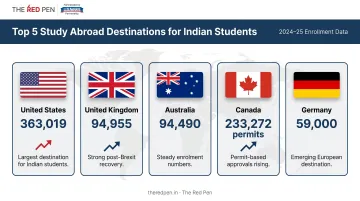
The numbers tell a clear story. As of January 2025, India's Ministry of External Affairs reported 1.88 million Indian students pursuing education abroad — up from 1.33 million in January 2024, a jump of over 40% in a single year.
The top destinations attracting Indian students include:
- USA — 363,019 Indian students in 2024/25, a 10% year-on-year increase; India remains the top sending country
- Canada — 233,272 study permits issued to Indian residents in 2023
- Australia — 94,490 Indian students in early 2026, representing 16% of all international enrolments
- UK — 94,955 Indian student entrants in 2024/25, with India as the top overseas country for the third consecutive year
- Germany — approximately 59,000 Indian students in winter 2024/25, a 20% increase, with India now the largest source country
What "Studying Abroad" Actually Means
For Indian students, studying abroad most commonly means an undergraduate programme — though postgraduate degrees also factor into the picture. Each destination carries distinct admission processes, tuition costs, scholarship ecosystems, and post-study work policies, which means the decision demands country-specific research rather than a generic shortlist.
More fundamentally, studying abroad is a strategic career decision wrapped in an academic one. The value builds from several interlocking factors:
- Degree recognition that holds weight with global employers
- International networks built across classrooms, internships, and campus life
- Cross-cultural fluency that differentiates candidates in competitive hiring markets
- Lived professional experience that accumulates over one to three years abroad
Key Benefits of Studying Abroad for Indian Students
Access to World-Class Education and Future-Ready Programmes
The Times Higher Education World University Rankings 2026 covers 2,191 institutions across 115 countries — a universe of quality far broader than what any domestic system can replicate. The destinations most popular with Indian students are home to many of the world's highest-ranked research universities.
Beyond rankings, the more practical advantage is programme depth and specialisation. International universities offer dedicated undergraduate and postgraduate programmes in fields that remain underdeveloped at India's most competitive institutions:
- Stanford University offers a dedicated B.S. in Data Science and an AI concentration within its Symbolic Systems programme
- University of Toronto has a specialist Data Science HBSc programme
- Imperial College London offers a 12-month MSc in Financial Technology (Fintech)
- Imperial also offers a one-year MSc in Environmental Technology
These are focused programmes with industry integration, research components, and alumni networks built specifically around emerging fields.
The Access Gap at Home
The domestic access problem is concrete, not theoretical.
JEE Advanced 2024 data shows:
- 250,284 JEE Main-qualified candidates were eligible for JEE Advanced
- 48,248 ultimately qualified
- Only 17,760 IIT seats were available
That is roughly one seat for every 14 qualified candidates at the final hurdle alone. For students who clear the bar academically but do not secure an IIT seat, studying abroad is often the stronger option, not a fallback.
Enhanced Career Prospects and Global Employability
An internationally recognised degree signals more than academic ability to recruiters. It signals that a candidate chose a more demanding path, navigated an unfamiliar system, and developed skills across different cultures and systems — qualities that multinational employers actively look for.
The employment data backs this up:
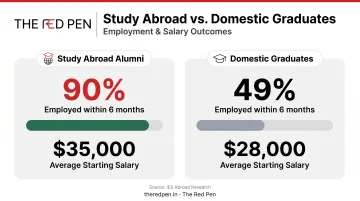
- 90% of IES Abroad alumni secured their first job within 6 months of graduation, compared to 49% of the general graduate population
- IES Abroad alumni averaged a $35,000 starting salary versus $28,000 for general US graduates — a $7,000 gap
- A QS Global Employer Survey found 60% of employers globally valued international study experience when hiring, rising to 71% in the energy sector and 64% in high technology
Post-Study Work Pathways
One of the most concrete career advantages is access to post-study work visas — structured pathways that let graduates build real international work experience without immediately returning home:
| Country | Post-Study Work Visa | Duration |
|---|---|---|
| USA | OPT (+ STEM extension) | 12 months + 24 months (STEM) |
| UK | Graduate Route Visa | 2 years (until Dec 2026) |
| Canada | Post-Graduation Work Permit (PGWP) | Up to 3 years |
| Australia | Temporary Graduate Visa (485) | 2–3 years |
| Germany | Graduate Job-Search Residence Permit | Up to 18 months |
These are not theoretical possibilities — they are official, government-backed pathways that Indian graduates actively use to build international careers before deciding where to settle long term.
Personal Growth, Independence, and Global Perspective
The career case for studying abroad is well documented. The personal development case is equally real, and in many ways more lasting.
Living abroad forces Indian students — many from structured, family-supported environments — to develop independence that simply cannot be replicated at home. Managing housing, finances, bureaucracy, and social adjustment simultaneously builds a kind of practical resilience that shows up clearly in professional settings later.
Research from the IIE supports this with specific figures. Among study abroad alumni surveyed:
- 76% reported significant development in intercultural skills
- 75.4% reported significant gains in flexibility and adaptability
- 71.8% reported increased confidence
- 76% reported greater self-awareness
A separate British Council study found that 85% of people with deep international experience were confident adapting to unfamiliar situations, and 71% felt confident communicating across cultures.
Why Classroom Diversity Matters
Studying alongside peers from 50+ nationalities — as is routine at universities like NYU (27,532 international students) or the University of Toronto (students from 175 countries) — reshapes how students think about problems, frame arguments, and collaborate under pressure. That shift goes well beyond cultural exposure.
These skills translate directly to leadership roles in global organisations, where managing diverse teams and navigating cross-cultural complexity are daily requirements.
For Indian students specifically, the language dimension matters too. Studying in an English-dominant academic environment sharpens professional communication in ways that classroom instruction alone cannot — the stakes, contexts, and audiences are genuinely different.
What Indian Students Miss Without International Exposure
The cost of skipping international education is harder to see. It builds slowly — and by the time it's visible, it's already shaping outcomes.
Competing in a Saturated Market
India's higher education system produced 1.04 crore graduates in 2021/22, according to the All India Survey on Higher Education. That is over 10 million candidates entering the workforce annually from domestic institutions — all holding broadly similar credentials and competing for overlapping roles. Without meaningful differentiation, standing out becomes increasingly difficult, particularly for roles at multinational firms or in sectors like consulting and research that actively look for international exposure.
The Networking Gap
This is perhaps the most underestimated cost. Students who stay home miss the opportunity to build an international professional network during the years when those relationships form most naturally — through dormitory conversations, group projects, campus recruiting events, and alumni communities.
The connections built during a degree abroad extend well beyond graduation. They tend to resurface as:
- Referrals into global firms and roles that never reach job boards
- Access to alumni networks spanning multiple countries and industries
- Cross-border collaborations that domestic peers simply cannot access
- Mentors who open doors to senior roles through trust, not applications
The Compounding Career Ceiling
Beyond the first job, the absence of international experience becomes a tangible barrier. Senior roles at global firms, lateral moves within multinational organisations, and graduate school admissions abroad all favour candidates with proven international exposure. For students targeting research, consulting, or technology careers, this disadvantage grows harder to reverse with each passing year.
How to Get the Most from Your Study Abroad Decision
Choosing to study abroad is only the beginning. The actual returns depend heavily on how the decision is made and how well the application is executed.
Match the Decision to Your Profile and Goals
The most common mistake is choosing a country or university based on reputation alone. The right destination depends on your academic profile, intended programme, career direction, financial situation, and post-study work priorities. A student targeting fintech has different optimal choices than one pursuing environmental science or clinical psychology.
Start Early — Much Earlier Than Most Students Do
For undergraduate applications, the preparation timeline is longer than most students realise:
- Grades 9–10: Academic planning, extracurricular development, enrichment programmes
- Grade 11: Standardised test preparation (SAT/ACT), initial college research, profile-building
- Summer before Grade 12: Essay brainstorming and draft development
- Early Grade 12: Finalise college list, prepare Early Decision applications
- October–November, Grade 12: Submit Early Decision/Early Action applications
- December–January, Grade 12: Submit Regular Decision applications
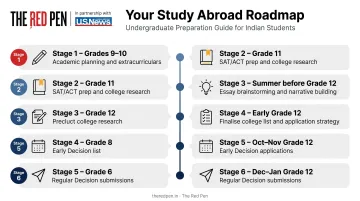
Most students leave essay writing and college list finalisation far too late. Starting in Grade 11 — ideally with a structured roadmap from Grade 9 — gives you the time to build a genuinely compelling application rather than rushing it.
Work with an Expert Who Knows the Process
International admissions processes are complex, vary by country and university, and shift year to year. Getting this right requires guidance across several areas:
- Essay strategy and narrative development
- Application sequencing and college list balance
- Scholarship and financial aid identification
- Post-submission decisions — waitlists, deferrals, and multiple offers
The Red Pen, a Mumbai-based admissions consulting firm, supports students through every stage of this process — from building a balanced college list to multi-round essay coaching and post-submission strategy. Their students have received offers from Cornell, Georgetown, Carnegie Mellon, and NYU, and the firm has helped secure over ₹50 crores in scholarships and financial aid.
Conclusion
Studying abroad gives Indian students something that is difficult to replicate at home: a combination of academic access, career differentiation, and personal development that pays dividends well beyond graduation. For students competing in one of the world's most crowded job markets, international education has shifted from an advantage to a baseline expectation in many high-growth fields.
The decision delivers the most when it is made deliberately: choosing the right country and programme for your specific goals, building a strong application with sufficient lead time, and navigating the process with informed guidance. The students who benefit most are not those who choose the most prestigious brand name — they are the ones who make the right fit decision and execute it well. That kind of clarity is exactly what The Red Pen helps students and families build — from shortlisting programmes to crafting applications that reflect who you actually are.
Frequently Asked Questions
Is it worth studying abroad for Indian students?
Yes, for most students who choose the right programme and destination. IIE research found that 90% of study abroad alumni secured their first job within 6 months, compared to 49% of domestic graduates. The financial investment is significant, but scholarships, assistantships, and post-study work opportunities improve the long-term return considerably.
Can I get a 100% scholarship to study abroad?
Fully funded scholarships do exist — Chevening (UK), Fulbright-Nehru (USA), and select DAAD programmes (Germany) are the most notable for Indian students — but competition is intense and eligibility requirements are demanding. Merit scholarships, partial funding, and teaching/research assistantships are more widely accessible and can meaningfully offset tuition and living costs.
Which countries are most popular for Indian students studying abroad?
The USA (363,000+ students), UK (94,955 entrants), Canada, Australia, and Germany are the leading destinations. Each suits different priorities:
- USA & Canada: Strong post-study work pathways, technology-focused programmes
- UK: Shorter, focused degrees (typically 3 years)
- Germany: Lower tuition costs, strong engineering programmes
- Australia: Quality education with post-graduation work flexibility
Do Indian employers value international degrees?
Yes, particularly in consulting, technology, finance, and research. Employers in these sectors actively look for candidates with international academic credentials and cross-cultural experience, and often treat international degrees from globally ranked universities as a differentiator in hiring and early career progression decisions.
What are the biggest challenges Indian students face when studying abroad?
Financial planning, cultural adjustment, and navigating complex admission processes are the most common challenges. Each responds well to early action: scholarship research from Grade 11, pre-departure cultural preparation, and structured guidance for applications all reduce the difficulty significantly.
How early should Indian students start planning to study abroad?
At minimum, 12–18 months before the target intake. For undergraduate applications, this means serious preparation should begin in Grade 11, with profile-building ideally starting in Grades 9–10. Essay drafting, college list finalisation, and Early Decision strategy all require more time than most students initially expect.