: Complete Guide](https://file-host.link/website/theredpen-ddyriq/assets/blog-images/080864ad-f22c-4869-bfd0-b81d40b5c145/1782139124482079_02f8f64d519541148649042cd448e7a5/360.webp)
The problem usually isn't ability. It's the absence of realistic practice under pressure.
A mock interview is one of the most effective tools available for closing that gap — yet most applicants either skip it entirely or treat it too casually to get real value from it. Done properly, a mock interview doesn't just reduce anxiety; it fundamentally changes how you present yourself, how you structure your thinking, and how you handle the unexpected.
This guide covers exactly how to prepare for a mock interview: what makes one effective, how to structure your practice sessions, and the most common mistakes that quietly undermine the whole exercise.
Key Takeaways
- A mock interview simulates the pressure of the real thing — value depends entirely on how seriously you treat it.
- The STAR method (Situation, Task, Action, Result) gives you a clear structure for answering behavioural questions.
- Feedback only works when it's specific, written down, and applied before your next session.
- Oxbridge, US college, and Canadian university interviews each follow distinct formats — and each demands its own preparation approach.
- The debrief is not optional — skipping it is how most candidates waste an otherwise strong session.
What Is a Mock Interview and Why Does It Matter?
A mock interview is a structured rehearsal that replicates the format, tone, and pressure of a real interview. The purpose: to practise responses, surface weaknesses, and receive honest feedback before anything is actually at stake.
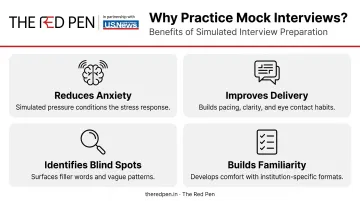
The core benefits are well-established:
- Reduces anxiety — practising under simulated pressure conditions the stress response, so nerves are less likely to derail performance on the day
- Improves delivery — candidates develop habits around pacing, clarity, and eye contact that are hard to build without an actual audience
- Identifies blind spots — an interviewer will notice patterns (filler words, vague answers, tangential responses) that candidates rarely spot in themselves
- Builds familiarity with question types and formats specific to the institution or role
The data backs this up. A 2023 study published in PMC on virtual interview training found that higher engagement with mock interview practice was associated with significantly greater odds of successful outcomes, with nine practice sessions identified as the most efficient threshold for improvement.
Why Admissions Interviews Require Specific Preparation
For university applicants targeting selective undergraduate programmes, mock interviews serve a specific purpose: demonstrating academic curiosity, personal fit, and intellectual maturity under pressure.
The stakes are real. Yale evaluates interviews for evidence of intellectual curiosity, character, and potential contribution to the community. Oxford's interviews are designed to assess academic potential and independent thinking — sometimes through unfamiliar problems students are expected to work through aloud.
That level of specificity demands preparation that goes beyond general confidence-building. For students applying to competitive US, UK, or Canadian universities, working with specialists who understand each institution's interview style makes a meaningful difference. The Red Pen offers dedicated undergraduate interview preparation, including an Oxbridge-specific service, for students who need coaching tailored to how these universities actually assess candidates.
How to Prepare for a Mock Interview: Step-by-Step
Step 1: Choose the Right Mock Interviewer
The interviewer matters more than most students realise. Someone who tells you "that was great" after every answer is not helping you prepare — they're helping you feel good.
An effective mock interviewer should:
- Ask probing follow-up questions, not just move down a list
- Be familiar with what the target institution actually looks for
- Give honest, specific feedback on content and delivery
- Push back when an answer is vague or too rehearsed
For highly competitive applications — Oxbridge, Ivy League, top Canadian programmes — a specialist with direct institutional knowledge makes a meaningful difference. The Red Pen's interview preparation, for example, is led by Namita Mehta, President and Partner, who brings deep expertise in guiding students through the distinctive formats used by Oxford, Cambridge, and other highly selective universities.
Step 2: Research the Institution Thoroughly
Before the mock session, you need to understand what you're walking into. This means researching the university's academic culture, course structure, recent initiatives, and stated values — not to drop buzzwords, but to give contextually grounded, specific answers.
Research also shapes the questions you ask the interviewer — a signal of genuine motivation that many candidates underestimate. Go in knowing:
- The course structure and any unique academic features
- Recent faculty research or departmental news relevant to your subject
- Why this institution over others with similar programmes
- One or two specific questions you'd genuinely want answered
Step 3: Set Up a Realistic Environment
Dress in the outfit you plan to wear for the real interview. Use the same video platform if the interview is online. Sit at a desk, in a quiet room, without notes visible.
If the setting is casual, the performance will be too. A realistic environment lets your mock interviewer assess and comment on the non-verbal signals that matter:
- Upright, engaged posture throughout
- Consistent eye contact (especially important for video interviews)
- Open body positioning — no crossed arms, no slouching
- Steady pacing without fidgeting or looking off-screen
Step 4: Practise Your Answers — Don't Memorise Them
With your environment set, the focus shifts to what you actually say. Prepare responses to expected question types using structured frameworks — the STAR method works well for behavioural questions — but avoid scripting word-for-word answers.
Interviewers — especially at Oxford and Cambridge — ask follow-up questions designed to probe how you think, not just what you've prepared. A memorised answer collapses the moment a tutor pushes back or redirects. Instead:
- Build 5–7 strong examples from your academic or extracurricular experience
- Know the structure of your answer, not the exact phrasing
- Practise adapting the same example to different question angles
Step 5: Record the Session and Debrief Thoroughly
Recording the session — video or audio — lets you catch what you can't notice in the moment: filler words ("um," "like," "basically"), pacing issues, or a habit of trailing off at the end of sentences.
The debrief should cover three dimensions:
- Did your examples directly answer what was asked, or did they drift?
- Was your pacing steady and your tone confident — or rushed and apologetic?
- Did each answer open clearly, build logically, and close with a specific point?
Missouri State's Career Center structures mock sessions so the critique phase runs longer than the interview itself — 30–40 minutes of feedback for a 15–20 minute session. That ratio is worth replicating: the debrief is where patterns get named and habits start to change.
Types of Questions Asked in a Mock Interview
Mock interviews draw on four distinct question types. Knowing what each one tests — and how to approach it — keeps you composed no matter which direction the conversation goes.
Behavioural Questions
These ask about past experiences to infer how you'll behave in the future: "Tell me about a time when you had to work through a difficult problem."
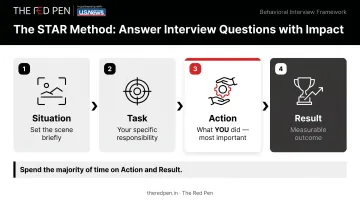
The STAR method, as outlined by MIT Career Advising, structures these answers effectively:
- Situation — set the context briefly
- Task — what was your specific responsibility?
- Action — what did you do? (this is the most important component)
- Result — what was the measurable outcome?
Strong STAR answers spend the majority of time on the Action and Result — not the setup. If you're still describing the situation at the halfway point, you've lost the balance.
Motivational and Fit Questions
"Why do you want to study History at Oxford?" or "Why this college?" — these questions are where vague answers are most damaging.
An answer that says "I've always loved literature" tells an admissions panel nothing. A strong answer references specific courses, faculty research, or programme structure that genuinely connects to your academic interests. The more specific your answer, the more credible your interest appears.
Situational and Hypothetical Questions
Oxford and Cambridge interviews frequently present unfamiliar problems — sometimes entirely outside the applicant's prior experience — and ask them to reason through it aloud. The point is not the "right" answer. It's the quality of the thinking process.
Practise mapping out your logic step-by-step, drawing on related knowledge you do have, and staying composed when the answer isn't immediately obvious.
General and Personality-Based Questions
"Tell me about yourself" and "What are your strengths and weaknesses?" assess self-awareness and communication. Prepare a focused response that highlights the 2–3 qualities most relevant to the programme you're applying to. Keep it concise — this is not an invitation to narrate your life story.
Key Variables That Determine Mock Interview Performance
Feedback Quality
Vague feedback ("you came across well!") produces vague improvement. Ask your mock interviewer to evaluate four things separately: content, delivery, structure, and non-verbal communication.
Specific critique — "your answer to the motivation question didn't reference anything about the programme itself" — gives you something to act on before the next session.
Realism of the Simulation
A low-fidelity session (casual clothes, no desk, chatting with a friend) builds some familiarity but not the composure needed for a high-stakes interview. The closer the mock session mirrors the real format, the more transferable the improvement.
Frequency and Iteration
A single session is rarely enough. Each subsequent mock interview should build on feedback from the previous one — not simply repeat the same format. Students applying for Oxbridge, scholarship panels, or MMI-format medical school interviews particularly benefit from multiple rounds spread over several weeks.
Self-Review Between Sessions
Watching yourself on video is uncomfortable. Do it anyway. It's the fastest way to notice patterns that an interviewer won't always flag explicitly, such as:
- Trailing off at the end of answers
- Over-explaining a single point
- Breaking eye contact at key moments
- Rushed pacing under pressure
Keep a written log of what you're working on between sessions so each mock builds on the last.
Common Mistakes to Avoid When Preparing for a Mock Interview
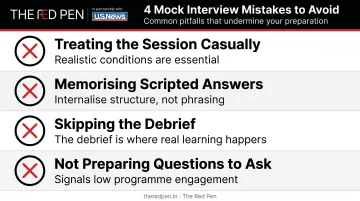
Treating the session casually — skipping the dress code, joining from a noisy room, or approaching it as a relaxed chat. The simulation only works if the conditions are realistic.
Memorising scripted answers — rehearsed responses are easy to spot and collapse the moment a follow-up pushes you off script. Internalise your examples and structure, not the phrasing.
Skipping the debrief — the interview itself is practice; the debrief is where the actual learning happens. Without a structured post-session review, most of the value of the mock interview is lost.
Not preparing questions to ask — failing to ask thoughtful questions at the end signals low engagement with the programme. Prepare two or three specific questions about the programme, culture, or coursework before the session — not after.
Frequently Asked Questions
How do I prepare for a mock interview?
Choose an interviewer who can give honest, specific feedback. Research your target institution thoroughly. Set up a realistic environment, practise using the STAR framework for behavioural questions, and review a recording of your session afterward.
What questions are asked in a mock interview?
Expect four main types: behavioural ("Tell me about a time when..."), motivational/fit ("Why this programme?"), situational or hypothetical problem-solving questions, and general personality questions like "Tell me about yourself."
What are the 5 C's of an interview?
The 5 C's describe qualities interviewers assess: Competence, Confidence, Communication, Credibility, and Character (sometimes swapped for Culture fit). It's an informal framework rather than a standardised admissions metric — but preparing thoroughly for a mock interview naturally strengthens all five.
What is the 30-60-90 rule in an interview?
It refers to a candidate's plan for what they aim to accomplish in their first 30, 60, and 90 days in a role. This is rarely relevant for standard undergraduate admissions, but can come up in scholarship panels or interviews that ask you to articulate structured goals.
How long should a mock interview last?
Roughly 45–60 minutes total: approximately 20–30 minutes for the actual Q&A simulation and the remainder for structured feedback and debrief. The Red Pen's sessions run 30 minutes of recorded mock interview followed by a 30-minute real-time feedback session.
How many mock interviews should I do before the real one?
At minimum, 2–3 sessions — with each one incorporating feedback from the last. For Oxbridge, scholarship panels, or other high-stakes formats, more sessions spaced over several weeks are advisable. One session is rarely sufficient.