Key Takeaways
- Alumni volunteers — not admissions officers — conduct Ivy League interviews, keeping them conversational, not high-stakes
- Missing an interview invitation does not hurt your application — limited alumni availability accounts for most gaps
- Brown and UPenn no longer offer standard alumni interviews; Cornell requires them only for Architecture applicants
- Generic answers sink strong candidates — specificity about professors, programmes, and campus culture is what interviewers remember
- Always prepare 4–5 questions to ask your interviewer; it demonstrates genuine interest and turns the meeting into a real dialogue
What Are Ivy League Interviews?
Getting an Ivy League interview invitation can feel both exciting and disorienting, particularly for students in India who haven't encountered the alumni interview format before.
The format itself is straightforward: a one-on-one conversation lasting 30 to 60 minutes, conducted by a volunteer alumnus or alumna (not an admissions officer), typically over Zoom, by phone, or occasionally in person.
After the meeting, your interviewer writes a brief report that gets added to your application file. What they don't do is make an acceptance or rejection recommendation — that call stays with the admissions committee.
What's the Purpose?
The interview serves two directions at once. The school gets a fuller sense of who you are beyond your grades and test scores. You get an unfiltered view of campus life from someone who actually lived it.
There are no trick questions and no single correct answer. It's a real conversation: you talk about your interests and experiences, and your interviewer shares what life at their school was actually like.
How Much Do Ivy League Interviews Actually Matter?
Across the board, the 2024–25 Common Data Sets list interviews as "Considered" , placing them below categories like "Very Important" or "Important." That said, the weight varies by school. Here's the current picture:
| School | Current Interview Format | Weight |
|---|---|---|
| Harvard | Alumni interview, assigned at admissions committee discretion; cannot be requested | Considered |
| Yale | Limited invitations after application; alumni or Yale student interviewers, virtual available | Considered |
| Princeton | Optional alumni interview post-application; virtual or in-person | Considered |
| Dartmouth | Alumni interview may be offered after application; phone/video and in-person available | Considered |
| Columbia | No alumni interviews — discontinued for the 2023–24 cycle | N/A |
| UPenn | No longer offers alumni conversations as part of the application process | N/A |
| Brown | No alumni interviews since 2019–20; optional video introduction (up to 90 seconds) instead | N/A |
| Cornell | No general alumni interviews; video interview required only for Architecture (B.Arch) applicants | N/A (general) |
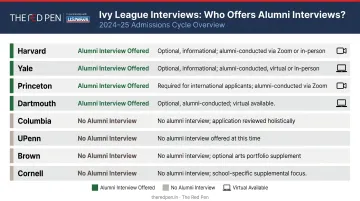
For students in India: Harvard explicitly confirms that not receiving an interview invitation will not hurt your application. Yale echoes this, stating that many successful applicants are never interviewed. Don't read into a missing invitation.
The good news is that Harvard, Yale, Princeton, and Dartmouth all offer virtual interviews, so students in Mumbai, Chennai, or Jaipur can participate without boarding a flight.
How to Prepare for Your Ivy League Interview
Research the School Before You Log On
Surface-level research won't survive a conversation with someone who spent four years on that campus. Go beyond the admissions website:
- Identify specific professors whose research connects to your academic interests
- Find courses or programmes that don't exist at comparable universities
- Look up student organisations, research labs, or campus traditions that genuinely appeal to you
- Re-read your own application essays — the interviewer likely hasn't seen them, but be ready to expand on what you wrote without simply reciting it
The goal is to answer "Why this school?" with particulars, not platitudes.
Practice Out Loud — Not Just in Your Head
Running through answers mentally and articulating them clearly in real time are very different skills. Rehearse with a parent, friend, or mentor. Record yourself once to check pace and filler words.
The target is fluency, not a memorised script. Interviewers notice when answers sound rehearsed, and it undercuts the conversational tone the format is built around.
If you want structured support, The Red Pen's interview coaching offers recorded mock sessions with real-time one-on-one feedback and a written review from a senior consultant. The undergraduate interview preparation (₹25,000 for non-Oxbridge universities) is available as a standalone service — no full consulting package required.
Get the Virtual Setup Right
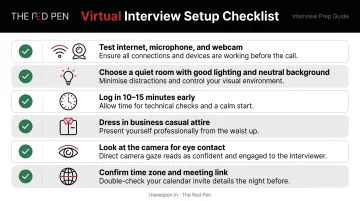
Technical glitches are avoidable with advance preparation. Run through this checklist at least 24 hours before your interview:
- Test your internet connection, microphone, and webcam
- Choose a quiet room with good lighting and a neutral background
- Log in 10–15 minutes early on the day
- Dress neatly — business casual is appropriate even on video
- Look at the camera, not at your own face on screen, to simulate natural eye contact
- If your interviewer is based abroad, confirm the time zone and double-check the meeting link in advance
Common Ivy League Interview Questions
There's no official standardised question list — Yale's admissions office describes the interview as a conversation focused on ideas, intellectual curiosity, character, and values, not a structured exam. That said, certain themes come up consistently across schools. Treat each question as an invitation to share something meaningful about yourself.
Academic Interest and Career Questions
"What are you interested in studying, and why?" This is where vague answers hurt you most. "I'm interested in economics" tells an interviewer very little. A stronger answer connects your subject to a real moment — a book that changed how you think, a project you couldn't stop working on, a problem you noticed in your community. Take the interviewer through the specific experience that sparked your interest, not just the subject itself.
"Where do you see yourself in 10 years?" Interviewers aren't expecting a perfectly mapped career plan. They want to see that you've thought seriously about your direction. It's entirely acceptable to express some uncertainty, as long as your answer reflects genuine curiosity and a sense of direction.
Personal Background and Character Questions
"Tell me about yourself." Don't answer in one sentence. This is your opportunity to give context — where you grew up, what shaped your perspective, what drives you. Speak with energy. The interviewer is building a mental picture of who you are, not collecting a résumé summary.
"What accomplishment are you most proud of?" Go beyond describing what happened. Connect the achievement to a specific insight — something you learned about yourself, or a value it clarified. An answer that shows reflection will land far better than one that simply recounts success.
"Tell me about a challenge you faced and how you overcame it." Walk through the situation plainly: what the challenge was, what you actually did, and what changed in how you think or act as a result. Avoid challenges that are really thinly veiled achievements — choose something where the difficulty was real and the growth was genuine.
School-Specific Fit Questions
"Why [this school]?" This is one of the most important questions in the interview. Generic answers — "because it's the best," "because of its reputation" — are red flags. Name a specific professor whose work interests you. Reference a programme that only exists at that school. Mention a student organisation you'd want to join. The more specific, the more credible.
"What would you contribute to our campus community?" Reframe this as an opportunity, not a pressure test. Reference specific clubs, research opportunities, or initiatives at that school, and explain how your skills or perspective would add to them — not just benefit from them.
Questions to Ask Your Interviewer
Asking thoughtful questions at the end of an interview does two things: it signals genuine interest in the school, and it turns a one-sided evaluation into an actual conversation. These are the kinds of questions only someone who actually attended the school can answer:
- What did you enjoy most about your time at [school]?
- What opportunities do you wish you had taken advantage of?
- What traits do you think help students thrive here?
- What has surprised you most about how your time there shaped your career?
- What advice would you give an incoming first-year student?
Use these as a foundation — adapt them based on what you already know about the school or what came up naturally in the conversation. Avoid anything whose answer is on the university's website. Asking about acceptance rates or tuition signals a lack of preparation. The best questions are ones only an insider can answer.
Frequently Asked Questions
Are there interviews for Ivy League schools?
Most Ivy League schools offer alumni interviews, but they're generally optional and not guaranteed. Availability depends on how many volunteer alumni are in your region. Not receiving an invitation carries no penalty — Harvard, Yale, and Princeton all confirm this explicitly.
What are the five hardest interview questions?
The five most commonly challenging questions are: "Why this school?", "Tell me about a failure or challenge," "What would you contribute to this campus?", "Who is your role model and why?", and "Where do you see yourself in 10 years?" Honest self-reflection and specific examples will serve you better than any scripted answer.
Do Ivy League interviews affect admissions decisions?
Interviews are generally listed as "Considered" — one component among many. The alumni report adds to your file, but grades, essays, recommendations, and activities carry more weight. A strong interview supports your application; a weak one rarely defines it.
Who conducts Ivy League interviews?
Volunteer alumni — not admissions officers — run these conversations. They share their impressions in a written report but don't make acceptance or rejection recommendations; Harvard alone coordinates nearly 10,000 such volunteers globally.
Should I send a thank-you note after my Ivy League interview?
Yes — a brief, sincere email within 24 hours is the right move. Reference something specific from your conversation to make it personal. Interviewers appreciate the follow-through, and it reinforces your interest.
Can students in India receive Ivy League interviews?
Virtual interviews have made the process accessible to international students, including those in India. Harvard, Yale, Princeton, and Dartmouth all conduct video or phone interviews, so geography is rarely a barrier to receiving or accepting an invitation.