This guide covers everything you need to know: what the interview is, how it works, the questions you'll likely face, how to prepare, and what happens after.
Key Takeaways
- Your interviewer only sees your name, contact info, and high school — not your essays, grades, or test scores
- Not receiving an interview invitation is not a red flag; it simply reflects alumni availability in your region
- Expect a 60-minute conversation — the format is informal, not a formal evaluation
- Strong answers are specific and personal — not scripted or generic
- From 2025–26, interviewers cannot reference race, ethnicity, or national origin in their written reports
What Is the Harvard Alumni Interview?
The Harvard alumni interview is conducted entirely by volunteer alumni — not admissions officers. According to Harvard College, nearly 10,000 alumni volunteers help recruit students from all 50 states and around the world. The person interviewing you attended Harvard; they are not employed by the admissions office and have no authority to admit or reject anyone.
What the Interviewer Actually Knows About You
This is the detail most applicants miss: your interviewer has not read your application. Harvard gives them only your name, contact information, and the name of your high school. Everything else — your essays, test scores, grades, and activities list — is unknown to them:
- Essays and personal statements
- Standardized test scores
- Academic grades and transcripts
- Extracurricular activities list
That changes the dynamic entirely. The interview isn't a chance to defend your application — it's a fresh introduction.
Is the Interview Optional?
Technically, yes. Harvard states that your application is considered complete without an interview and will receive a full evaluation regardless.
But if you're invited, accepting is strongly advisable. Skipping it means missing out on one of the few chances to add a human dimension to your application.
Not receiving an invitation carries no negative signal. Most regions simply don't have enough alumni interviewers to cover every applicant — it's a staffing limitation, not a reflection of your candidacy.
How the Harvard Alumni Interview Process Works
Scheduling and Format
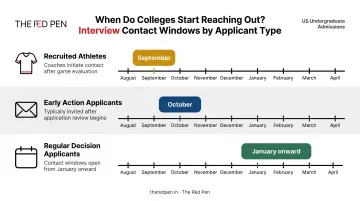
Interview timing varies by application type:
- Recruited athletes — typically contacted in September
- Early Action applicants — contacted in October
- Regular Decision applicants — contacted from January onward
The interviewer will reach out by personal email or phone. Harvard offers three accepted formats: in-person, video (Zoom or similar), or phone. The choice depends on your location, the interviewer's preference, and logistical factors.
If you want to verify that your interviewer is genuinely affiliated with Harvard's College Interviewing Program, you can contact the admissions office directly at 617-495-1551 or college@fas.harvard.edu.
What to Expect During the Interview
Plan for roughly 60 minutes, though conversations can run shorter or longer. The tone is relaxed and exploratory — closer to a mentorship conversation than a formal panel interview. Expect questions across a few broad areas:
- Academic interests and intellectual curiosity
- Life outside the classroom (activities, hobbies, passions)
- Goals, aspirations, and what drives you
- Personality and how you think about the world
There are no trick questions or stress tests.
The 2025–26 Policy Change You Should Know
Following the Supreme Court's 2023 ruling in SFFA v. Harvard, Harvard instructed alumni interviewers not to reference an applicant's race, ethnicity, or national origin in their written reports. The Harvard Crimson reported in October 2025 that the updated interviewer handbook explicitly bars these references — and that if a report includes prohibited information, Harvard removes it from the file and seeks a second interview.
For applicants, the practical approach stays the same: speak freely about your experiences, communities, and activities. Your interviewer will capture the essence of your conversation in their report — the policy shapes how they write it up, not what you share.
Harvard Alumni Interview: Common Questions and How to Answer Them
No two interviews follow an identical script, but certain themes appear consistently. The goal here isn't to memorise answers — it's to think in advance about what you genuinely want to communicate.
Academic Interests and Intellectual Curiosity
Typical question: "What are you potentially interested in studying?" or "What's an idea or subject you've been obsessing over recently?"
Harvard isn't looking for a polished five-year plan. They want to see that you engage with ideas beyond what's required of you. The best answers:
- Name a specific subject, not a broad field ("the economics of informal labour markets" beats "economics")
- Connect it to something you've actually done — a course, a project, a rabbit hole of reading
- Show genuine enthusiasm without over-explaining
Challenges and Growth
Typical question: "Tell me about a challenge you faced and how you overcame it."
The interviewer cares less about how dramatic the obstacle was and more about what your response reveals about your character. Choose a challenge that led to real reflection — where you changed your thinking or behaviour, not just one where you powered through.
Avoid challenges that are primarily about impressive results. The most compelling story is the one where you struggled and learned something uncomfortable — not the one where everything worked out neatly.
Extracurricular Activities and Passions
Typical question: "What do you do outside of school?" or "What activity means the most to you and why?"
Don't list activities. Pick one or two and go deep — what have you built, learned, or changed your mind about because of this?
An interviewer who hears "I've been doing robotics for four years" is less engaged than one who hears "I've been trying to solve this specific mechanical problem for four years, and I finally understood why my first approach was wrong."
Books, Media, and Intellectual Life
Typical question: "What's the best book you've read recently?" or "What's something — a podcast, article, documentary — that made you think differently?"
This question is really about how you think, not what you've read. Give a specific title, your honest reaction, and connect it to a larger idea you're curious about. A strong answer covers three things:
- The specific title and a genuine (not performed) reaction
- One idea it sparked or challenged in your thinking
- A connection to something else you care about
Avoid "safe" choices selected to impress — a thoughtful take on a lesser-known book beats a rehearsed answer about a famous one.
Values and People Who Inspire
Typical question: "Who do you admire and why?"
Pick someone authentic to your worldview. It doesn't have to be a famous figure — a family member, teacher, or local professional often makes for a more memorable answer than a predictable historical figure. What the interviewer is listening for:
- A specific quality (not "they're inspiring" or "they work hard")
- How that quality has concretely shaped your own choices or outlook
What matters is that the connection feels real, not rehearsed.
Aspirations and Harvard Fit
Typical question: "How do you envision your college experience?" or "Why Harvard?"
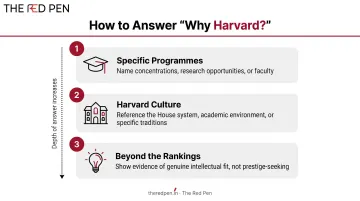
This is where preparation pays off. Interviewers notice immediately when an applicant is reciting a Wikipedia-level answer about Harvard being prestigious. What they want to hear:
- Specific programmes, concentrations, or research opportunities that genuinely interest you
- How Harvard's House system, academic culture, or particular faculty connects to what you want to explore
- Evidence that you've thought beyond the rankings — and beyond the name
Questions to Ask Your Harvard Interviewer
Your interviewer attended Harvard. They have lived the experience you're applying for — and that makes them one of the most useful people you'll speak to during this process. Coming prepared with 2–3 thoughtful questions signals genuine curiosity and gives the conversation real momentum.
Strong questions to consider:
- What aspect of your Harvard experience has most shaped who you are professionally or personally?
- What do you wish you had known before your first year?
- How has the Harvard alumni network influenced your career trajectory?
- Was there a course or professor who genuinely changed how you think?
Avoid questions easily answered on the Harvard website. Asking about application deadlines, financial aid processes, or general campus facts signals you haven't done basic research — and wastes the limited time you have with someone who can offer far more.
Listen carefully to the answers. The best interviews evolve organically — your follow-up to their response often matters more than the next prepared question on your list.
How to Prepare for Your Harvard Alumni Interview
Research Beyond the Admissions Page
Go deeper than the standard admissions website. Look into specific academic concentrations, ongoing faculty research, student organisations, and Harvard traditions that interest you. If you can mention a specific professor's research area or a particular House culture that appeals to you, your answers will sound grounded rather than generic.
Practise Out Loud
Reading about the interview format is not the same as experiencing it. Practise with a friend, family member, or education counsellor who can push back on vague answers and help you get comfortable with open-ended questions.
For students in India who are more accustomed to structured academic assessments than open-ended dialogue, this kind of practice is especially valuable. The Red Pen's interview preparation service (starting at ₹25,000) includes recorded mock sessions with real-time feedback and detailed written reviews from senior consultants, tailored to help Indian applicants adapt to the conversational format US alumni interviewers use.
Logistics for Virtual Interviews
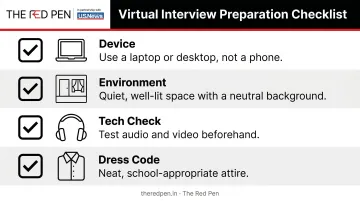
If your interview is online:
- Use a laptop or desktop, not a phone
- Find a quiet, well-lit space with a neutral background
- Test your audio and video beforehand
- Dress neatly — think school-appropriate, not formal
For in-person interviews, the same dress standard applies — and aim to arrive at least ten minutes early so you're settled before the conversation begins.
What Happens After the Harvard Alumni Interview
After the conversation ends, your interviewer submits a written report to the admissions committee. Based on a 2019 federal court finding in the Harvard admissions case, this report includes numerical ratings across academic, personal, and overall categories — not just a narrative summary.
Here's what that report means for your application:
- The interviewer has no admission authority. Their report is one input among many in a broader review.
- An imperfect interview rarely decides outcomes. Harvard's own student-facing guidance states the interview is "only one part of many" and "will never make or break your application."
- Strong applications are strengthened by strong interviews — but the interview cannot compensate for significant weaknesses elsewhere, nor will it single-handedly override a compelling written application.
Once you're done, resist the urge to replay every answer. The report is already submitted — your energy is better spent on any remaining application components, such as final essays or supplemental materials that are still within your control.
Frequently Asked Questions
Do all Harvard applicants get an alumni interview?
No. Interview availability depends entirely on how many alumni volunteers are based in your region. Harvard acknowledges that most regions don't have capacity to interview every applicant. Not being interviewed carries no negative weight on your application.
How do you become a Harvard alumni interviewer?
Harvard College alumni can volunteer through the College Interviewing Program by contacting the admissions office or via the Harvard Alumni Association portal. Volunteers must hold a degree from Harvard University — certificates from executive education or leadership programmes don't qualify.
How long is the Harvard alumni interview?
The typical interview runs about 60 minutes, though some run shorter or longer given the conversational format. Avoid scheduling anything immediately after — conversations can extend when things go well.
Does the Harvard alumni interview affect admission chances?
The interview contributes to your review but isn't the deciding factor on its own. A strong conversation adds a personal dimension to an already competitive application — it won't compensate for major gaps, but it can meaningfully reinforce a profile that's already compelling.
What should I wear to a Harvard alumni interview?
Dress neatly — think what you'd wear to a school presentation or a parent-teacher meeting, not a formal event. For virtual interviews, ensure your background is clean and your lighting is adequate. When in doubt, err slightly more formal — it's easier to recover from being a little overdressed than visibly underprepared.