Introduction
Harvard's acceptance rate for the Class of 2029 was 4.18% — meaning fewer than 5 in every 100 applicants received an offer. At that level of competition, every component of your application matters, including the alumni interview.
Many students underestimate this conversation. They over-prepare scripted answers expecting a formal interrogation — then freeze the moment the interviewer steers things somewhere unexpected. Harvard's alumni interview is conversational by design. It's meant to reveal the person the application can't fully show.
This guide covers what Indian applicants actually need: how the interview works, the questions alumni ask most often, model answer frameworks, the harder questions that trip students up, and how to prepare without sounding rehearsed.
Key Takeaways
- Harvard alumni interviewers only receive your name, contact details, and school name — not your application
- The interview is one part of many and will never single-handedly make or break your admission
- Specificity wins: a named book, a real project, a concrete moment always outperforms a vague answer
- Prepare 3–4 questions to ask your interviewer; it shows genuine curiosity about the school, not just politeness
- Skipping an interview (or not being offered one) carries no penalty in the admissions process
What Is the Harvard Interview? Format, Process, and What to Expect
Who Conducts It
Harvard alumni interviews are conducted by volunteer graduates — nearly 10,000 alumni volunteers globally, not admissions officers. Your interviewer receives only your name, contact information, and high school name. They never see your essays, grades, or test scores.
The interview isn't a review of your application — it's a fresh introduction where you control what the interviewer learns about you.
The Format
- Duration: Approximately one hour, though this varies by conversation
- Setting: In-person, over Zoom, or by phone — depending on alumni availability in your area
- Tone: Deliberately informal. Harvard's own guidance describes it as a conversation with an alumnus, not an evaluation panel
Interviewers submit a written report to the admissions committee after your meeting. That report includes ratings across personal, extracurricular, and academic dimensions — though Harvard's Crimson reporting notes that written comments carry more weight than numerical scores.
How Much Does It Matter?
Harvard states the interview will "never make or break" the application. For strong or weak applications, it rarely changes the outcome. Where it matters most is for borderline cases — a compelling interview report can tip the decision when everything else is close.
One important note for Indian applicants: not receiving an interview is not a negative signal. Harvard's international FAQ states that the absence of an interview will not adversely affect your candidacy. Interview availability depends entirely on alumni presence in your area.
Common Harvard Interview Questions and Model Answers
Academics and Intellectual Curiosity
"What are you potentially interested in studying?"
This question isn't asking you to declare a major. It's testing whether you've pursued a subject with genuine depth. Harvard wants students who have already followed their curiosity somewhere specific.
Model answer framework:
- Name the subject clearly
- Describe how that interest developed — a specific class, project, or experience
- Connect it to a future goal or question you want to explore
Avoid saying "I'm not sure" without following it with genuine intellectual curiosity. Uncertainty is acceptable — a complete lack of engagement is not. Show that you've thought about ideas beyond the syllabus, even if your direction isn't fully formed.
"What was your favourite book you've read recently?"
The interviewer isn't testing your literary taste. They want to see how you think — what moves you, what you carry forward from what you read.
Model answer framework:
- Title + one-sentence summary
- Why it resonated personally (not just "it was well-written")
- One idea or question it left you with
Don't choose a classic you think sounds impressive if you can't speak about it with genuine enthusiasm. A lesser-known book you loved is far more compelling than Crime and Punishment delivered flatly.
Extracurriculars and Identity
"What do you do outside the classroom?"
This is not an invitation to recite your activity list. Alumni interviewers find that exhausting, and it tells them nothing about who you actually are.
Model answer framework:
- Choose one or two activities that genuinely matter to you
- Explain why they matter — what drives your involvement
- Share what you've learned or how you've grown through them
Authenticity over impressiveness. A student who runs a small science club and can articulate exactly why it matters to them will leave a stronger impression than someone with ten activities and no real connection to any of them.
"Tell me about a challenge you faced and how you overcame it."
This question tests resilience and, more importantly, self-awareness. The "what I learned" element is what alumni find most revealing.
Model answer framework:
- Briefly describe the obstacle — academic, personal, or extracurricular
- Explain the concrete steps you took to address it
- Articulate clearly what it taught you about yourself
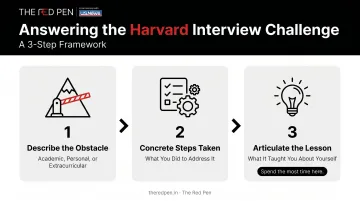
Keep the challenge section brief. Spend the most time on your response and your reflection.
Character and Values
"Who do you admire and why?"
This is a values question. The person you choose reveals what qualities you prize — and aspire to.
Model answer framework:
- Name a specific person (not a generic historical figure recited by rote)
- Identify 2–3 concrete qualities you admire
- Connect those qualities to your own goals or actions
A parent, teacher, or community figure can be just as powerful as a famous name — sometimes more so, because it's personal and specific. The strongest answers don't just describe who someone is — they explain how that person shaped how you think or act. That connection is what the interviewer is actually listening for.
Harder Harvard Interview Questions You Should Be Ready For
"Why Harvard specifically?"
This is one of the most important questions and the one most poorly answered. Saying "Harvard has great academics and amazing opportunities" is not an answer — it applies to 50 universities and signals you haven't done your research.
What a strong answer looks like:
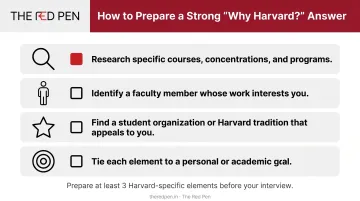
- Reference specific programs, courses, concentrations, or research opportunities you've explored
- Name a professor whose work interests you, a student organisation you'd want to join, or a Harvard tradition that genuinely appeals to you
- Tie it to a specific personal or academic goal
Prepare at least three Harvard-specific elements before your interview. Read the Harvard Crimson, explore the course catalogue, look up faculty in your area of interest. That specificity is what separates a memorable answer from a forgettable one.
"What would you contribute to the Harvard community?"
This question asks you to think beyond your own goals. What do you bring to others?
Model answer framework:
- Identify a unique skill, perspective, or experience you have
- Connect it to a gap, conversation, or community at Harvard — a specific club, academic community, or lived perspective that would be enriched by your presence
Avoid generic answers like "I'd bring diversity." That says nothing. The answer needs specificity: what kind of diversity, expressed how, contributing where.
"What do you believe that most people disagree with?"
Alumni ask this to test intellectual confidence and independent thinking — not to hear something provocative. It's to demonstrate that you can form and defend a clear, reasoned position on something you genuinely care about.
How to prepare:
- Identify 2–3 topics you have real, considered views on
- Practice articulating your position clearly and then explaining your reasoning
- Be willing to engage with a counterargument without crumbling or getting defensive
Pick a topic you've genuinely wrestled with — something where your position emerged from experience or reading, not from wanting to sound interesting.
"Is there anything in your application you'd like to clarify or add?"
This question catches students off guard because it sounds easy. Most students say "no, I think my application covers everything" — which is a missed opportunity.
Use this moment to:
- Add genuine context the application doesn't explain (a grade dip, a late-discovered passion, a family circumstance)
- Reinforce a theme you want the interviewer to remember
- Introduce a recent development that happened after you submitted
Prepare one or two points in advance so you're ready to speak to them naturally rather than scrambling in the moment.
Questions to Ask Your Harvard Interviewer
Harvard's own guidance states that applicants should ask questions they cannot answer from the website. Questions about majors, campus size, or application deadlines signal that you haven't done basic research.
Strong questions to adapt:
- "What aspect of your Harvard experience has had the most lasting impact on your career?"
- "What surprised you most about life at Harvard as a student?"
- "How did Harvard shape the way you think or approach problems?"
- "What advice would you give an incoming first-year student?"
- "Is there anything about Harvard you wish you'd taken more advantage of while you were there?"
These questions can only be answered by someone who lived the experience — and that's precisely what transforms a formal evaluation into a real conversation.
How to Prepare for Your Harvard Interview
Practice Out Loud
Most students prepare by thinking through their answers mentally. Then they sit down across from an interviewer and discover that articulating thoughts aloud is a completely different skill.
Conduct at least 2–3 mock interviews with a parent, teacher, or mentor who asks follow-up questions — not just reads from a list. Follow-up questions are where most students struggle, because they've rehearsed a script that only covers the first layer.
Working with an experienced counsellor — someone who knows how Harvard alumni interviewers think — can close that gap quickly. The Red Pen's interview preparation service offers recorded mock sessions with written feedback, covering both virtual and in-person formats, so students practise the way they'll actually be tested.
Know Your Own Story
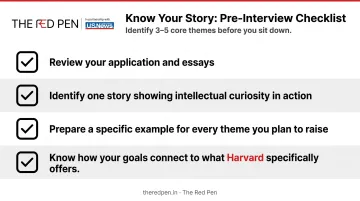
Harvard interviews reward students who have a clear, coherent narrative about who they are and where they're going. Before your interview, identify 3–5 core themes or stories you want the interviewer to remember. Then practise weaving them in naturally — not by forcing a pre-planned answer, but by knowing your material well enough to find the opening when it appears.
A few ways to sharpen your narrative before the interview:
- Review your application and essays — your interviewer may have read them
- Identify one story that shows intellectual curiosity in action
- Prepare a specific example for any theme you plan to raise
- Know how your goals connect to what Harvard specifically offers
Research Harvard Deeply and Specifically
Go beyond the homepage. Read the Harvard Crimson, look up faculty in your field of interest, explore student organisations, and note any recent developments at the university. This research is what separates a compelling "Why Harvard?" answer from a forgettable one — and it makes your responses feel anchored in real knowledge of the school, not borrowed from a brochure.
Practical Logistics
- Dress smart-casual — not formal, not casual
- Log in or arrive a few minutes early
- For virtual interviews: test your audio and video in advance, choose a quiet and well-lit space
- Don't memorise scripts. Harvard's own student guidance puts it directly: "Harvard does not accept robots yet."
Harvard Interview Mistakes That Can Cost You
Giving Vague or Generic Answers
"I'm passionate about making a difference" is not an answer. Specificity is what makes a response memorable — a named book, a real project, a concrete moment. Vague answers leave no impression at all.
Treating the Interview as a One-Way Performance
Students who deliver polished monologues without engaging with the interviewer miss the point entirely. The Harvard interview is a conversation. Listen carefully, follow up on what the interviewer shares, and show genuine curiosity about their experience. Alumni specifically note this kind of engagement in their reports.
Underselling Yourself Out of Modesty
Many students from Indian academic backgrounds downplay personal achievements — softening accomplishments or attributing success to luck or circumstance. In the Harvard interview, speaking confidently about what you've done is both appropriate and expected.
The key distinction is grounding your achievements in genuine reflection rather than boasting. What did you learn? What would you do differently? Those questions show self-awareness and make your accomplishments land with far more weight.
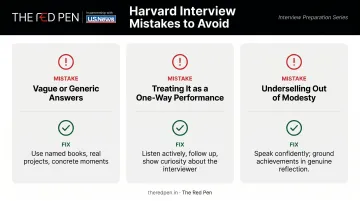
Avoiding these three mistakes won't just make you sound polished — it'll make you sound like someone worth admitting.
Frequently Asked Questions
What are the 5 hardest Harvard interview questions?
The toughest questions are "Why Harvard specifically?", "What would you contribute to the community?", "What do you believe that most people disagree with?", "What is your biggest weakness?", and "Is there anything in your application you'd like to clarify?" Each requires genuine self-awareness and Harvard-specific research — rehearsed answers rarely survive follow-up.
What are the 7 most common Harvard interview questions?
The most frequently asked questions are: tell me about yourself, what do you want to study, what do you do outside school, describe a challenge you overcame, who do you admire, what's your favorite book, and why Harvard.
Is a Harvard interview a good sign?
Receiving an interview is a positive signal, but not a guarantee of admission. Interviews are offered based on alumni availability in your area, and students who don't receive one are not at any disadvantage — Harvard confirms this directly.
Does everyone get a Harvard interview?
No. Harvard has nearly 10,000 alumni volunteer interviewers globally, but availability varies by location. Not all applicants receive an interview, and the absence of one does not affect your application negatively.
How long is the Harvard interview?
Harvard interviews typically last approximately one hour. They're designed as relaxed, informal conversations, though the actual duration varies depending on the flow of discussion.
Can international students from India get a Harvard interview?
Yes. Harvard has alumni clubs and contacts across India, including in Mumbai, New Delhi, Chennai, and Bengaluru. Indian applicants can and do receive interview invitations, though availability depends on alumni presence in your specific area.