Introduction
Harvard received 47,893 applications for the Class of 2029 and admitted just 2,003 students — an acceptance rate of roughly 4.18%. Behind those numbers is a brutal reality: a strong academic profile gets you into the conversation, but the supplemental essays are where most applicants lose ground.
Unlike the Common App personal statement, Harvard's five supplemental prompts are tightly scoped — 150 words each, with no room for warm-up or filler. Each prompt targets something your grades and test scores cannot show — how you think, what you've lived through, and what you'd actually bring to campus.
This guide walks through all five of Harvard's 2025-26 supplemental prompts: their exact wording, what each one is really testing, how to approach each strategically, and the mistakes that cost applicants.
Key Takeaways
- Harvard requires five supplemental short-answer essays, each capped at 150 words
- Treat the five responses as a portfolio — each must reveal something new, not repeat what's elsewhere
- Harvard wants to see self-awareness, genuine curiosity, and a clear sense of how you'll contribute to its community
- Specificity wins — concrete details and real moments separate memorable responses from forgettable ones
What Are Harvard's 2025-26 Supplemental Essay Prompts?
Harvard's official FAQ confirms five required short-answer questions, each with a 150-word limit. All first-year applicants — domestic and international — submit the same prompts via the Common Application.
Here are the exact prompts:
- Diversity and Contribution: "Harvard has long recognised the importance of enrolling a student body with a diversity of perspectives and experiences. How will the life experiences that shaped who you are today enable you to contribute to Harvard?"
- Disagreement and Dialogue: "Describe a time when you strongly disagreed with someone about an idea or issue. How did you communicate or engage with this person? What did you learn from this experience?"
- Extracurricular or Formative Experience: "Briefly describe any of your extracurricular activities, employment experience, travel, or family responsibilities that have shaped who you are."
- Future Use of Harvard Education: "How do you hope to use your Harvard education in the future?"
- Roommate Essay: "Top 3 things your roommates might like to know about you."
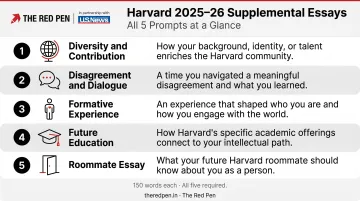
Harvard's Application Tips page describes these prompts as tools to understand how applicants' life experiences shaped them, how they will engage with others at Harvard, and what their aspirations look like. No single response exists in isolation; admissions readers see all five together, alongside your Common App personal statement.
How to Write Each Harvard Supplemental Essay
Prompt 1: Diversity and Contribution
This essay has two distinct jobs. First, ground your response in a specific identity, community, or lived experience. Second, connect it to a concrete contribution you will make at Harvard. Writers who only do one or the other leave the essay unfinished.
"Diversity" here is broader than race or ethnicity. The prompt asks about life experiences and perspectives — which can mean geographic background, family circumstance, a first-generation story, an unusual interest, or an economic reality that shaped how you see the world.
Structure to aim for:
- First half (~70 words): one vivid, specific detail from the experience itself
- Second half (~70 words): a forward-looking contribution — ideally naming a Harvard student organisation, initiative, or research community that connects to that experience
Naming a specific Harvard group or programme signals that you have done real research, not just reflected on your background. The response will fall flat without the contribution element — even a strong reflection on identity becomes incomplete without the "so what at Harvard?" half.
Prompt 2: Disagreement and Dialogue
Harvard is not asking whether you won an argument. It is testing intellectual maturity — specifically, your ability to hold a genuine disagreement without becoming dismissive, and to grow from the encounter.
Where to spend your 150 words:
- Very briefly establish the disagreement (2–3 sentences maximum)
- Spend the majority on how you engaged — what did you actually say or do?
- Close with a genuine, specific lesson learned
The most common mistake here is writing a response that reads as "I was right, they came around." Admissions officers are looking for open-mindedness, not a win. Harvard's own language around open inquiry emphasises the ability to engage opposing viewpoints with curiosity and empathy — that is the quality being assessed.
Avoid two traps:
- Picking a trivial disagreement (a minor classroom debate) that undersells your capacity for real intellectual engagement
- Coming across as self-righteous or dismissive of the other person's perspective
Prompt 3: Extracurricular or Formative Experience
The key phrase is "shaped who you are" — not "what you did." This is not a resume entry. Harvard wants to understand the personal transformation or insight the experience produced, not a description of the activity itself.
A few practical decisions to make before you write:
- Pick something not already covered in depth elsewhere. If your Common App personal statement is about competitive swimming, this prompt needs to draw on a different experience entirely.
- The activity does not need to sound impressive. A family responsibility, a part-time job, or caring for a sibling can carry far more emotional weight than a prestigious internship — if the personal depth is real.
- Open with a moment, not a summary. Drop the reader into a specific scene. One concrete detail does more work than two sentences of background.
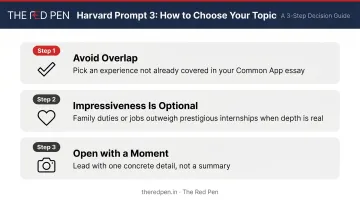
Choose the experience that changed how you think — not the one that looks best on a résumé.
Prompt 4: Future Use of a Harvard Education
This is essentially a "Why Harvard" essay fused with a goals essay — and it requires both elements to work. Vague aspirations like "making a difference" or "giving back to society" will not hold up at this word count. You need one or two concrete future goals, and then a direct connection to specific Harvard resources that will help you get there.
Harvard offers more than 3,700 courses across 50 fields of study, the Harvard College Research Program (HCRP) for student-initiated independent research with faculty mentors, and a General Education programme that connects coursework to real-world questions.
Citing one of these specifically — or a named faculty research area, or a particular student organisation — shows genuine engagement with what Harvard actually offers.
Structure to aim for:
- 1–2 sentences grounding your goals in your personal backstory (why are these goals authentically yours?)
- The remainder connecting those goals to named Harvard resources or communities
Skip the flattery. Name the professor, programme, or community — that specificity is what separates a compelling response from a generic one.
Prompt 5: The Roommate Essay
This is the only essay in the set where academic achievement is actively the wrong focus. Admissions officers want to see the person behind the transcript — the "off-duty" version that grades cannot capture.
What makes strong responses:
- All three items are specific and authentic — not general traits ("I'm curious," "I work hard")
- Together, they paint a three-dimensional picture — they don't all need to be quirky, but they should show range
- The tone is conversational, even a little warm
What to avoid:
- Using all three items as additional opportunities to showcase academic accomplishments
- Generic statements that any applicant could claim
- Forcing an artificial connection between the three — they don't need to link thematically
Strong transitions between the three items make the essay feel cohesive rather than a bulleted list. Think of it as a short piece of writing with a natural rhythm, not three separate answers.
What Harvard Is Really Looking For Across All Five Essays
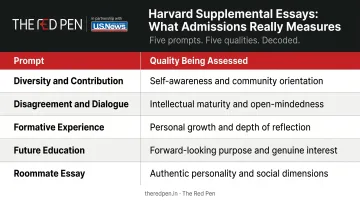
Harvard's admissions overview states its focus is on considering the whole student and how they have interacted with the world. The five prompts are not random — each one is designed to surface a specific quality:
| Prompt | Quality Being Assessed |
|---|---|
| Diversity and Contribution | Self-awareness and community orientation |
| Disagreement and Dialogue | Intellectual maturity and open-mindedness |
| Formative Experience | Personal growth and depth of reflection |
| Future Education | Forward-looking purpose and genuine interest |
| Roommate Essay | Authentic personality and social dimensions |
The No-Overlap Principle
Because Harvard reads your Common App personal statement and all five supplements together, every response must add new information. Before drafting anything, map out all six pieces — your personal statement plus the five supplements. Assign each one a different dimension of your identity, experiences, or interests. If two essays cover the same ground, one needs to change.
Working Within the 150-Word Limit
That mapping work also shapes how you write each response. With only 150 words, there's no room to cover multiple angles — pick one concrete detail and follow it to its insight. Keep these principles in mind:
- Target 130–150 words; responses well below the limit often feel underdeveloped
- Lead with the specific image or moment, not background context
- Cut qualifiers and scene-setting — if a word doesn't add image or insight, remove it
Common Mistakes to Avoid
Repeating content across essays. If Prompt 3 covers a particular activity or experience, Prompt 1 must draw on something entirely different. Think of each essay as a different camera angle on yourself.
Leaning on vague claims instead of concrete detail. Elevated vocabulary and broad statements ("I am passionate about justice") without a grounding story cause responses to blend into the pile. Harvard admissions readers see thousands of essays; what stands out is specific, lived detail — not polished-sounding language that could belong to anyone.
Misreading Prompt 2 as a story about being right. Any response that reads as self-congratulatory or dismissive of the opposing person's view will undermine your application. The disagreement essay is about engagement and growth, not resolution.
Tips to Make Your Harvard Essays Stand Out
Start with a scene, not a statement. At 150 words, you cannot afford a slow build. Drop the reader into a specific moment — a conversation, a sensory detail, a concrete action. One sharp image does more work than two sentences of context.
Research Harvard specifically for Prompts 1 and 4. Go beyond well-known programmes. Look at specific faculty research areas, named student organisations, and Harvard's mission language around educating citizen-leaders for society. Applicants who cite something specific signal real interest rather than surface-level brand appeal.
Consider working with an experienced admissions counsellor. Shaping a cohesive narrative across six essays — your Common App personal statement plus five supplements — is one of the most demanding parts of the Harvard application. Overlap, repetition, and missed story angles are the most common pitfalls.
The Red Pen's counsellors use a storyboarding approach to help applicants map their strongest stories across all six pieces and ensure each essay adds something new. For Indian students especially, the work often involves surfacing distinctive experiences and framing them in ways that resonate with US admissions readers.
Frequently Asked Questions
How many supplemental essays does Harvard require?
Harvard requires five short-answer supplemental essays, each with a 150-word limit. They are submitted as part of the Harvard-specific section of the Common Application, and all five are required for every first-year applicant.
What is Harvard looking for in its supplemental essays?
Harvard uses the five prompts to assess the whole student — how life experiences shaped the applicant, how they engage with others, and what they hope to contribute to and gain from the Harvard community. Self-awareness, intellectual curiosity, and community orientation are the key qualities being evaluated.
Can I reuse content from my Common App personal statement?
Reusing content is strongly inadvisable. Harvard admissions readers see both your personal statement and all five supplements together, so overlapping content wastes limited space and signals a lack of strategic thinking. Each essay must add genuinely new information.
How should Indian students approach the diversity essay?
Indian applicants bring distinctive perspectives — shaped by cultural identity, family responsibilities, and regional or cross-border experiences — that can anchor strong responses to Prompt 1. The key is connecting that background to a specific contribution you intend to make at Harvard, not simply describing where you come from.
What are the biggest mistakes students make?
The three most common errors are repeating content across essays, writing in a generic or overly formal voice instead of an authentic one, and misreading Prompt 2 as a story about winning an argument. That prompt is about demonstrating growth through genuine dialogue — not debate victories.
Does Harvard want exactly 150 words per essay?
Harvard's official guidance sets a 150-word limit per response. Aim for 130–150 words, making every sentence count. Responses well under the limit can feel underdeveloped, and padding to reach the ceiling is just as harmful.