With over 65,600 applicants competing for roughly 5,500 spots — an acceptance rate of approximately 8.4% based on Cornell's 2024–25 Common Data Set — the supplemental essays carry real weight. For Indian applicants in particular, where academic profiles often cluster at a high level (strong boards, IB scores, SATs), the essays become one of the clearest differentiators in the pool.
This guide covers every Cornell essay type, what admissions readers actually look for, how to structure each response, and the mistakes that cost even prepared applicants.
Key Takeaways
- Cornell requires a college-specific essay (500–650 words for most schools) plus a universal community essay (350 words) for most applicants
- Every college-specific prompt asks two things: Why this major? and Why this college within Cornell?
- Specificity is the only strategy: generic praise of Cornell's reputation will not set your application apart
- The community essay must stay focused on you, not the community itself
- Research Cornell's specific programs, faculty, and resources before you write a single word
Cornell Supplemental Essays: What You're Working With
Cornell has eight independent undergraduate colleges and schools, and each assigns its own supplement format. Before writing anything, understand exactly what your target college requires.
Essay Requirements by College
| College / School | Word Limit | Number of Essays |
|---|---|---|
| College of Agriculture and Life Sciences (CALS) | 500 | 1 |
| College of Architecture, Art, and Planning (AAP) | 650 | 1 |
| College of Arts and Sciences (A&S) | 650 | 1 |
| Brooks School of Public Policy | 650 | 1 |
| SC Johnson College of Business | 650 | 1 |
| College of Human Ecology (CHE) | 600 | 1 |
| School of Industrial and Labor Relations (ILR) | 650 | 1 |
| College of Engineering | 200 + 200 + four 100-word short answers | 6 total |
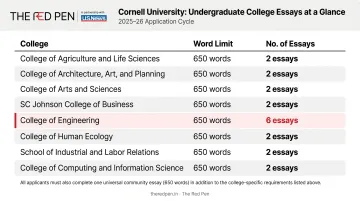
Engineering applicants carry the heaviest writing load by far. Everyone else is working with one substantial college-specific essay plus the universal community essay.
How Essays Fit Into Cornell's Review
Cornell's review has no single formula for admission decisions. Academic indicators — grades, course rigor, test scores — are the primary quantitative signals.
The supplemental essays are where Cornell assesses something harder to measure: genuine intellectual fit with the chosen major, fit with the target college's culture, and what the applicant will actually contribute to campus.
For Indian applicants, where strong academic profiles are common across the applicant pool, the essays often become the clearest point of differentiation. A 1540 SAT with a flat, generic supplement looks identical to hundreds of other applications. The same score attached to a specific, researched, personal essay reads as a distinct candidate.
That context matters when you look at Cornell's middle 50% SAT ranges: 730–770 (Evidence-Based Reading and Writing) and 770–800 (Math), with an ACT composite of 33–35. Being within range gets your application read. What happens after that depends largely on your essays.
How to Write the Cornell Community Essay
The prompt: "We all contribute to, and are influenced by, the communities that are meaningful to us. Share how you've been shaped by one of the communities you belong to." (350 words)
This essay functions as a diversity essay. It asks what perspective, identity, or lived experience you bring to Cornell — not a recap of your achievements.
Choosing Your Community
"Community" is open-ended. It can be:
- A cultural or regional group
- A sport, hobby, or trade
- A faith community
- An online forum or interest group
- A family unit or neighborhood
- A professional or academic circle
Choose the community that has most genuinely shaped how you think rather than the one that sounds most impressive on paper. An unexpected choice (a regional craft tradition, a niche online community, a family business) often lands more memorably than a predictable one (a national debate team, a school club) because it reveals something specific and personal.
Structuring the Essay
The 350-word limit is tight. Every sentence needs to carry weight. The essay must accomplish three things:
- Define the community with vivid detail: give the reader enough specificity to picture it
- Show how it shaped you, not just tell: use a concrete moment or experience, not adjectives
- Connect that shaping to Cornell: the essay should end facing forward, not looking back
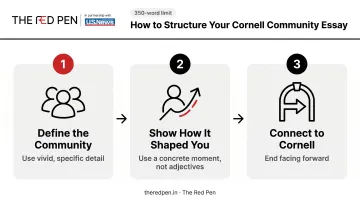
Most students write about their community's activities and achievements, then forget to bring the essay back to themselves. The reader finishes knowing a lot about the group and almost nothing about the individual. Concrete moments are how you fix that. A single specific scene does more work than three adjectives.
Show vs. Tell: A Direct Example
Telling: "Being part of this community made me more resilient and open-minded."
Showing: "The third time I stayed past midnight to help Priya finish her saree border (not because anyone asked, but because leaving felt wrong) I realised I'd stopped thinking of weaving as craft and started thinking of it as obligation in the best sense."
The second version places the reader in a specific moment. The writer doesn't claim resilience ; the action demonstrates it. Use at least one moment or sensory detail that puts the reader inside your experience.
Connecting to Cornell
The strongest community essays don't end by reflecting on the past ; they project into the future. Name a specific residential programme, student organisation, or community at Cornell where this identity continues. This signals school fit and demonstrated interest within the 350-word limit itself.
How to Write College-Specific "Why Cornell" Essays
Every college-specific prompt, regardless of how it's worded, is asking two questions:
- Why this major? (intellectual fit)
- Why this college at Cornell, specifically? (school fit)
Answering the second question with references to Cornell's reputation, rankings, or Ithaca's beauty is the fastest way to weaken your essay. Admissions readers at each college read thousands of supplements — they know immediately when an applicant hasn't done specific research.
The "Why Major" Component
Build a brief narrative arc — not a list of interests, but a sequence of moments that shows intellectual development over time:
- An early encounter with the subject that sparked genuine curiosity
- A deepening experience — a project, a mentor, or a discovery that shifted how you think
- A current pursuit that demonstrates you're actively engaged right now
Keep this grounded in high school experiences. Childhood memories ("ever since I was five...") dilute the essay's focus and waste limited word count. Recent, demonstrable experiences carry more weight.
The "Why This College at Cornell" Component
This section requires genuine research. Anything that could be written about another top university should be cut. Evidence of fit that actually works:
- Named faculty and their specific research (not just "Cornell has great professors")
- Unique interdisciplinary programmes that aren't widely offered elsewhere
- Student organisations tied specifically to the college
- Signature courses or curricula that reflect the college's distinct approach
- The college's institutional culture — what makes CALS different from A&S, or ILR different from SC Johnson
For Indian applicants who cannot visit campus, this research is entirely achievable remotely. Use the college's official website, faculty lab pages, department newsletters, and Cornell Daily Sun archives — or reach out to current students or alumni directly.
Organising this research before you draft is the critical step most students skip. Tools like The Red Pen's INK (Interactive Narrative Kit) help structure what you've found into a coherent essay framework, so the writing itself becomes far more focused.
Weaving Both Components Together
Avoid the two-halves structure: "Here's my background / Here's Cornell." The essay should feel like a conversation between your history and Cornell's specific offerings — not two separate pitches stitched together.
A simple model to keep in mind:
Past experience → specific Cornell opportunity → how it advances your defined goal
Return to this loop throughout. Each Cornell resource you mention should connect back to something you've already done or discovered.
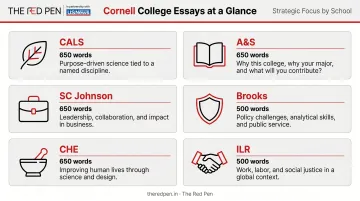
Tailoring for Key Colleges
Each college's prompt reflects its distinct identity. Word counts matter — going significantly over or under signals poor editing.
- CALS (500 words): Purpose-driven science is the frame here. CALS admits directly to a major, so vagueness about your field of study is a significant weakness — name the discipline and explain why it addresses a real challenge.
- A&S (650 words): Show intellectual curiosity that spans departments, not just your primary subject. A&S values breadth alongside depth, and your essay should reflect that.
- SC Johnson (650 words): Business as a career path isn't enough. Frame it as a tool for addressing a specific problem you've identified.
- Brooks (650 words): Ground your policy interest in a real-world problem you've encountered, researched, or lived with — not a broad issue you've read about.
- Human Ecology (600 words): Identify a community challenge and explain how CHE's interdisciplinary structure gives you a specific approach to addressing it.
- ILR (650 words): Labour and workplace issues should connect to personal experience. Evidence of direct engagement — activism, organising, fieldwork — carries more weight than theoretical interest.
Tips for Cornell Engineering Essay Prompts
Engineering applicants face a substantially heavier writing load than any other Cornell college. Six separate responses — each with a strict word ceiling — means precision is the entire game.
The Two Long Essays (200 Words Each)
- "Why do you want to study engineering?" — Focus on a specific problem or moment that revealed your engineering instinct. Avoid the generic love-of-problem-solving framing. What particular challenge made engineering feel like the right lens?
- "Why do you want to study at Cornell Engineering?" — Name labs, research initiatives, or project teams whose work connects directly to your stated interests. Listing courses from the catalog as your primary evidence of fit rarely works; courses are available at many universities. Faculty research and specific programmes are Cornell's differentiators.
The Four Short Answers (100 Words Each)
These are opportunities to reveal personality not visible elsewhere in your application. One specific, concrete thing per answer — no more.
- "What brings you joy?" — This does not need to be engineering-related. Answer honestly. A reader who sees six engineering-focused responses and one genuine personal response remembers the genuine one.
- "What unique voice will you bring?" — Skip claims about being hardworking or collaborative. Name a perspective tied to your specific background or identity that will actually shape how you engage with engineering problems.
- "Meaningful activity" — One activity, one specific reason it matters to you. Don't summarise; distil.
- For the "Meaningful award" prompt, resist the urge to describe what the award was. Admissions readers care about what it revealed or changed for you.
At 100 words, every sentence carries weight. If a sentence doesn't add something new, cut it.
Common Mistakes in Cornell Supplemental Essays
Generic research. Essays that name-drop courses available at any university, or praise Cornell's "collaborative culture" with no specific evidence, are immediately recognizable. Research must happen before writing, not after.
Listing achievements instead of showing impact. Describing what your community does rather than how it shaped you misses the prompt entirely. The reader finishes knowing about the group and nothing about you as an individual.
Repeating other parts of the application. The college-specific essay should add a dimension not visible in your personal statement, activities list, or community essay. Read your entire application as a unit before finalising any supplement — if two components say the same thing, one of them is wasted space.
Frequently Asked Questions
Does Cornell have supplemental essays?
Yes. All first-year applicants to Cornell submit supplemental essays. Most applicants write a college-specific essay (500–650 words depending on the school) plus a universal community essay (350 words). Engineering applicants write six separate responses.
How long should the Cornell supplement essay be?
Word counts vary by college: the community essay is 350 words; most college-specific essays are 500 or 650 words; Engineering applicants write two 200-word essays and four 100-word short answers. For longer prompts, aim close to the limit without padding — the space exists because Cornell wants full answers.
What are the most common mistakes in Cornell supplemental essays?
The biggest mistakes are writing generic "Why Cornell" answers that could apply to any Ivy, failing to name specific programs or professors, and treating the college-specific essay as a second personal statement. Cornell's prompts ask about fit — vague enthusiasm without researched detail signals a weak application.
What is Cornell looking for in its supplemental essays?
Cornell is looking for genuine intellectual fit with the chosen major, specific alignment with the target college's culture and offerings, and the distinct perspective the student brings to campus life. Strong essays demonstrate all three through personal, researched detail — not general enthusiasm.
Can I reuse my Cornell supplement essay for other Ivy League applications?
Cornell's prompts are too school-specific to reuse directly. The "school within a school" structure demands detail that only works for Cornell, and any sentence that could apply to another university weakens the essay. Thematic overlap across applications is fine; Cornell-specific detail must remain Cornell-exclusive.
When is the Cornell supplement due?
The Cornell supplement is submitted with the Common Application — November 1 for Early Decision and January 2 for Regular Decision. Begin researching and drafting several weeks before the deadline to allow time for multiple revision rounds.