Columbia requires six supplemental responses for the 2025–26 cycle. Each is short—100 to 150 words—but that brevity is deceptive. Together, these prompts form a curated portrait of who you are, and admissions officers read them looking for intellect, curiosity, and what Columbia calls "dynamism." Many applicants treat the supplements as an afterthought. That's a mistake.
This guide breaks down every prompt, explains what's actually being evaluated, and gives you a clear strategy for each response.
Key Takeaways
- Columbia's six prompts work together to reveal your intellectual identity, values, resilience, and fit — answer them as a cohesive set.
- Generic responses that could apply to any selective university will not work — Columbia expects specificity.
- The 100–150 word limits demand precision—every sentence must earn its place.
- Write in your actual voice — admissions readers identify performed "application tone" immediately.
- Each essay should reveal something not visible elsewhere in your application.
Columbia's 2025–26 Supplemental Prompts: An Overview
All six prompts come directly from Columbia's official application questions page:
| # | Prompt | Limit |
|---|---|---|
| 1 | List texts, resources, and outlets that have contributed to your intellectual development outside academic courses—books, journals, websites, podcasts, essays, plays, presentations, videos, museums, and other content you enjoy. | 100 words |
| 2 | Tell us about an aspect of your life or lived experience that is important to you, and describe how it has shaped the way you would learn from and contribute to Columbia's multidimensional and collaborative environment. | 150 words |
| 3 | Describe a time when you did not agree with someone and discuss how you engaged with them and what you took away from the interaction. | 150 words |
| 4 | Describe a situation in which you navigated adversity and discuss how you changed as a result. | 150 words |
| 5 | Why are you interested in attending Columbia University? Consider what you find unique and compelling about Columbia. | 150 words |
| 6 | What attracts you to your preferred areas of study at Columbia College or Columbia Engineering? | 150 words |
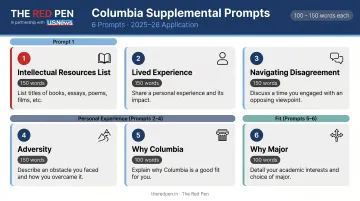
These six prompts aren't random. According to Columbia's own admissions pages, they're designed to reveal academic interests, intellectual curiosity, habits of mind, sense of self, and community fit. Each prompt covers distinct ground — together, they build a complete picture of who you are as a thinker and a person. Treating them as a connected set, rather than six separate tasks, is what separates strong applications from forgettable ones.
One important note for Indian applicants: don't filter your experiences through what you think a US committee wants to hear. Columbia actively values global diversity. With over 14,500 international applicants in 2024–25, authentic cultural context is an asset. Present your experiences honestly.
How to Write the Columbia List Essay (Prompt 1)
The list prompt trips up more applicants than any other. It looks simple—just names of books and podcasts, no narrative required. But that simplicity is the trap.
Columbia says the Columbia-specific questions reveal "intellectual curiosity, habits of mind, and love of learning." The list is their first test of all three. Admissions officers read these lists to understand how you think, what you seek out independently, and whether your curiosity extends beyond the classroom.
Crafting a List That Works as a Whole
Knowing what the list signals helps you build one intentionally. The most effective lists have synergy — items that speak to each other reveal sustained intellectual interests far more powerfully than a random collection of impressive-sounding titles.
For example: pairing The Warmth of Other Suns (Isabel Wilkerson) with a 99% Invisible episode on urban housing policy signals a genuine, cross-format interest in migration and cities—not two separate checkboxes.
Aim for:
- A mix of formats (books, podcasts, documentaries, academic journals)
- A balance of rigorous and accessible material
- Titles that connect to your broader application narrative
Avoid two common failure modes:
- Overdressing: A list of dense academic tomes signals performance, not passion. If you genuinely read dense philosophy texts for pleasure, include them—but not to impress.
- Underdressing: All pop culture with no intellectual depth suggests you haven't explored ideas beyond entertainment.
What to Avoid in the List
- Assigned reading with nothing else — listing only curriculum texts signals zero independent curiosity. If The Great Gatsby appears, pair it with something you sought out yourself.
- Titles you haven't genuinely engaged with — experienced readers detect inauthenticity quickly.
- Material that contradicts your application story — a prospective environmental science applicant with no science-adjacent titles creates a jarring disconnect.
How to Write the Personal Experience Essays (Prompts 2, 3, and 4)
Prompts 2, 3, and 4 all require short, story-driven essays. Each tests a distinct dimension of character, but all reward specificity, honest self-reflection, and a clear arc. Within 150 words, there's no room for throat-clearing—open mid-situation and move.
Prompt 2: Lived Experience and Columbia's Community
This prompt has two parts, and many applicants only answer one. It asks what makes you distinct and how that shapes what you'll bring to Columbia's collaborative environment.
The strongest responses:
- Focus on one specific community, identity, or experience (not a survey of your background)
- Show concrete impact—how did this experience actually change how you think or act?
- Project forward: connect that experience to something specific about Columbia's campus life or intellectual culture
What doesn't work: identity labels without reflection. Stating "I am the daughter of immigrants" tells the committee nothing unless you show what that has meant for your worldview and how it positions you to contribute to Columbia's community.
Prompt 3: Navigating Disagreement
Columbia is evaluating intellectual maturity here: not debate skills. The ideal essay shows you can hold a genuine conviction and genuinely listen.
Walk a careful line:
- Don't be wishy-washy ("both sides have merit"). That reads as having no real perspective.
- Don't be combative. The essay should show you engaged, not won.
- Do focus on what you learned or how your thinking shifted.
Steer away from highly polarizing political topics unless you're very confident in your framing.
A disagreement with a classmate over a historical interpretation, a conflict with a mentor over a research direction, or a family debate about cultural tradition often yields stronger, more specific essays than national political controversies.
Prompt 4: Overcoming Adversity
The challenge doesn't need to be dramatic. It needs to be real and to show genuine growth.
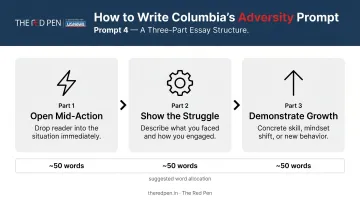
Open mid-action—drop the reader into the middle of the situation in your first sentence. You have 150 words; don't spend 50 on setup.
Reserve the final third of the essay for what actually changed:
- A concrete skill or capability you didn't have before
- A shift in how you see a problem, a person, or yourself
- A new way of engaging with difficulty—not avoiding it
- Evidence that the experience reshaped how you act, not just how you feel
Admissions officers want evidence that you process difficulty and emerge with greater self-awareness. That quality—what Columbia calls "dynamism", meaning active, reflective engagement with challenge—is what these essays are designed to surface.
How to Write the Why Columbia and Why Major Essays (Prompts 5 and 6)
Prompts 5 and 6 form the "fit" section of the supplemental package. They work as a pair: Prompt 5 focuses on Columbia's community, culture, and campus life; Prompt 6 focuses on your academic interests and intellectual fit. Write them together and check that they complement—not repeat—each other.
Prompt 5: Why Columbia?
Generic praise will not move the needle. Columbia has over 500 student clubs and organizations and more than 200 research centres, institutes, and labs—mentioning these numbers in your essay adds nothing. What matters is which specific one, and why it connects to you specifically.
A practical two-part framework:
- Identify concrete Columbia offerings—a specific student organisation, a named programme, a campus tradition, a particular community space. Focus on culture and community here (not academics, which belong in Prompt 6).
- Connect each element directly back to something you've already done, experienced, or genuinely value.
Two well-connected examples outperform five generic ones. The test: if you could swap "Columbia" for another university name without changing the essay, start over.
For Indian students, this research step often takes more time than the writing itself—Columbia's website is dense, and knowing where to look (student life pages, club directories, alumni spotlights) matters. The Red Pen's supplemental essay coaching helps students do this school-specific research systematically, so the connections they write about are genuine rather than Googled at the last minute.
Prompt 6: Why This Major?
Open with a brief, vivid anecdote—a specific moment or experience that shows the origin of your interest. Not "I have always been fascinated by economics." Instead, the moment economics became real for you: a conversation, a problem you encountered, something you read.
The second half of this essay must name specific Columbia resources:
- A particular professor's research area (use Columbia's departmental faculty pages)
- A course listed in the Columbia College Bulletin
- A research centre or unique curricular approach
For engineering students, Columbia's directory lists departments and strategic research areas—including Computational Engineering and AI, Sustainability and Climate, and Medicine and Health—which give you specific, researchable starting points.
One precise, well-researched connection is worth more than three vague gestures toward "Columbia's world-class faculty."
Common Mistakes to Avoid
Before you finalize your application, watch out for these four patterns that consistently weaken Columbia supplementals:
Generic school-swap essays. If you replaced "Columbia" with "Yale" and nothing felt obviously wrong, the essay isn't Columbia-specific enough. Every Why Columbia response should be irreplaceable — tied to specific programs, faculty, or intellectual traditions you can't find elsewhere.
Recycling your Common App or activities list. Each supplemental is a new opportunity to reveal a different facet of who you are. If your Common App essay is about leadership through sport, don't anchor your lived experience essay there too.
Rushing the list prompt. Many applicants spend hours on Prompts 5 and 6, then dash off the list in ten minutes. It deserves equal strategic attention — it's often the first thing a reader sees and shapes expectations for everything that follows.
Drafting each essay in isolation. Before you submit, read all six responses together. Ask: do they collectively tell a coherent, multi-dimensional story? Is there any repetition that wastes a prompt?
Frequently Asked Questions
What does Columbia University look for in supplemental essays?
Columbia reviews every application "holistically and with care" and uses the supplemental prompts to assess academic curiosity, intellectual engagement beyond the classroom, community contribution, resilience, and genuine institutional fit. Responses that name-drop Columbia's reputation without specifics won't satisfy any of these criteria.
How many supplemental essays does Columbia require?
Columbia requires six supplemental responses for 2025–26: one list prompt (100 words) and five short essays of up to 150 words each. Prompt 6 applies to both Columbia College and Columbia Engineering applicants.
Can I reuse supplemental essays from other schools for Columbia?
Essay structures can be adapted, but direct reuse is a significant risk. Columbia's prompts are specific, and any response that feels generic—or worse, contains references to another school—will stand out to experienced admissions readers for the wrong reasons.
What topics should I avoid in Columbia supplemental essays?
Avoid generic praise of Columbia without specific research, highly polarizing political stances in the disagreement essay without careful framing, and topics that repeat information already covered elsewhere in your application.
When should I start writing my Columbia supplemental essays?
Begin brainstorming in June or July before your senior year. Six separate responses each demand individual attention, and rushed supplemental essays are one of the most common and preventable mistakes in selective university applications.
Is standalone essay support available for the Columbia supplements?
Yes, you don't need a full consulting package to get expert help. The Red Pen offers standalone essay support and editing services, including options for supplemental essays, with edit-only services starting from ₹15,000.