Introduction
Every year, thousands of students apply to Ivy League schools with near-perfect GPAs, 1580+ SAT scores, and extracurricular records most adults would envy. Most of them don't get in.
Harvard admitted just 4.18% of applicants to the Class of 2029. Yale admitted 4.6%. Princeton: 4.42%. At these acceptance rates, academic excellence is the baseline — not the differentiator.
What separates admitted students from equally qualified ones is almost always the essay. It's the only component where a student controls the entire narrative — no rubric, no percentile rank, no teacher standing between them and the reader.
This guide breaks down what Ivy League admissions officers look for, walks through annotated examples of successful essay approaches across multiple schools, and gives you a writing framework to apply before your next draft. There's also dedicated guidance for Indian students navigating the U.S. personal essay format — specifically, how to make your cultural background work for you rather than disappear into generic language.
Key Takeaways
- Ivy League acceptance rates hover around 4–9%, making the essay one of the few remaining ways to stand out
- Admissions officers detect inauthenticity immediately — specificity and genuine voice matter more than impressive topics
- Students typically write 3–6 essays per application: one Common App personal statement plus school-specific supplementals
- Strong essays show, don't tell — concrete scenes beat abstract claims about character every time
- The "so what" — what an experience reveals about you — is what separates a diary entry from a compelling college essay
Why Your Essay Matters More at Ivy League Schools
When grades and test scores no longer distinguish candidates, something else has to. At Ivy League schools, that something is the essay.
Yale's admissions guidance states that essays exist to understand the "personal side" of applicants — the dimension that transcripts and recommendation letters can't fully capture. Brown confirms its process is holistic, reviewing every application in full. Princeton's official guidance describes essays as an expression of intellectual integrity — so important that the school explicitly emphasizes they must be the applicant's own work.
The Essay as Your Direct Voice
Your GPA tells admissions officers what you achieved. Your essay tells them who you are while achieving it — a dimension no other part of the application can capture.
The essay reveals:
- How you think and what you find genuinely interesting
- Your values and how you've tested them in real situations
- Whether you have the self-awareness to reflect meaningfully on your own experiences
- Your voice — specific enough that it could only have been written by you
The Particular Challenge for International Students
That universal challenge hits differently for Indian applicants. The U.S. personal essay format is unlike anything taught in Indian schools — it asks students to be vulnerable, specific, and narrative-driven, often the opposite of the formal, achievement-oriented writing style most students have spent years perfecting.
The goal is to write authentically as yourself, in a format that American admissions readers can connect with. Your background and experiences are strengths here, not obstacles to overcome.
The Types of Essays Ivy League Schools Require
A single Ivy League application requires far more writing than most students expect. The Common App personal statement is just the starting point.
Common App Personal Statement vs. Supplementals
- Common App personal statement: One essay submitted to every school you apply to through Common App; up to 650 words
- Supplemental essays: School-specific prompts, submitted separately, that each Ivy designs differently — these are where schools assess fit, intellectual interest, and motivation
A typical Ivy League application requires 3–6 essays total, depending on the school.
Common Supplemental Essay Types
| Essay Type | Examples | Typical Word Limit |
|---|---|---|
| "Why This School" | Cornell, Dartmouth | 100–650 words |
| "Why This Major" | Brown, Princeton BSE | 150–500 words |
| "Intellectual Interest" | Yale | 200–400 words |
| Short answer / open-ended | Harvard, Columbia | 50–150 words each |
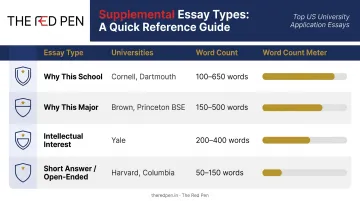
Dartmouth's "Why Dartmouth" response is confirmed at just 100 words — every word counts. Harvard's 2024–2025 supplement includes five short answers of 150 words each, covering topics from lived experience to what you'd share with your future roommate.
Word limits shape how you write, not just how much. A 100-word prompt demands surgical precision — one weak sentence wastes 1% of your budget. A 500-word prompt gives you room for a narrative arc, a scene, a turning point. Treat each limit as its own format, and write accordingly.
What Ivy League Admissions Officers Actually Look For
Authenticity Over Performance
Former Stanford admissions officer Grace Kim put it plainly in an interview with CNBC: "We always said when I was an admissions officer, we want it to be so personal to the student that you couldn't put anyone else's name on that essay and have it still be true about that other student."
Admissions officers read thousands of essays per cycle. They can tell, almost immediately, when a student is writing to impress rather than to reveal.
The student who writes about winning a state championship sounds like fifty other students who won state championships. The student who writes about the forty-five-minute drive home after losing, and what they thought about the whole way, sounds like no one else.
Specificity and the "Show, Don't Tell" Principle
Compare these two openings:
- "I am a curious person who loves learning about science."
- "The beaker cracked at 11:47 PM on a Tuesday. I had been trying to isolate the compound for six days."
The second one earns attention. It puts the reader inside a moment. Abstract claims about character are forgettable; concrete scenes are not.
Every strong Ivy essay uses:
- Specific sensory details (what you saw, heard, felt)
- Real dialogue or internal thought
- Named places, people, and moments — not vague summaries
Intellectual Depth and Reflection
Ivy League schools want evidence of a "life of the mind." That means the essay can't just recount what happened — it has to show what you made of it.
After every paragraph, ask yourself:
- So what?
- What changed?
- What did I understand differently?
If you can't answer those questions, the paragraph is a diary entry. Reflection is what turns experience into insight.
Narrative Structure and Voice
Once you've identified what you want to say, the next question is how to say it. Two structures work well for college essays:
- Narrative: A single story arc — opening scene, rising tension, resolution, reflection. Best for one defining experience.
- Montage: A thematic thread weaving through multiple vignettes. Best for students whose identity or interests don't reduce to a single moment.
Neither is automatically better. What matters is that the structure serves your story and your voice comes through clearly — not a performed voice, but the one you actually use when thinking out loud.
Ivy League Essay Examples That Worked — and Why
The examples below are drawn from successful applicant profiles documented by reputable college counselling resources. Study them for technique — the specific choices that made each essay land — rather than using them as templates.
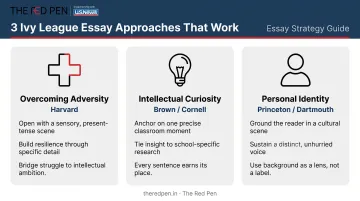
Overcoming Adversity (Harvard-Style)
One successful Harvard supplemental essay opened with a precise, physical image: the student relearning to walk with a walker after spinal surgery, quietly singing K-pop lyrics to time each step. The essay closed by connecting that daily discipline to a future interest in neuroregeneration research.
Why it worked:
- Sensory specificity (the walker, the song) put the reader inside the experience
- Resilience came through the details, not through claims like "I learned perseverance"
- The essay didn't end with the recovery — it connected the personal story to intellectual ambition, grounding identity in where the student was headed, not just where they had been
Intellectual Curiosity ("Why Major" — Brown/Cornell Style)
A Brown applicant writing about mathematics in 150 words grounded an abstract passion in a single classroom moment — the exact instant a proof clicked — and traced what that feeling meant for how they approach problems generally.
A Cornell essay used a different structure: it opened with a grandfather who couldn't afford prosthetics, and followed that single image through to a lifelong drive to study biomechanics, naming specific Cornell labs and faculty along the way.
Why it worked:
- Every sentence — from the opening anecdote to the school-specific research programmes — traced back to one central motivating idea
- School-specific details weren't decorative; they showed exactly why Cornell, not just any university with a biomechanics department
- There was no wasted space
Personal Identity and Voice (Princeton/Dartmouth Style)
A Princeton essay used a dinner table scene with a multicultural family — competing languages, different generations, conflicting opinions — to explore open-mindedness as a core value. A Dartmouth essay opened with childhood stories about Hindu mythology and connected them to a passion for writing historical fiction.
What both shared:
- A specific, grounded scene that opened into a larger theme about identity
- A distinct voice — the kind of detail and framing that would fall flat if transplanted into any other student's essay
- Cultural background used as a lens: a starting point that led somewhere, rather than a credential to list
How to Write Your Ivy League Essay: A Step-by-Step Approach
Step 1 — Find Your Real Story
Don't start with the prompt. Start with yourself.
List 5–8 moments, values, or experiences that feel genuinely yours. Resist the pull toward "trophy topics" — the championship, the internship, the award. Those belong in your activity list.
The best essay topics are often quiet: a conversation with a grandparent, a mistake you made and why, a question you couldn't stop thinking about. A specific, ordinary moment handled honestly will outperform an impressive one handled generically every time.
Step 2 — Identify Your "So What"
Once you have a topic, ask: What does this reveal about me that isn't already visible in my application?
The essay should add a new layer, not restate what's in your transcript or résumé. If an admissions officer could read your essay and learn nothing new about you, the topic isn't doing its job.
Step 3 — Choose Your Structure
- Narrative: Use this for a single transformative experience with a clear before and after
- Montage: Use this when your identity or intellectual interests don't reduce to one moment
Whichever you choose, your opening line must earn the reader's attention immediately — not with a dictionary definition or a broad philosophical claim, but with a scene, a question, or a line that makes the reader want the next one.
Step 4 — Write With Specificity and Sensory Detail
Go back through every paragraph and ask: Can I make this more specific?
Replace vague language with concrete imagery:
- Weak: "I was nervous before the competition."
- Strong: "My hands wouldn't stop shaking as I re-read the last line."
The essay is not a report. It is an experience the reader lives alongside you.
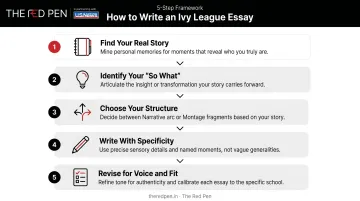
Step 5 — Revise for Voice, Clarity, and Fit
The first draft should be written freely — no self-censorship, no imaginary admissions officer looking over your shoulder. Subsequent drafts are where the real work happens.
During revision, check:
- Does every sentence earn its place?
- Have you eliminated clichés and vague language?
- Does the conclusion answer the implicit "so what"?
- When you read it aloud, does it sound like you — or like a formal performance of you?
Strong essays typically go through five or more drafts before they feel truly finished. If you want a structured approach to this process, The Red Pen's INK (Interactive Narrative Kit) guides students from initial brainstorming through to final polish — topic selection, narrative arc, and voice, all in one framework. Learn more at theredpen.in/interactive-narrative-kit.
Common Mistakes to Avoid
Rehashing the Résumé
The personal statement is not a prose version of your activity list. Admissions officers already have that information. The essay should reveal the person behind the achievements — what you actually think, feel, and care about.
Choosing a "Safe" Topic for the Wrong Reasons
Many students gravitate toward topics that sound impressive: mission trips, championship wins, volunteer leadership. These can work — but only when handled with genuine depth and honesty.
A former Harvard student's guide on the Harvard College website puts it well: the personal essay is where admissions officers hear the applicant's own voice. A "safe" topic handled generically is far weaker than an unusual topic handled with real reflection.
Neglecting Supplemental Essays
This is where many otherwise strong applications fall apart. After weeks spent on the personal statement, students treat supplementals as an afterthought.
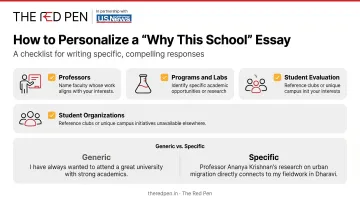
For "Why School" essays specifically, vague praise — "I love Harvard's collaborative culture" or "Princeton's academic rigour appeals to me" — is immediately detectable as underprepared. Specificity is what makes these essays credible. Research and mention:
- Professors whose research or courses align with your interests
- Specific programmes, labs, or student organisations you'd join
- Unique academic opportunities that aren't available at every peer institution
Frequently Asked Questions
How long should an Ivy League essay be?
Word limits vary by school and essay type. The Common App personal statement allows up to 650 words; Ivy League supplementals range from 100 (Dartmouth's "Why Us") to 650 words. Aim to reach, but not exceed, the stated limit for each prompt.
What topics should I avoid in my Ivy League essays?
Overused topics include sports injuries with generic life lessons, mission trips that centre the writer's perspective, and straightforward achievement recaps. The topic matters less than the depth of reflection — an honest essay about something small will outperform a generic essay about something impressive.
Can I write about the same experience for multiple Ivy League school essays?
Your Common App personal statement is submitted to all schools, so that content is shared by design. Supplemental essays, however, must be tailored to each school. Submitting identical content across school-specific prompts is a mistake admissions readers notice quickly.
Do Ivy League admissions officers actually read every essay?
Yes. Yale's admissions process involves officers reading applications, making notes, conferring with colleagues, and presenting candidates to the Admissions Committee. Dartmouth confirms it reads every application carefully. The essay is a genuine differentiator, not a formality.
Can Indian students write about their cultural background in Ivy League essays?
Absolutely. Essays about cultural identity, family dynamics, or experiences unique to growing up in India can be highly compelling. The key is to use cultural context as a lens — revealing personal values, intellectual curiosity, or growth — rather than simply describing the culture itself.
How many drafts should I expect to write?
Strong essays go through multiple rounds of revision. The first draft should be written freely; subsequent drafts refine structure, language, and voice. Most students find that structured feedback between drafts — from a teacher, mentor, or admissions counsellor — catches blind spots that self-editing misses.