Introduction
MIT's acceptance rate for the Class of 2029 sat at 4.6% — roughly 95 out of every 100 applicants were turned away. For students with strong grades and test scores, the supplemental essays are often the only place a real person can emerge from an otherwise identical-looking application.
That pressure is felt acutely by Indian applicants, many of whom are writing for an admissions culture they haven't encountered before. MIT's essays don't reward formality or impressive-sounding topics. They reward specificity, intellectual honesty, and a voice that sounds like no one else's.
This article breaks down real MIT supplemental essay examples, analyzes what made them work, and extracts lessons you can apply — whether you're writing about slam poetry in Portland or a robotics project in Pune.
Key Takeaways
- MIT essays reward authenticity and specificity, not academic formality or impressive-sounding topics
- The strongest essays anchor a large idea — curiosity, community, resilience — in a single, concrete personal moment
- Each prompt asks something distinct — treat them separately, not as variations on the same theme
- Use real examples with critique to spot what works — and what sounds good but falls flat
- Admissions readers evaluate all five essays together — a cohesive set outperforms five disconnected strong essays
What MIT Is Really Looking for in Supplemental Essays
MIT's selection philosophy begins with fit. According to MIT Admissions, the process centers on "the match between you and MIT" — not simply academic strength, but evidence of mission alignment, collaborative drive, hands-on creativity, intellectual intensity, and a sense of responsibility to community.
Grades and test scores establish academic readiness. The essays establish whether you think, engage, and connect with the world in ways that belong at MIT.
The Five Current Prompts (2025–2026)
MIT runs its own application portal; it does not accept the Common App. The current short-answer questions ask for approximately 100–200 words each:
- Field of study: What appeals to you most right now, and why at MIT specifically?
- Pleasure: What do you do simply for the pleasure of it?
- Unexpected path: How have you done something different from what was expected in your educational journey?
- Collaboration: Describe one way you've collaborated with others to learn, grow, or contribute to your community
- Unexpected challenge: How did you manage a situation or challenge you didn't expect? What did you learn?
What Each Category Is Really Testing
Each prompt probes a different dimension:
- Pleasure prompt: Do you have genuine intellectual or personal interests beyond achievement?
- Unexpected path: Can you take ownership of an unconventional choice and articulate its reasoning?
- Collaboration: Do you engage meaningfully with people different from yourself, or just list group activities?
- Challenge: Can you reflect honestly on difficulty rather than reframe every setback as a triumph?
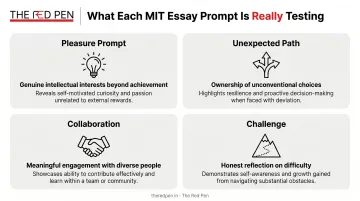
Understanding this before you write prevents the most common mistake: answering the surface question while missing the real one.
MIT Essay Example: "Something You Do Simply for the Pleasure of It"
The Prompt and What It's Really Asking
The current wording: "We know you lead a busy life, full of activities, many of which are required of you. Tell us about something you do simply for the pleasure of it."
MIT links this prompt directly to its stated value of balance. That word — simply — is deliberate. This is an anti-humblebrag prompt. MIT is not asking what impressive hobby rounds out your profile. They want to know what genuinely delights you when no one is grading it.
A Strong Example: Curiosity Through Reading
One well-circulated example (analyzed by CollegeVine) features a writer who uses Lewis Carroll's Alice in Wonderland as a lens for explaining why reading became essential — both an escape from world events and a tool for understanding them. The essay names specific books, references real events, and traces a credible intellectual journey in under 100 words.
Why this essay worked:
- The language is precise without being ornate — words like "devoured" and "gallivant" carry weight without straining
- The writer moves from personal escape to broader empathy, showing genuine intellectual depth
- In under 100 words, a reader understands this person's worldview, not just their hobby
Where it fell short:
The closing line about "transcending generational gaps" reads as an afterthought — grafted on rather than earned. In short-format essays, every sentence must carry its weight. A closing that looped back to the Alice metaphor would have been tighter and more memorable.
Lesson for Your Own Essay
That gap between the essay's strengths and its closing line points to a broader principle: every sentence needs to earn its place, especially in 100 words.
Choose an activity that is genuinely yours — not the one that sounds most impressive. Then ask: what does this reveal about how I see the world? A student who reads obscure Indian mythology at 2 a.m. has a more interesting answer than one who lists competitive chess without conviction.
MIT Essay Example: "Describe the World You Come From"
Note: This exact prompt does not appear on MIT's current 2025–2026 official page. It has appeared in MIT Admissions blog posts, including a retrospective by an admitted student, and in earlier application cycles. The examples below illustrate the identity and context themes MIT consistently values across past and present prompts.
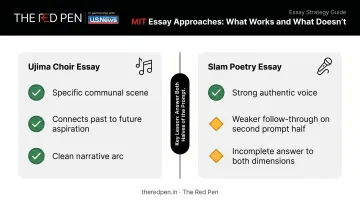
The Ujima Choir Essay
One CollegeAdvisor example opens in a third-grade classroom with a call-and-response song about collective work and responsibility — the Swahili concept of ujima. The writer then connects that formative memory directly to their present aspiration of becoming a bioengineer who works collaboratively.
The opening scene functions as the thesis, not decoration. By the time the writer names bioengineering, the reader already understands why.
The Slam Poetry Essay (MIT Admissions Blog, Rona W., 2019)
Rona W.'s MIT Admissions blog post describes writing about slam poetry in Portland — how performing spoken word opened her eyes to communities outside her suburban experience and crystallised the belief that writing creates empathy.
Rona reflects in the post that the essay leaned too heavily on the poetry itself and didn't give enough texture to Portland as a place. That observation points to something worth remembering: the "world" prompt has two parts — describe the world, and explain how it shaped you. Essays that nail one half but neglect the other leave the prompt only partially answered.
Common Thread and Lesson
Both essays use a specific communal scene (a choir, a poetry slam) to convey a value system rather than just a story. The difference between them comes down to follow-through:
- The ujima essay connects past scene to future aspiration in a single, clean arc
- The slam poetry essay has stronger voice but weaker follow-through on the "shaped your dreams" dimension
- The gap between the two is not talent — it's answering both halves of the prompt
For Indian applicants: a specific family ritual, a classroom dynamic in your city, a neighbourhood tradition — none of these are lesser subjects. They are exactly the material that lands. The more specific the world, the more convincingly it explains who you've become.
MIT Essay Example: "Community Contribution and Collaboration"
The Prompt and What It's Really Asking
Current wording: "MIT brings people with diverse backgrounds together to collaborate, from tackling the world's biggest challenges to lending a helping hand. Describe one way you have collaborated with others to learn from them, with them, or contribute to your community together."
The emphasis is on genuine collaboration — learning from others, not just doing things for others. An essay that describes leading a group project where you made all the decisions doesn't answer this prompt well, even if the outcome was impressive.
A Strong Example: The Soccer Referee Essay
One well-known example essay describes a referee who stops play — not to penalise a young girl for an incorrect throw-in, but to teach her. The writer uses italicised internal narration to bring the reader into their thinking in real time, showing how they chose education over enforcement.
Three things this essay gets right:
- The tight scene creates strong imagery without wasting words on setup
- The internal monologue technique is a genuine formal choice — it shows rather than tells
- The final line ("I strive to see the potential") elevates a small anecdote into a personal philosophy, which is exactly what these short essays need to do
What to Watch For:
The writer doesn't establish their role clearly at the opening — readers briefly wonder whether this is a referee or a coach. The collaboration dimension is also implicit rather than explicit. MIT's prompt asks about collaboration with people different from you; an essay that only shows one person teaching another doesn't fully engage with that framing.
When a prompt contains a specific emphasis — diverse backgrounds, mutual learning, community contribution — don't leave it implied. Name it.
What Makes MIT Supplemental Essays Work: Universal Patterns
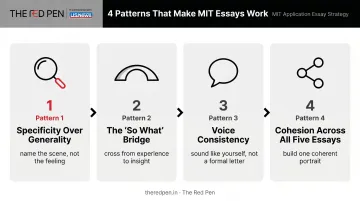
Across the examples above and MIT's own stated values, four patterns separate effective essays from forgettable ones.
Pattern 1: Specificity Over Generality
Every essay that worked used named, concrete details. The ujima essay names the song and the grade. The soccer essay names the player. The reading essay names specific titles.
Run this audit on every draft: find every sentence containing "I love," "I enjoy," or "my community taught me" — then replace it with a scene, a moment, or a specific example. Generic claims tell admissions readers nothing they haven't read a thousand times.
Pattern 2: The "So What" Bridge
Strong essays don't stop at the experience. They cross to what it revealed or changed. A useful revision tool: after describing an event, write the phrase "and what this showed me was..." — then work that insight back into the narrative naturally, so it reads as earned rather than declared.
The slam poetry essay is a partial illustration of this: the voice is authentic, but the bridge from "this is what I did" to "this is who I became" needed more weight.
Pattern 3: Voice Consistency
The best MIT essays sound like a specific person. Short sentences, natural rhythm, even moments of dry humour when it fits — all of these land better than stiff, formal prose. MIT explicitly states these are not writing tests. Reading your draft aloud is the most reliable way to catch stilted phrasing before a reader does.
Pattern 4: Cohesion Across All Five Essays
Each supplement should add a new dimension to the portrait, not echo another essay or contradict it. Admissions readers move through applications quickly and are constructing a mental image of you as a person — one essay about academic passion, another about community identity, another about how you handle difficulty. Together, they should build a coherent, three-dimensional portrait of who you are.
This is where pre-writing strategy matters most. The Red Pen's counsellors use a storyboarding process, working with students to map their narrative across all application components before any drafting begins. This ensures each essay earns its place without overlapping or leaving gaps.
Frequently Asked Questions
What does MIT look for in supplemental essays?
MIT looks for evidence of genuine intellectual curiosity, collaborative spirit, and honest self-reflection. Essays should show how you think and engage with the world, not simply list achievements. Admissions readers are building a portrait of you as a person — not scoring a checklist.
What are the 5 D's of college essays?
The 5 D's — Discovery, Dedication, Diversity, Difficulty, Dreams — are a framework some counsellors use to evaluate essay strength. Strong MIT essays touch several of these naturally. The key is honest personal reflection — not engineering your response to hit each dimension.
What extracurriculars impress MIT?
MIT values depth over breadth. An applicant who pursued one or two activities with genuine commitment and created real impact is more compelling than someone with a long list of surface-level clubs. Self-initiated projects and unusual pursuits stand out to admissions readers.
How long should MIT supplemental essays be?
MIT's current guidance is approximately 100–200 words per short-answer question. Staying close to that range signals writing discipline and respect for the reader's time. Treat the word limit as a ceiling that forces clarity, not a floor to fill.
Can I reuse my Common App personal statement for MIT supplements?
No — and for two reasons. MIT doesn't use the Common App; it runs its own portal. More importantly, each MIT supplemental prompt asks something distinct. Reusing personal statement content almost always misses the specific intent of each question.
How many supplemental essays does MIT require?
MIT's 2025–2026 application includes five short-answer essay questions, each approximately 100–200 words. All five should be treated with equal care — together, they build a complete picture of who you are beyond your academic record.