Introduction
Submitting your application is one thing. Sitting across from an admissions interviewer — or facing a camera in a virtual session — is something else entirely. For many Indian students, the university interview is the part of the process they feel least prepared for.
Not every university requires an interview. But selective institutions in the US, UK, and Canada increasingly use them to assess candidates beyond grades and test scores. For Indian applicants, the interview adds a dimension that board exams rarely test: demonstrating intellectual curiosity in real time, explaining your motivations to a stranger, and doing it all in English under pressure.
The specific challenges are predictable — and that means they're solvable. Demonstrating fluency while organising complex thoughts. Explaining a CBSE or ISC education to someone unfamiliar with it. Articulating why you want to study abroad without sounding dismissive of Indian universities. Each of these gets much easier with preparation.
This guide covers:
- The questions you're most likely to face across US, UK, and Canadian university interviews
- How to approach each question type strategically
- How to prepare effectively before interview day
Key Takeaways
- Interviews assess personality, motivation, and fit — not just academic achievement
- Expect three types of questions: personal background, academic interest, and international-student-specific topics
- Generic answers are easy to spot — research your university and course specifically
- Practice out loud — spoken rehearsal builds fluency and structure faster than reading notes
- Honest self-reflection is more impressive than a polished but hollow response
Understanding the University Admissions Interview Format
How Formats Differ by Destination
Interview formats vary considerably depending on where you're applying — and knowing what to expect changes how you prepare.
- US liberal arts colleges and selective universities (Yale, MIT, Swarthmore): alumni or student-led conversations focused on personality, fit, and intellectual interests. Yale describes interviews as 30–45 minute conversations conducted by alumni or current students.
- Oxford and Cambridge: a distinctly different experience. Oxford frames interviews as academic conversations — closer to a short tutorial — designed to observe how you think, not test factual recall. Cambridge interviews run 20–45 minutes and carry significant weight in the admissions decision.
- Canada and Australia: less uniform. University of Toronto relies primarily on academic results; UBC Sauder's BCom uses a pre-recorded video interview. Melbourne requires interviews only for specific courses.
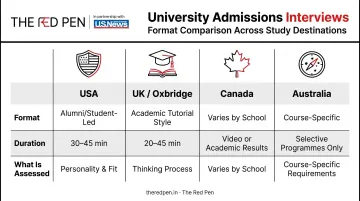
Always check your invitation email and the university's admissions page for format details before preparing.
What the Interview Arc Looks Like
Most interviews — roughly 20 to 45 minutes — follow a recognisable progression: icebreaker personal questions first, then academic and motivational questions, finishing with an opportunity for you to ask something. Knowing this arc helps you pace yourself and avoid front-loading your best material.
Treat it as a conversation, not an interrogation. Interviewers are assessing communication skills, intellectual curiosity, and cultural fit — not just your answers. A few practical reminders:
- Pause before answering a complex question — it signals maturity, not hesitation
- Ask for clarification if a question is unclear; interviewers expect it
- Save a thoughtful question to ask at the end; it shows genuine engagement
- Avoid rushing — pacing yourself through the arc matters as much as content
Personal and Background Questions
"Tell Me About Yourself"
This is the most universal opener — and the one most students answer poorly by reciting their CV. What interviewers actually want is a coherent narrative that connects your background, your academic interests, and where you're heading.
A useful structure: past → present → future.
- Past — your origin point: A specific experience or influence that sparked your interest, such as a project, a conversation with a teacher, or a book that shifted how you thought
- Present — what you're doing now: Your current academic focus and what you're pursuing outside school
- Future — where you're going: The direction you're heading and why this university fits that path
Keep it to 2–3 minutes. Practice it out loud until it sounds natural, not rehearsed.
"What Are Your Strengths and Weaknesses?"
Safe, vague weaknesses — "I'm a perfectionist" — tell interviewers nothing. They signal that you haven't thought carefully about yourself, and interviewers notice immediately.
A genuinely impressive answer picks a real weakness and shows active improvement. For example: "During board exam season in Class 12, I struggled to manage my time across multiple preparation tracks and extracurriculars. I started using weekly planning blocks and learned to set realistic daily targets. It didn't make the pressure disappear, but I stopped losing days to disorganisation."
Specific. Recent. With a demonstrable improvement arc.
"What Do You Like to Do in Your Spare Time?" and "What Are You Currently Reading?"
These questions reveal whether you're genuinely curious and self-directed. The ideal answer connects a hobby or book to broader intellectual interests — ideally with a link to your chosen field.
Saying you're reading a popular science book because your biochemistry teacher mentioned it in passing is more memorable than naming a classic you finished two years ago. Be honest and specific.
"What Achievement Are You Most Proud Of?"
The strongest answers are recent, meaningful, and show personal growth — not just a certificate on a wall. Non-academic achievements (community leadership, creative projects, sports captaincy, or sustained volunteer work) are valid — and frequently more interesting to interviewers.
The key is to explain what the experience demanded of you and what it changed.
"How Would Your Friends Describe You?"
Think of this as an indirect personality assessment. Rattling off adjectives — "hardworking, kind, determined" — gives the interviewer nothing to work with. Pick one or two genuine traits and back each with a concrete example:
"They'd probably say I'm the one who asks too many questions — in a good way, I think. When we worked on our school science project, I kept pushing the group to revisit our assumptions, which slowed us down at first but led to a much stronger result."
Academic and Subject-Specific Questions
"Why Do You Want to Study This Subject?"
Vague answers about "always loving" a subject consistently fall flat in academic interviews. Oxbridge interviewers, for instance, are trained to probe exactly this — Cambridge explicitly states that interviews assess academic ability, potential, and motivation. They can tell within minutes when a student hasn't gone beyond the school syllabus.
Strong answers trace a genuine intellectual journey:
- A specific module, book, or project that deepened your interest
- A question you encountered that you couldn't fully answer
- A connection between your chosen subject and something happening in the world
The answer should end with a clear link to a longer-term goal — not necessarily a rigid career plan, but a direction.
"Why Did You Choose This University?"
Generic answers about rankings or reputation are red flags. Every applicant mentions rankings. What differentiates you is showing you've done real research.
Build your answer around specific, named details:
- A particular module or course structure
- A faculty member whose research connects to your interests
- A teaching approach, research centre, or institutional resource you can't find elsewhere
At The Red Pen, this is one of the first things covered in interview preparation: go beyond the homepage, name actual professors and programmes, and explain why those specific offerings matter to you specifically.
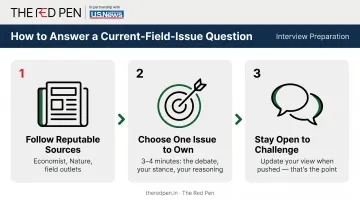
"Discuss a Current Issue in Your Chosen Field"
Demonstrating institutional fit matters, but so does showing intellectual curiosity beyond your coursework. This question tests whether you engage with your subject outside school — interviewers want to see you form a structured opinion with evidence, not just describe a headline.
How to prepare:
- Follow one or two reputable sources relevant to your discipline (academic journals, quality publications like The Economist, Nature, or field-specific outlets)
- Pick one issue you can discuss for 3–4 minutes: what the debate is, where you stand, and why
- Be willing to update your view if the interviewer pushes back — that's the point
"What Relevant Skills or Experiences Do You Have?" and "What Are Your Career Aspirations?"
These two questions work best together. Choose two or three transferable skills from extracurriculars, projects, or work experience and illustrate each with a specific example. Then connect them to both the demands of the degree and the direction you want to go.
You don't need a rigid 20-year plan. What you need is a directional goal: a career area you're drawn to, and a clear explanation of how this specific course gets you there.
Questions Unique to International Students
Indian applicants face an additional layer of questions that domestic students never encounter. These focus on motivation to study abroad, readiness for cultural transition, and ties to home — and they matter particularly for US visa contexts and UK admissions.
"Why Study Abroad Rather Than in India?"
The strongest answers go beyond "better education" — which can come across as dismissive of Indian institutions. Instead, anchor your answer in something specific:
- A programme structure or specialisation not available in India
- Exposure to a particular research ecosystem or industry
- A global career goal that requires international credentials or networks
Frame studying abroad as an additive opportunity, not an escape. Interviewers respond far better to "I want access to X, which I can build on my Indian educational foundation" than to "Indian universities don't match up."
"Why Did You Choose This Specific Country?"
This question tests whether your choice was deliberate or arbitrary. Connect the country's academic culture, industry environment, or institutional strengths to your specific goals. Consider what makes the country a logical fit — not just a desirable one. A student applying to read Computer Science in the US, for example, might point to proximity to Silicon Valley research culture and the flexibility of the liberal arts system to explore adjacent interests. That's a reasoned answer. "It has great universities" is not.
Strong country-choice answers typically connect:
- The country's industry ecosystem to your career field
- Academic culture or curriculum structure to your learning style
- Specific institutional strengths to your stated goals
"How Will You Adjust to a New Culture and Academic Environment?"
This is an adaptability question, not a loyalty test. Interviewers want evidence of resilience — draw on real experiences of navigating unfamiliar situations: a new school, travel, working in a diverse team, managing independence during board exam season.
Be specific. "I'm adaptable" tells interviewers nothing concrete. "When I joined a new school in Class 11 and knew nobody, I found my footing by..." is the start of a convincing answer.
"What Do You Miss Most About Home?" and "How Often Will You Return?"
These seemingly casual questions are actually assessing emotional readiness for the transition. Genuine, reflective answers work far better than scripted ones. Interviewers aren't testing your loyalty to India — they're checking that you've thought realistically about what the transition involves.
Across all four of these questions, the common thread is the same: show that your decision to study abroad is considered, not impulsive, and that you've done the inner work to back it up.
How to Prepare for Your University Interview
Research Your University Thoroughly
Before practicing a single answer, spend real time on the university's website: course structure, optional modules, faculty research areas, teaching methodology. Aim to prepare at least two or three specific, non-generic answers that reference the university by name. If you can't do that, you haven't researched enough.
Practice Out Loud — Seriously
This is the single most impactful thing you can do. Thinking through answers in your head and saying them aloud are completely different experiences. Spoken rehearsal improves structure, reduces filler words, and builds confidence in a way that mental preparation simply cannot replicate.
Practice with someone who will give honest feedback: a parent, teacher, or a professional who knows what these interviews actually look for. The Red Pen's mock interview service is built for exactly this:
- 30-minute recorded session under real interview conditions
- 30-minute live feedback call with a senior consultant
- Detailed written review after the session
- Oxbridge preparation handled by Oxford and Cambridge specialists (priced at ₹44,800, vs. ₹25,000 for non-Oxbridge) — because the preparation genuinely differs

Prepare for Interview Day Itself
Before the interview:
- Review your research notes and the two or three specific university details you want to mention
- Prepare 2–3 thoughtful questions to ask the interviewer — questions that go beyond what the website already answers
On the day:
- Arrive (or log on) early
- Listen to the full question before you begin answering
- Take a breath before responding to complex questions
- Avoid answers that sound memorised — if you've prepared properly, you won't need a script
The closing "Do you have any questions for us?" is itself an assessment point. Students who say "no" or ask something easily Googled signal a lack of genuine interest. Questions about course culture, research opportunities, or how the department's teaching approach has evolved show you've engaged seriously.
Frequently Asked Questions
What are the most common university interview questions for international students?
Questions fall into three main categories: personal background ("tell me about yourself," strengths and weaknesses), academic motivation ("why this subject," "why this university"), and international-student-specific questions about studying abroad and cultural adaptation. Prepare across all three — interviewers can pull from any of them.
How can international students pass a university interview?
Focus on thorough course and university research, practice answers out loud rather than mentally, and lead with genuine intellectual curiosity over rehearsed perfection. Authentic self-awareness consistently outperforms polished but hollow responses.
Do all universities require interviews for international students?
No. According to NACAC's Fall 2023 survey, 54.6% of US colleges rate the admissions interview as having "no importance," while only 4.3% rate it as "considerable." Interviews are most common at highly selective US liberal arts colleges, Oxbridge, and competitive programmes like Medicine and Law. Check each institution's admissions process individually.
How long do university admissions interviews typically last?
Most run between 20 and 45 minutes — Swarthmore interviews last 20–30 minutes, Yale 30–45 minutes, and Cambridge 20–45 minutes. MIT interviews can extend from 30 minutes to two hours depending on the conversation. Review your invitation and university website for format specifics beforehand.
Should I prepare differently for US versus UK university interviews?
Yes. US interviews (often alumni-led) tend to be conversational, focusing on personality and fit. UK interviews — especially Oxbridge — are academic and tutorial-style, designed to probe how you think through problems, not what you already know. The preparation, and the mindset you walk in with, should differ accordingly.
How should I handle a question I don't know the answer to?
Stay calm, think out loud if it helps, and be honest if you're uncertain. Interviewers — especially at Oxbridge — appreciate a thoughtful attempt and intellectual honesty over a rushed or fabricated answer. Showing reasoning ability and genuine curiosity matters far more than knowing every fact.