Introduction
Most Oxford applicants spend weeks dreading trick questions designed to catch them out. In practice, that's quite the opposite of what happens.
Oxford interviews are not ambushes. They are academic conversations modelled on the university's tutorial system, where tutors want to see how you think, not just whether you've memorised the right answer. Once you grasp that distinction, your entire preparation approach shifts.
Oxford shortlists roughly 10,000 of the 23,000+ applicants who apply each year for approximately 3,245 undergraduate places. If you've been invited, you've already cleared a significant competitive hurdle. What follows will help you use that invitation well — covering the interview format, real question types across subjects, and a preparation strategy you can act on immediately.
Key Takeaways
- Oxford interviews roughly 10,000 of 23,000+ annual applicants — an invitation is a meaningful achievement
- Tutors assess how you think, not how much you know
- Five distinct question types appear across subjects, each requiring a different preparation approach
- Thinking aloud is explicitly encouraged — silence is not
- All 2026 interviews are conducted online via Microsoft Teams
What the Oxford Interview Actually Is
Oxford describes undergraduate interviews as academic conversations about your chosen subject, similar to a short tutorial. The tutors interviewing you may become your actual teachers if you receive an offer. They're not assessing you against a checklist; they're testing whether you can function in Oxford's demanding tutorial environment.
What Tutors Are Assessing
Oxford is explicit about what it looks for:
- Intellectual curiosity — do you find ideas genuinely interesting?
- Motivation for the subject — is this academic enthusiasm or just a strong grade?
- Ability to engage with unfamiliar ideas — can you work through something new when guided?
- Critical thinking under gentle pressure — how do you respond when challenged?
What Tutors Are Not Assessing
The interview is also defined by what it is not. Oxford states that decisions are not based on manners, appearance, or background — only on academic potential and intellectual engagement.
The interview is not a personality test, a social confidence assessment, or an opportunity to showcase extracurricular achievements. A quiet student who works through an unfamiliar problem with genuine curiosity will fare better than a confident one who can't engage with the reasoning itself.
Who Gets Shortlisted — and When
Oxford receives over 23,000 undergraduate applications each year and shortlists around 10,000 candidates. Tutors base shortlisting decisions on your full application: academic record, admissions test performance, personal statement, predicted grades, academic reference, and any submitted written work. If you don't receive an invitation, your application was unsuccessful at that stage — Oxford sends no separate rejection letter.
Timeline to know:
- Shortlisting decisions are communicated between mid-November and early December
- Candidates typically receive often just one week's notice before their interview
- All undergraduate interviews for the 2026 cycle are conducted online via Microsoft Teams in early-to-mid December
- Many courses reallocate candidates between colleges during shortlisting, so your interview college may differ from your application college
For Indian applicants, the online format removes the need to travel — but it also means the preparation window is compressed and demanding.
Oxford Interview Format: Structure, Technology, and What to Expect
Structure
Most shortlisted candidates have more than one interview, sometimes at more than one college. Joint course applicants are typically interviewed separately by tutors from each subject. Oxford aims to give at least 24 hours' notice for any additional interviews.
A typical interview follows this pattern:
- A warm-up question (often drawn from your personal statement)
- Subject-specific academic questions — progressing in difficulty
- Problem-solving questions, sometimes involving entirely new material introduced mid-interview
Technology Tiers for Online Interviews
Oxford assigns each subject to one of three technology tiers:
| Tier | Requirements |
|---|---|
| Tier 1 | Computer with microphone, webcam, speakers, and Microsoft Teams |
| Tier 2 | Tier 1 plus a Miro virtual whiteboard on the same device |
| Tier 3 | Tier 1 plus a touchscreen device (min. 8 inches, not a mobile phone) with stylus for Miro virtual whiteboard |
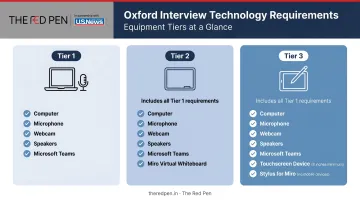
No candidate is expected to purchase equipment. If Tier 3 technology is a problem, colleges will arrange an alternative.
When You Don't Know the Answer
Tutors regularly introduce new concepts mid-interview. This is intentional — they want to see how you engage with unfamiliar material in real time, not whether you already know the answer. Keep these points in mind:
- There is often more than one valid answer
- Thinking aloud is explicitly encouraged and is part of what's being assessed
- A well-reasoned wrong answer almost always outperforms a correct answer with no explanation
Types of Oxford Interview Questions — With Real Examples
Oxford publishes its sample interview questions with tutor commentary. Reviewing these is one of the most targeted preparation moves available. The questions fall into five categories.
1. Personal Statement and Motivation Questions
These open the interview and are designed to settle nerves, not test depth. Tutors may ask:
- "Why have you applied for this course?"
- "You mentioned X in your personal statement — can you tell me more about that?"
Re-read everything you submitted before your interview. If you listed a book, re-read it critically — not just what it argues, but what questions it raises or leaves unanswered.
2. Curriculum Extension Questions
These take familiar A-level or IB concepts and push them further. Examples:
- Biology: "Why do some habitats support higher biodiversity than others?"
- Chemistry: a solubility graph you're asked to interpret and explain
The goal is to see how far your thinking can stretch beyond the syllabus — tutors are far more interested in your reasoning process than in textbook recall.
3. Novel Problem and Logical Reasoning Questions
Entirely unfamiliar scenarios that test structured reasoning:
- Chemistry: "How many different molecules can be made from six carbon atoms and twelve hydrogen atoms?" — Tutor commentary notes this lets candidates demonstrate understanding of chirality, isomerism, and ring structures.
- Computer Science: "A group of 7 pirates has 100 gold coins..." — Tests algorithmic reasoning and the ability to work backwards through a problem.
No prior knowledge of the specific problem is expected or needed.
4. Material-Based Questions
Candidates may be given a text, poem, graph, data set, or image and asked to analyse it. Some subjects add extra preparation time: Economics candidates receive a written puzzle 10 minutes before the interview, while Fine Art interviews centre on a portfolio discussion.
The key skill here is evidence-based reasoning — working through the material aloud, showing your thinking as it develops, rather than reaching for a "correct" conclusion.
5. Philosophical and Ethical Questions
Common in Law, PPE, Philosophy, and Theology:
- "If the punishment for parking on double yellow lines were death, and therefore nobody did it, would that be a just and effective law?"
Tutor commentary is clear: there's no expected right or wrong answer. Strong responses separate justness from effectiveness, consider proportionality, and respond to counterarguments without abandoning the position entirely.
Subject-Specific Oxford Interview Questions by Discipline
Humanities and Social Sciences
| Subject | Sample Question | What It Tests |
|---|---|---|
| History | "What would a historian find interesting about the place where you live?" | Observation, curiosity, applying historical thinking to the everyday |
| Law | "Should it be illegal to run a red light in the middle of the night on an empty road?" | Normative reasoning — separating legal effectiveness from justice |
| English | "Why might an English student be interested in the fact that Coronation Street has been running for 50 years?" | Applying literary analysis beyond canonical texts — serialisation, character development, popular vs canonical status |
STEM and Quantitative Subjects
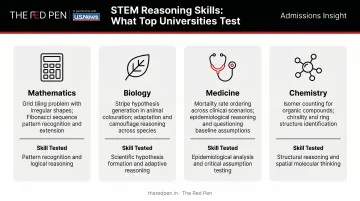
- Mathematics: "How many ways are there to cover a 2 x n rectangular grid with 2 x 1 tiles?" — Tests systematic investigation, pattern recognition, and Fibonacci-style reasoning applied to a new context.
- Biology: "Why do many animals have stripes?" — Candidates generate and test multiple hypotheses around adaptation, camouflage, and mimicry.
- Medicine: "Put these countries in order by crude mortality rate: Bangladesh, Japan, South Africa, the UK." — Tests epidemiological reasoning — the counterintuitive answer (Japan ranks highest, due to its ageing population) rewards candidates who interrogate assumptions rather than rely on instinct.
PPE and Interdisciplinary Subjects
PPE and interdisciplinary courses test your ability to hold multiple frameworks at once — philosophical, economic, and political — often within a single question.
- PPE: "The plane will fly whether or not I take it, so there's no moral reason not to travel by plane. Is this convincing?" — Tests whether you can identify logical gaps and reason through individual responsibility for collective outcomes.
- Economics and Management: "Do bankers deserve the pay they receive?" — The aim is to move past a fairness instinct and reason through competitive labour markets, talent scarcity, and whether market outcomes reflect social value.
Across every subject, the interviewer's job is not to assess what you know — it's to see how you think when the answer isn't obvious. Preparing for that discomfort, rather than memorising model answers, is what separates strong candidates.
How to Prepare for Your Oxford Interview: Step by Step
Step 1: Master Your Personal Statement
Re-read everything you submitted. Every book mentioned, every project described, every interest cited. Tutors frequently open here, and candidates who can only skim the surface of something they claimed to be passionate about lose credibility immediately. Be ready not just to describe what something argues, but to articulate what questions it leaves open.
Step 2: Practise Thinking and Speaking Simultaneously
This is Oxford's own top preparation tip. Most students are not accustomed to explaining their reasoning aloud in real time — it feels unnatural at first. Practise working through problems with a teacher, family member, or even by recording yourself. The goal is not polished answers. It's audible reasoning.
Mock interviews in a genuinely academic style are essential — meaning someone who will push back on your answers and see how you adapt, not just nod encouragingly.
Step 3: Read Beyond the Syllabus
Oxford interviews explore how you engage with ideas beyond the school curriculum. Read quality journalism relevant to your subject — The Economist, Nature, Financial Times. Have a developed opinion on a recent development in your field, with evidence and honest acknowledgement of counterarguments. Interviewers notice when enthusiasm is real.
Step 4: Use Oxford's Own Preparation Resources
Oxford provides two resources that are among the best preparation available:
- Sample interview questions with tutor commentary — subject-specific questions with tutors explaining exactly what they're looking for
- Demonstration interview videos — real tutors interviewing current students, followed by tutor commentary on what worked and why
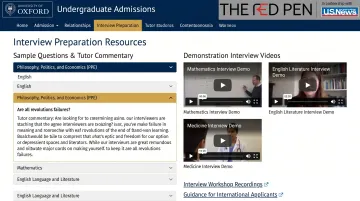
Both are free. Start here before looking anywhere else.
Step 5: Close the Gap with Expert Guidance
For Indian applicants unfamiliar with the Oxford tutorial format, the learning curve is steeper — and the preparation window is short. The Red Pen offers a dedicated Undergraduate Interview Prep for Oxbridge service (₹44,800), led by President Namita Mehta, who brings deep expertise in training applicants for the Oxford and Cambridge interview process.
The service is available as a standalone purchase — no full consulting package required. For students who want structured coaching in the intellectual dialogue Oxford expects, it's a practical way to prepare with someone who understands what these interviews actually demand.
Frequently Asked Questions
How do you prepare for an Oxford University interview?
Re-read your personal statement, practise explaining your reasoning aloud, work through Oxford's published sample questions, and watch their demonstration interview videos. Mock interviews in a tutorial-style format — where someone challenges your answers and sees how you adapt — are more useful than rehearsing set responses.
What are the most common Oxford University interview questions?
Oxford interview questions fall into five types: personal statement and motivation questions, curriculum extension questions, novel problem-solving questions, material-based analysis questions, and philosophical or ethical reasoning questions. All five assess reasoning and intellectual engagement rather than subject recall.
What is a good interview score at Oxford?
Oxford does not publish a standardised numeric interview score. Oxford weighs academic record, admissions test results, and interview performance together — no single element decides your outcome. Candidates who demonstrate genuine intellectual engagement and strong reasoning are the ones who receive offers.
Does Oxford interview everyone who applies?
No. Oxford shortlists roughly 10,000 of 23,000+ annual applicants. If you're not invited to interview, your application was unsuccessful at the shortlisting stage. Receiving an invitation is a meaningful competitive achievement.
How many Oxford interviews will I have?
Most shortlisted candidates have more than one interview, sometimes at more than one college as part of Oxford's reallocation process. Joint course applicants are typically interviewed separately by tutors from each subject. Oxford aims to give at least 24 hours' notice for any additional interviews.
Can international students attend Oxford interviews online?
Yes. All Oxford undergraduate interviews are currently conducted online via Microsoft Teams, making them fully accessible to applicants in India. You need a reliable internet connection, a quiet space, and the appropriate device for your subject's technology tier.