This guide focuses on admissions interviews conducted by universities — the kind Oxford, Cambridge, and selective US universities use to assess academic curiosity, communication skills, and programme fit. It covers the types of questions you will face, how to structure strong answers, what to ask the interviewer, and how to prepare effectively.
Key Takeaways
- University interviews assess intellectual curiosity and self-awareness, not just academic grades
- Interview questions typically fall into four types: motivational, competency-based, subject-specific, and personal reflection
- The STAR method (Situation, Task, Action, Result) structures competency answers clearly
- Preparing 5–7 personal examples before the interview prevents blanking under pressure
- Thoughtful questions at the end of the interview leave a strong final impression
What University Admissions Interviews Actually Test
Interviewers are not trying to catch you out. They are having a structured conversation to assess whether you can thrive in a rigorous academic environment.
According to Cambridge, interviews are "academic conversations" and "a core part" of the admissions process, used to assess potential for the chosen course. Oxford's guidance states that tutors look for "self-motivation and enthusiasm for your subject" — decisions are not based on manners, appearance, or background.
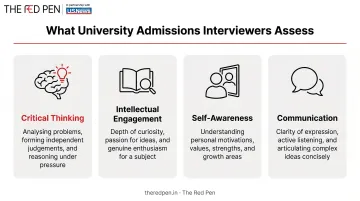
What interviewers are actually evaluating:
- Critical thinking — reasoning through an unfamiliar problem, not reciting a memorized answer
- Intellectual engagement — showing genuine curiosity rather than surface-level interest in your subject
- Self-awareness — understanding your own strengths, motivations, and where your knowledge has limits
- Communication — articulating ideas clearly when you're thinking on your feet
Interview Formats Vary by Institution
| Format | Where It Appears |
|---|---|
| One-on-one academic interview | Oxford, Cambridge (most subjects) |
| Multiple Mini Interviews (MMIs) | Medicine programmes at Imperial, Manchester, Bristol |
| Alumni conversations | Princeton, Dartmouth, MIT (optional) |
| Video interviews | UBC Sauder BCom, Waterloo Engineering |
Each format demands a different preparation approach, so research your specific university before you begin. For Indian students applying to US and UK universities, interview invitations typically arrive later in the admissions cycle, once the initial application review is complete — which means strong interview performance often carries outsized weight in the final decision.
Types of University Interview Questions and How to Answer Them
Motivational Questions
These questions probe why you chose this specific course and university. Interviewers are checking for genuine academic interest, not a rehearsed speech.
Common examples:
- "Why do you want to study this subject?"
- "Why this university?"
- "Where do you see yourself in five years?"
How to answer: Tie your response to specific course features — particular modules, faculty research areas, or the teaching style (tutorials vs. lectures). Generic statements like "this university has a great reputation" tell the interviewer nothing useful about you.
Before the interview, prepare by researching:
- Optional modules and how they connect to your interests
- Faculty whose research aligns with what you want to explore
- Recent departmental publications or projects worth mentioning
A student who can say "I was drawn to Professor Y's research on Z" signals real preparation — and gives the interviewer something to follow up on.
Competency and Behavioural Questions
Unlike motivational questions, these focus on what you've actually done — using past behaviour to predict how you'll perform.
Common examples:
- "Tell me about a time you overcame a setback."
- "Describe a situation where you led a team."
- "How do you handle conflicting opinions?"
How to answer: Use the STAR method (covered in the next section). Draw examples from academic projects, extracurricular activities, or part-time work. Vague answers — "I generally handle conflict well" — carry no weight. Specificity matters, and so does reflecting on what you learned.
Subject-Specific and Academic Questions
These questions test depth of knowledge and genuine intellectual curiosity in your chosen field.
Common examples:
- "Discuss a current issue in your field."
- "Tell us about a book or article that influenced your thinking."
- "What's the most interesting thing you've studied recently?"
How to answer: Stay current with reputable publications in your field and prepare 2–3 books or articles you can discuss confidently — including aspects you disagreed with. Interviewers often follow up with probing questions, so prepare to go beyond the headline argument. The Red Pen coaches medicine applicants, for instance, to engage with live clinical debates — not just summarise articles, but take a position on them.
Personal Reflection Questions
These come at the end of many interviews and assess how well you know yourself — including your limits.
Common examples:
- "What are your strengths and weaknesses?"
- "What isn't on your CV?"
- "How do you stay motivated?"
How to answer: Choose a genuine weakness and frame it around active steps you have taken to improve. The classic "I'm a perfectionist" response is overused and unconvincing. A student who says "I struggled with public speaking, so I joined a debate club last year" lands far better than one who deflects with a strength dressed up as a flaw.
How to Structure Your Answers: The STAR Method
The STAR method — Situation, Task, Action, Result — is a well-established framework for answering competency and behavioural questions. Yale's Office of Career Strategy and MIT's Career Advising team both endorse it for exactly this purpose.
The four components:
- Situation — Brief context. Where were you, and what was happening? (2–3 sentences maximum)
- Task — What did you need to achieve or solve?
- Action — What did you specifically do? Use "I," not "we." This is the most important part.
- Result — What happened? Aim for a measurable or observable outcome.
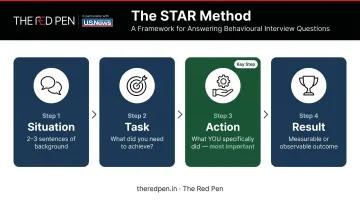
These four steps give your answer shape. The mistake most students make, though, is spending too long on setup and too little on what they actually did. The Action component is where you demonstrate the skills the interviewer is assessing — give it the most time.
Adding Reflection: The Fifth Step
Many students stop at Result. Adding a brief reflection — what you learned or what you would do differently — demonstrates maturity and self-awareness. Imperial College Medicine's interview guidance explicitly uses a STARR framework (with the second R for Reflection) for exactly this reason.
STAR in Practice
Question: "Describe a time you handled a difficult situation."
Without structure: "I had a tough group project once where people weren't contributing, but we managed to get it done in the end."
With STAR:
"In my final year, I was leading a group project for a national science competition. Two team members stopped contributing two weeks before the deadline, leaving three of us to complete their sections. I scheduled individual check-ins with each person, identified that one was dealing with exam pressure and the other had lost confidence in his role. I reassigned tasks based on each person's strengths and created a daily progress tracker. We submitted on time and placed second nationally. Looking back, I would have structured clearer roles at the start to prevent the bottleneck — that's something I now apply to every group project."
What makes the second answer stronger is that it names specific actions, shows how you read people, and ties the outcome to your decisions — not luck or group effort.
Questions to Ask the Interviewer
Saying "no" to "Do you have any questions for us?" signals indifference — never skip this. Prepare 3–4 questions in advance, and avoid anything easily answered on the university's website.
Strong question examples you can adapt:
- "What distinguishes students who thrive in this programme from those who struggle?"
- "How does the department support undergraduate research or independent projects?"
- "What does a typical tutorial or seminar look like in the first year?"
- "What do you find most intellectually rewarding about teaching this subject?"
These questions signal genuine curiosity about the academic experience, not just about securing a place. The answers can also help you compare programmes if you receive multiple offers.
How to Prepare for Your University Interview
Research the Programme Thoroughly
Know the course structure, optional modules, faculty specialisms, and any recent departmental news before the interview. This research is the foundation for answering motivational questions convincingly — and it shows.
Oxford advises applicants to review submitted work and practise talking about their subject. Cambridge recommends practising explaining ideas out loud, not just thinking them through silently.
Build a Bank of Personal Examples
Prepare 5–7 strong examples from your academic, extracurricular, and personal life that can be adapted to different questions. Cover:
- A leadership experience
- A time you overcame a setback
- A moment of intellectual curiosity or discovery
- A situation involving teamwork or conflict
- Something that isn't on your CV
Having these ready before the interview prevents blanking under pressure.
Do Mock Interviews
Mock interviews are the single most effective preparation tool. The goal is to get comfortable articulating ideas out loud — thinking through an answer in your head and saying it clearly are very different skills.
Working with an experienced admissions counsellor gives you structured practice with feedback tailored to your target universities. The Red Pen's interview preparation service includes recorded mock sessions, real-time feedback, and written review from a senior consultant. For Oxbridge applicants, The Red Pen offers specialist preparation led by Namita Mehta, who specialises in the Oxford and Cambridge interview format.
Once your preparation is in place, a few practical steps on the day itself can make a real difference.
Interview-Day Logistics
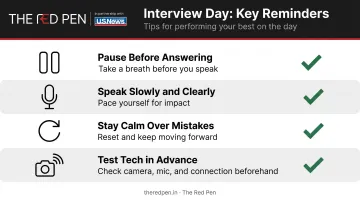
- Pause before answering — a brief pause signals thoughtfulness, not hesitation
- Speak slowly and clearly — nerves speed up speech
- Don't panic over mistakes — calmly revise your answer and continue
- For online interviews — test your camera, microphone, and internet connection the day before. Bristol Medicine specifies a minimum internet speed of 1.5Mbps for remote interviews
Frequently Asked Questions
How should I prepare for a university admissions interview?
Research the university and programme thoroughly, prepare personal examples using the STAR method, and practise with mock interviews. Specific preparation — knowing course details, faculty research, and your own examples — translates directly into stronger, more confident answers.
What are the most common university admissions interview questions?
Questions fall into four categories: motivational (why this course/university), competency-based (past experiences and skills), subject-specific (academic knowledge and reading), and personal reflection (strengths, goals, self-awareness). Most interviews draw from all four.
What is the STAR method and how do I use it?
STAR stands for Situation, Task, Action, Result: a framework for structuring competency-based answers clearly. Describe the context briefly, state what you needed to achieve, explain what you specifically did, and share the outcome — including a sentence on what you learned.
Do all universities require an admissions interview?
No. Oxford and Cambridge interview shortlisted applicants, and Cambridge interviews over 75% of applicants. Many US universities offer optional alumni interviews, while others (such as LSE or Columbia) conduct none. Always confirm interview requirements on each university's admissions page.
What should I avoid saying in a university admissions interview?
Avoid vague, generic answers ("I've always loved science"), exaggerating achievements, speaking negatively about previous schools or teachers, and using "we" when describing your personal contribution to a team effort.
How long do university admissions interviews typically last?
Most interviews run between 20 and 45 minutes, though Cambridge sessions can total up to an hour across one or two rounds. MMI formats use multiple shorter stations instead of a single interview. Confirm the exact format with each university's admissions office before you prepare.