Here's what changes everything: preparation. Not memorisation, but genuine preparation.
According to NACAC's Fall 2023 admissions data, interviews carry considerable or moderate importance for a meaningful share of colleges — and at institutions like Yale, they're explicitly evaluative. The students who walk out feeling confident aren't the ones with the flashiest résumés. They're the ones who walked in knowing their stories.
This guide covers 25 common college interview questions, grouped by theme, with answering strategies for each — so you're prepared for the conversation, not just the questions.
Key Takeaways
- College interviews are evaluative conversations: interviewers want to understand who you are beyond your application, not catch you off guard.
- The strongest answers are specific and personal — "I'm a hard worker" tells an interviewer nothing.
- Preparation is not memorisation — know your stories, then let the conversation breathe.
- Always prepare 2–3 questions to ask your interviewer — it signals genuine interest and keeps the conversation two-sided.
What to Expect in a College Interview
Interview Types and Formats
Most college interviews fall into two broad categories: informational (relationship-building, not formally reviewed) and evaluative (formally assessed and added to your application file). The practical advice: treat every interview as evaluative, regardless of what you're told going in.
Three formats are common:
- In-person — on campus or with a local alumni representative
- Virtual — live video calls via Zoom or Google Meet
- Recorded video submissions — asynchronous formats like those used by Waterloo Engineering, or optional video introductions at Brown and UChicago
Duration varies more than most guides admit. College Board says to expect 30 minutes to an hour, while MIT interviews typically run a full hour and can extend to two. Plan for 30–60 minutes and be ready for longer.
Who Will Interview You
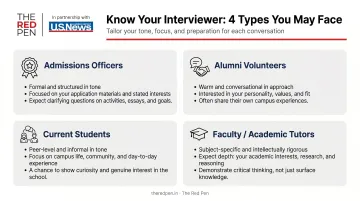
Knowing who sits across from you — whether in person or on screen — shapes how you prepare. The interviewer type determines the tone, depth, and focus of the entire conversation:
- Admissions officers — formal, structured, focused on fit and your application
- Alumni volunteers — more conversational, locally focused, often keen on your personality and values (Yale, MIT, Harvard, Georgetown all use alumni)
- Current students — peer-level, informal, often focused on campus life and community
- Faculty/academic tutors — subject-specific and intellectually rigorous (common at Oxford and Cambridge)
Oxford and Cambridge interviews stand apart from the rest — they are academic conversations designed to explore how you think, not recitations of what you know. Oxbridge preparation needs to be subject-focused, not just personal.
25 Common College Interview Questions, Grouped by Theme
Rather than memorising 25 separate scripts, build a bank of stories and talking points. Most interviewers won't ask all 25 — but knowing them means nothing catches you off guard.
Questions About Who You Are
- Tell me about yourself.
- How would your friends describe you?
- Describe yourself in three adjectives.
- What makes you unique?
- What do you like to do outside of school?
How to answer: These are invitations to shape your narrative, not recite your application. Pick one or two specific, concrete details that connect your personality to why you'd be a good fit on that campus. The answer to "tell me about yourself" should feel like the start of a conversation — not a LinkedIn summary read aloud.
Questions About Your Academics
- What do you hope to study in college, and why?
- What has been your favourite class in high school, and why?
- Describe a project, paper, or lab you particularly enjoyed.
- What book, article, or idea has recently challenged how you think?
- What academic goals do you hope to accomplish in college?
How to answer: You don't need a perfectly mapped career plan. Interviewers want to see intellectual curiosity — what drew you to the subject, and what questions it makes you want to keep asking. Focus on the "why," not your grades or class rankings.
Questions About Character, Strengths, and Challenges
- What are your biggest strengths?
- What are your biggest weaknesses?
- Tell me about a challenge you've had to overcome.
- Tell me about a time you acted as a leader.
- What achievement are you most proud of?
How to answer: For strengths, skip "hardworking" and "detail-oriented" — pick a quality that actually differentiates you, and anchor it with one brief example. For weaknesses and challenges, share something real. What impresses interviewers is self-awareness and the growth that followed, not the absence of difficulty. Honest and specific always lands better than polished and generic.
Questions About Your Fit for This College
- Why do you want to attend this college?
- What are your goals for college?
- What will you contribute to our campus community?
- What are you looking for in a college?
- Is there anything about your application you'd like to clarify or expand on?
How to answer: This category separates prepared students from unprepared ones quickly. Reference specific programs, professors, research opportunities, clubs, or campus culture elements that genuinely connect to your goals. Generic answers about "reputation" or "location" won't distinguish you. If you can't name something specific about the college, you haven't done enough research.
Future Goals and Curveball Questions
- Where do you see yourself in 10 years?
- Who is your role model, and why?
- If you could have dinner with any three people, dead or alive, who would they be?
- How do you handle stress?
- Do you have any questions for me?
How to answer future questions: Frame your answer around a direction, a value, or a type of impact you want to have — then connect it to what this specific college offers.
For curveballs (questions 22–23): The goal isn't a clever answer. It's a revealing one. Interviewers want to see how you think, what you value, and what kind of person you are. There's no objectively right answer to the dinner party question, but walking in without one prepared is a missed opportunity to show who you are.
For question 25: Always say yes. Prepare 2–3 specific, thoughtful questions in advance, ones that can't be answered by a quick scan of the college's homepage.
How to Answer College Interview Questions Effectively
Use a Simple Answer Structure
For behavioural questions — challenges, leadership moments, achievements — a clean three-part structure prevents rambling:
- Set up the situation briefly (one or two sentences of context)
- Describe the action you specifically took
- Share the result or what you learned from it
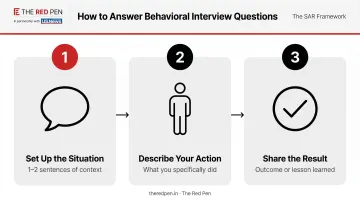
This keeps answers focused without sounding robotic. The goal is clarity, not a scripted performance.
Specificity Beats Generality
A single vivid anecdote about one meaningful experience will always outperform a vague summary of five. Interviewers remember stories. They don't remember bullet points.
Instead of: "I've always been a leader in group settings."
Try: "When our Model UN team lost our faculty advisor three weeks before a national conference, I coordinated a rotating prep schedule so every delegate could still practice their resolution. We ended up placing second overall."
One story. Specific. Memorable.
Practicing vs. Memorising
Knowing your key stories well and memorising word-for-word answers are not the same thing. The first builds genuine confidence; the second tends to come across as rehearsed and flat.
Harvard's own guidance describes the interview as a chance to share what makes you tick — not to perform. Practice your answers out loud, with a real person, not just in your head. Record yourself if no one's available. Pay attention to pacing, filler words, and whether your answers actually sound like you.
When You Draw a Blank
It happens to everyone. The best response: pause, breathe, and ask for a moment if you need one. Saying "That's a question I want to give a thoughtful answer to — can I take a second?" reads as composure, not weakness.
Interviewers aren't trying to trip you up. They'll take someone who thinks before speaking over someone who rushes and rambles.
Stay Consistent With Your Application
Composure under pressure matters — so does consistency across your entire application. If your interview is evaluative, the interviewer may have read your essays. Your spoken answers should deepen what you wrote — not contradict it. Be ready to expand on your application's themes, not revisit them from scratch.
Tips to Prepare for Your College Interview
Research the College Thoroughly
Before any interview, spend time on:
- Department and faculty pages (know at least one professor whose work interests you)
- Clubs, research centers, or programmes specific to your goals
- Recent news about the college (new initiatives, campus developments)
- Course offerings that aren't available at comparable schools
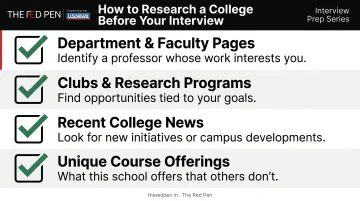
This research serves double duty — it fuels your "Why this college?" answer and gives you material for the questions you'll ask the interviewer.
Practice Out Loud
Thinking through answers in your head feels very different from saying them aloud. Practice with a friend, parent, or mentor who will actually push back and ask follow-up questions. Record a session on video — you'll catch filler words and eye contact issues you never noticed otherwise.
For virtual interviews specifically, test your audio, lighting, and background at least a day in advance. A lagging connection or a cluttered background is a distraction you can avoid entirely.
Work With an Expert If You're Targeting Competitive Universities
For students in India applying to selective US, UK, or Canadian universities — where interviews carry real evaluative weight — structured mock interview preparation can shift how confidently and specifically you perform on the day. The Red Pen offers dedicated undergraduate interview preparation, covering both virtual and in-person formats, with recorded mock sessions and one-on-one feedback.
There's a separate Oxbridge-specific package for students targeting Oxford and Cambridge, where the subject-focused interview format demands a distinct approach. Both are available as standalone services, so students who've already handled their applications can focus preparation time specifically on the interview.
Frequently Asked Questions
What are the most common college interview questions?
The most frequently asked questions include "Tell me about yourself," "Why do you want to attend this college?", "What do you hope to study and why?", and questions about strengths, challenges, and extracurriculars. All 25 are covered in depth above, grouped by theme.
What should I say in a college interview?
Focus on specific, personal stories that connect your background and goals to the college you're applying to. Authentic, well-prepared answers leave a stronger impression than polished but generic ones.
What are good questions to ask in a college interview?
Ask about a specific academic programme, a research opportunity, the interviewer's own experience at the college, or how students in your intended department get involved in hands-on work. Avoid anything easily answered on the college's website.
Do college interviews affect admission decisions?
It depends on the college. Yale explicitly calls its interviews evaluative; military academies treat them as required application components. Other schools use them primarily for information-gathering. A strong interview rarely guarantees admission, but a weak one can hurt — always treat the interview as evaluative.
How long do college interviews typically last?
Most college interviews run between 30 and 60 minutes, though MIT interviews can last up to two hours and some schools schedule 30-minute sessions. The format is designed to feel conversational rather than formal.
How should I prepare for a college interview?
Three steps: research the specific college in depth, practise answering common questions out loud with a real person, and prepare a short list of thoughtful questions for the interviewer. The more specific your preparation, the stronger your answers will be.