Introduction
The night before a college interview, most students face the same spiral: What if I blank? What if I say the wrong thing? What if I come across as rehearsed? These fears are completely normal — and preventable.
A mock college interview is the most direct way to convert that anxiety into actual confidence. Not because practice eliminates nerves, but because it replaces the unknown with experience. Once you've sat through a 30-minute mock, the real thing stops feeling like a test and starts feeling familiar.
This guide walks you through what a mock interview actually is, the question types you'll encounter at US, UK, and Canadian universities, and a preparation approach built around authentic answers — not scripted ones.
Key Takeaways
- College interviews — evaluative or informational — are your chance to show the person behind the application, and mock prep helps you make the most of it.
- Questions cluster into five predictable categories: personal background, academics, extracurriculars, school fit, and curveballs.
- Effective prep means real-condition simulations and structured feedback — not memorising scripts.
- Interviewers look for genuine self-awareness and intellectual curiosity, not polished performances.
What Is a Mock College Interview and Why Does It Matter?
A mock college interview is a structured practice session that replicates the real admissions interview. A student answers typical questions, receives feedback on both content and delivery, and identifies gaps — before any of it counts.
Most students have never sat through a formal evaluative interview before. The skills it demands don't come naturally without practice:
- Structuring a clear, conversational answer under pressure
- Thinking on your feet when a question catches you off guard
- Maintaining composure and staying present throughout
What the Research Shows
A 2023 study of 451 undergraduate engineering students found that 53% expected excessive stress before oral evaluations, but only 25% actually reported excessive stress afterwards. Students with no prior oral exam experience expected significantly more stress than those who had practice. The takeaway: familiarity with the format reduces anxiety.
What the Interview Is Actually Testing
This matters because the real interview is not an academic test. MIT says its interview helps admissions see the "whole person" beyond how an applicant looks on paper. Yale states that its interviews assess intellectual curiosity, character, values, and potential contribution. The shift in mindset — from performing to conversing — students rarely develop on their own. A mock interview builds that instinct before it counts.
Types of College Interviews to Prepare For
Not all college interviews work the same way. Knowing the format before you walk in — or log on — determines exactly how you should prepare.
Evaluative vs. Informational
- Evaluative interviews: The interviewer's notes become part of your application file. Yale explicitly states that all its interviews are evaluative.
- Informational interviews: Primarily focused on helping you learn about the college, though interviewers may still share impressions with admissions committees.
Treat every interview as evaluative, regardless of how it's described. Even a relaxed informational session is an opportunity to make an impression.
Interview Formats to Know
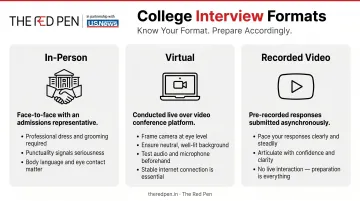
| Format | Key Preparation Considerations |
|---|---|
| In-person (on campus or local) | Professional dress, punctuality, body language awareness |
| Virtual (Zoom, Google Meet, FaceTime) | Camera angle, lighting, audio quality, stable internet connection |
| Recorded video submission | No live interaction — pacing, clarity, and editing matter more |
Each school has specific requirements worth confirming ahead of time:
- Stanford permits Zoom, Google Meet, Microsoft Teams, or FaceTime, and recommends headphones to reduce audio feedback
- Oxford expects online candidates to test their equipment and internet connection in advance
- UBC Sauder requires a technology check before the formal VidCruiter recording begins
These formats differ more than most students expect. Speaking to a camera with no one responding — as in a recorded submission — demands a very different kind of preparation than a live Zoom conversation.
Common Mock College Interview Questions by Category
No two interviews are identical, but questions consistently fall into five categories. Preparing a solid, flexible response for each category — rather than memorising individual answers — is the most effective strategy.
Personal and Background Questions
- "Tell me about yourself."
- "Describe yourself in three adjectives."
- "How would your friends describe you?"
- "What's something not on your application that you'd want us to know?"
What interviewers want here: Not a biography — a focused narrative that connects who you are to why you'd thrive at this particular school. MIT advises students to think through stories and examples that give a vivid sense of their passions and aspirations, not just a list of achievements.
Academic Questions
- "What do you hope to study, and why?"
- "Tell me about a project or paper you're proud of."
- "What was your most — or least — favourite subject, and why?"
- "What's the last book you read outside of school?"
What interviewers want here: Genuine intellectual curiosity. These questions test whether you actually engage with ideas, not whether your grades are impressive. Yale advises students to be engaged conversationalists and to elaborate rather than give one-word responses.
Extracurricular and Personal Interest Questions
- "What do you do outside of school?"
- "Tell me about a leadership experience."
- "What are you most proud of?"
- "Is there an activity you wish you'd started earlier?"
What interviewers want here: How you'd contribute to campus life beyond academics. The goal isn't to list everything — it's to talk meaningfully about one or two things you actually care about.
"Why This College?" Questions
- "Why do you want to attend this school?"
- "What are your goals for college?"
- "What would you contribute to our campus community?"
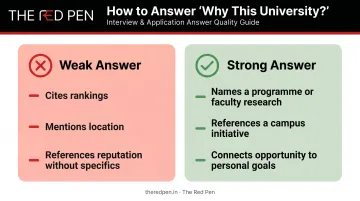
What makes a weak answer: Citing rankings, location, or reputation without specifics. Any student could say the same thing about any school, which is precisely what makes these answers forgettable.
What makes a strong answer: Referencing a specific programme, a faculty member's research, a campus initiative, or an opportunity that genuinely aligns with your interests. Generic praise signals you haven't done your homework.
Curveball and Situational Questions
- "If you could have dinner with anyone, who would it be?"
- "What song best describes your last year?"
- "If you were an animal, what would you be?"
These questions aren't traps. Oxford notes that applicants may be asked to explore unfamiliar ideas or think through problems aloud — the point is to see how a student reasons, not whether they land on the "right" answer.
There is no correct response. Take a beat, commit to something specific, and explain your reasoning — that process is exactly what the interviewer is evaluating.
How to Prepare for Your Mock College Interview
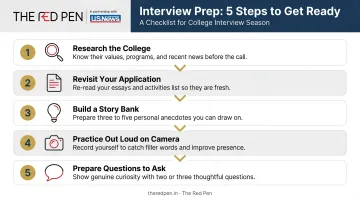
Step 1 — Research the college before rehearsing answers
Interview prep starts with college research, not question rehearsal. Know specific programmes, professors, campus initiatives, and aspects of student life that genuinely interest you. This research is what makes "Why this school?" answers feel real rather than scripted. Princeton describes the alumni interview as a conversation — students who've done their homework have something to actually talk about.
Step 2 — Revisit your application and personal statement
Most interviewers probe what's on the application. Re-read your essays and activities list before any mock session. Authenticity in the interview is easier when you haven't forgotten what you actually submitted.
Step 3 — Build a story bank, not a script
Prepare 6–8 personal anecdotes and experiences that can flex across different question types. The same story about leading a school debate team might answer a leadership question, a challenge question, or a "tell me about a failure" question — depending on how you frame it. Knowing your talking points is essential. Reciting a rehearsed speech is a different thing entirely — and interviewers notice.
A versatile story bank might include:
- A project or initiative you led and what went wrong
- A moment when your perspective genuinely shifted
- An experience that connects directly to your intended field of study
- A challenge you navigated without a clear roadmap
Step 4 — Practice out loud, ideally on camera
Thinking through an answer silently feels completely different from speaking it. Record yourself or practise in front of a mirror. Listen for filler words ("um," "like," "you know"), check your pacing, and notice body language habits you might not be aware of. If your real interview is on Zoom, practise on Zoom.
Step 5 — Prepare 2–3 thoughtful questions to ask the interviewer
Ending with "No, I don't have any questions" is a missed opportunity. Harvard advises applicants to bring questions, framing the interview as a two-way conversation. Strong questions reference something specific about the school — not something easily answered by the homepage. For Oxbridge applicants, this matters even more: tutors expect intellectual curiosity, so your questions should reflect genuine engagement with the subject, not just campus logistics.
How to Run a Productive Mock Interview Session
Set up realistic conditions
A mock interview done informally — sitting on a bed, answering questions vaguely — doesn't build the right reflexes. Match the format of the real interview (Zoom vs. in-person), run it for 20–30 minutes, dress appropriately, and sit at a proper desk setup. Controlling these variables removes surprises on the actual day.
Choose the right mock interviewer
Practising with a parent or friend has value for building basic comfort. But for genuine calibration, work with an experienced counsellor, teacher, or admissions advisor who will ask real follow-up questions — questions like "Why?", "How did that make you feel?", or "What would you do differently?"
These probes push students past surface-level answers, which is exactly what selective university interviewers do.
The Red Pen's admissions counsellors conduct recorded mock interview sessions tailored to the specific interview styles of US, UK, and Oxbridge universities, with real-time verbal feedback after each session and detailed written feedback from senior consultants. For Oxbridge preparation, The Red Pen offers a dedicated service led by counsellors who are Oxford and Cambridge graduates themselves — a meaningful edge, given how different Oxbridge academic interviews are from the conversational alumni interviews common in the US.
Give structured feedback after the session
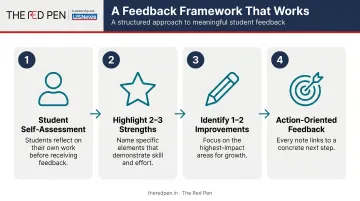
A structured feedback framework:
- Ask the student how they thought it went first — this builds self-assessment habits
- Highlight 2–3 specific things that worked well
- Identify 1–2 concrete areas to improve
- Keep feedback action-oriented, not personal
Repeat the process
One mock session is not enough. Aim for at least two or three sessions with different interviewers — each will notice different things, and each session surfaces new areas to refine. The goal isn't identical answers every time. It's genuine fluency with any question that comes your way.
Frequently Asked Questions
What is a mock interview in college?
A mock college interview is a practice simulation of the actual admissions interview, conducted in a low-stakes setting so students can rehearse their answers, improve communication, and receive structured feedback before the real thing.
How do you prepare for a mock interview?
Research the college thoroughly, revisit your essays and activities list, build a story bank of 6–8 personal experiences, practise out loud on camera, and prepare thoughtful questions to ask the interviewer.
What will be asked in a mock interview?
Questions typically fall into five categories: personal background, academics, extracurriculars, "why this college," and curveball or situational questions. Mock sessions are designed to cover this full range.
Does a bad college interview hurt your chances?
For most schools, a single weak answer rarely derails a strong application — NACAC's Fall 2023 data shows only 4.3% of US colleges rate interviews as considerably important. At evaluative schools like Yale, however, the interview does inform the file. Mock preparation significantly reduces the risk of a genuinely poor performance.
Who should conduct my mock college interview?
Experienced admissions counsellors, teachers, or school advisors are ideal. The best mock interviewers ask genuine follow-up questions, push past surface-level answers, and provide specific feedback grounded in what admissions teams are actually looking for.
How many mock interviews should I do before the real one?
Aim for at least two to three sessions with different interviewers. Each session surfaces different areas for improvement, and repetition builds genuine fluency so your answers feel natural rather than rehearsed.