Getting an interview means the university already sees potential in your application. At Oxford, roughly 10,000 students are shortlisted from over 23,000 applicants for around 3,300 places. For Oxford Medicine, 41.4% of complete applications were shortlisted in 2025. An invitation is not a formality — it's a genuine selection stage.
This guide covers everything you need: why interviews happen, what formats to expect, how to prepare thoroughly, how to answer common questions with confidence, and what to ask in return.
Key Takeaways
- Research the programme deeply — go beyond the course overview page
- Reread your personal statement before every interview session
- Practise answers aloud, not just in your head
- Show interviewers how you think through a problem, not just what you've memorised
- Prepare two or three genuine questions to ask at the end
Why Universities Conduct Interviews — and Who Gets Invited
Grades and essays tell admissions tutors what you've achieved. Interviews reveal something harder to fake: how you think.
According to Oxford's admissions guidance, interviews are designed as academic conversations — similar to a short tutorial — that explore how applicants engage with new ideas. Cambridge shares that view — interviewers care about how you work through a problem, not just the final answer.
Who Gets Called for Interview?
Not every course or university interviews applicants. The programmes most likely to require one include:
- Medicine, dentistry, and veterinary science — required by nearly all UK medical schools
- Nursing, midwifery, and social work — professional suitability is assessed alongside academic potential
- Law — standard at Oxbridge; some universities interview applicants with non-standard qualifications
- Creative and performing arts programmes, where portfolio reviews often accompany or replace formal interviews
- Every shortlisted Oxbridge applicant — Oxford and Cambridge interview all candidates they advance
Outside these categories, many non-Oxbridge humanities and social science programmes skip the interview entirely. Before preparing, check the admissions page for each programme you've applied to — requirements vary more than most applicants expect.
Types of University Interviews: What to Expect
University interviews come in several distinct formats, and the preparation required varies significantly between them.
Common Interview Formats
| Format | Typical Length | Where It's Used |
|---|---|---|
| One-on-one academic interview | 35–60 minutes | Oxbridge, many single-subject courses |
| Panel interview | 30–45 minutes | Law, humanities, some sciences |
| Multiple Mini Interviews (MMIs) | 8–10 minutes per station | Medicine, healthcare programmes |
| Group interview or task | Varies | Some creative and vocational courses |
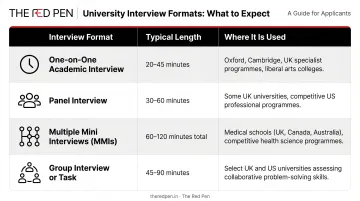
MMI formats vary considerably by medical school. Manchester Medicine uses a five-station MMI with 8 minutes per station, Leicester Medicine runs seven stations of around 10 minutes each, and Sheffield typically uses eight sections. Each medical school sets its own structure, so always verify the format on the programme page directly.
In-Person vs. Online
Virtual interviews are now standard at several major universities. Oxford has confirmed its December 2026 undergraduate interviews will be online. Cambridge's 2026 format depends on the individual College. King's College London conducts nursing and midwifery interviews via Microsoft Teams.
For students applying from India, online interviews are especially common. If your interview is virtual, make sure you have the following in place beforehand:
- Stable internet connection tested the day before
- Working camera and microphone
- Quiet room with a neutral, tidy background
- Laptop or desktop — not a phone
Some programmes also require additional materials around interview time. Check course-level requirements carefully — examples include:
- Cambridge may request written work or artwork uploads after shortlisting
- Loughborough Design and Creative Arts requires a portfolio as part of the UCAS application
- Imperial College London lists computer-based admissions tests, including ESAT and TMUA
How to Research and Prepare Before Your Interview
Good preparation means knowing your subject, your application, and the programme well enough to think clearly under pressure — not scripting perfect answers.
Research the Programme Specifically
Go beyond the course overview page. Read:
- Faculty research interests and recent publications
- Department news or newly launched modules
- The university's stated teaching philosophy
- Any research centres or labs relevant to your subject
Being able to reference a specific element of the programme — not just its ranking — signals genuine motivation.
Reread Your Personal Statement
Both Oxford and Cambridge explicitly advise applicants to reread their personal statement before interview. Oxford tutors often use it as a starting point to help candidates settle in.
Print it out. Annotate every claim, book, or experience you mentioned. Prepare to expand on any of them at length.
Stay Current in Your Field
Interviewers at selective universities want to see intellectual curiosity that extends beyond the syllabus. Cambridge advises applicants to demonstrate their own thoughts, opinions, and critical thinking. Read a few key texts deeply rather than skimming many. Follow one or two relevant debates or publications in your subject area.
Run Structured Mock Interviews
Speaking answers out loud — under time pressure, with someone asking follow-up questions — reveals gaps that mental rehearsal never does. Work with a teacher, mentor, or admissions counsellor who can give specific feedback on both content and delivery.
The Red Pen offers recorded mock interview sessions with real-time verbal feedback and a written review from a senior consultant. Their Oxbridge-specific preparation addresses the distinct demands of subject-based academic interviews, and sessions are available online across India.
Sort Logistics Early
For in-person interviews: confirm travel, accommodation, and the exact venue location well in advance. For online interviews: run a full technical test the day before. A connection failure on the morning of your interview creates unnecessary stress and leaves a poor impression.
Common University Interview Questions and How to Answer Them
"Why do you want to study this subject?"
This is the most important question in most interviews — and the easiest to answer badly.
Vague answers ("I've always liked it") or answers that focus on career earning potential rarely impress. What works is tracing a genuine intellectual journey: what sparked your curiosity, what you've explored beyond the syllabus, and how your thinking has developed.
Be specific. Referencing a paper you read, a problem you couldn't stop thinking about, or a moment when the subject connected to something unexpected is far more compelling than broad enthusiasm.
"Why this university?"
This question tests whether you've done real research. Generic answers about rankings or campus atmosphere won't distinguish you.
Cite specifics: a faculty member's work you find genuinely interesting, a unique module or interdisciplinary structure, a research centre or teaching approach that matches how you learn. The more specific, the more credible.
"What are your strengths and weaknesses?" / "How would your friends describe you?"
These questions are an invitation to show self-awareness — but only if you back claims with concrete examples.
For weaknesses, the worst answer is a thinly disguised strength ("I work too hard"). The best answer describes a genuine limitation, then demonstrates what you've already done to address it. Interviewers are looking for intellectual honesty, not perfection.
"Tell me about something you've read recently" / Subject-specific questions
Oxford History frames its interviews as tests of thinking, not knowledge recall. Cambridge interviewers care how you work through a problem, not just whether you arrive at the right answer.
Subject-specific questions are an opportunity to show how you engage with new material in real time. When a question surprises you:
- Pause and think before answering
- Show your reasoning process, not just a conclusion
- Acknowledge if you're uncertain — and say what you would do to find out
- Engage openly if the interviewer pushes back on your view
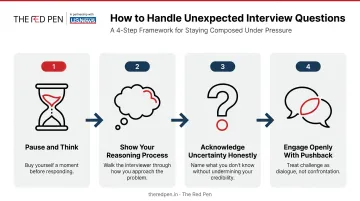
This intellectual flexibility is often what separates successful candidates from those who prepared well but struggle to adapt.
"Why should we offer you a place?"
This usually closes the interview as a synthesis question. Bring together your academic strengths, your specific fit with this programme, and one quality or perspective you'll contribute to the cohort.
A strong closing statement covers three things:
- Your academic strengths and what drives your interest in the subject
- Why this programme specifically fits how you think and learn
- One quality or perspective you'll bring to the cohort
Prepare this in advance. Knowing your three points cold means you can deliver them naturally — even if the conversation leading up to that moment went somewhere unexpected.
Smart Questions to Ask Your Interviewer
UCAS advises applicants to ask questions as part of showing genuine enthusiasm and finding out whether the course is right for them. Note that at Oxford, asking questions is optional and does not form part of the formal assessment — but a thoughtful question still signals the quality of your research.
Here are the most effective questions to have ready, grouped by what you want to find out.
Strong academic questions:
- How has the department's approach to [specific topic] evolved in recent years?
- What do you find most intellectually challenging to teach in this programme?
- Are there research opportunities available to undergraduates, and at what stage?
- How does the course balance breadth in the first year with specialisation later?
Useful pastoral and practical questions:
- What do graduates from this programme typically go on to do?
- Are there placement, internship, or study-abroad opportunities built into the programme?
- How does the university support international students in adjusting to UK academic expectations?
What to avoid: Questions whose answers are clearly on the university website — these waste interview time and signal poor preparation. The strongest questions ask for the interviewer's own perspective on something the website cannot tell you.
On the Day: Presentation, Body Language, and Mindset
Presentation
Smart-casual is the right target — not a formal suit, not your most comfortable weekend clothes. The goal is to look like someone who takes the opportunity seriously. For online interviews, this extends to your background and camera framing.
UCAS advises dressing smartly but comfortably, and Cambridge notes that applicants can wear whatever they feel comfortable in — so don't overthink it.
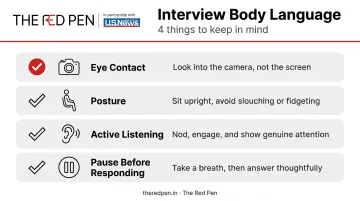
Body Language
- Maintain natural eye contact (for online interviews, look at the camera, not the screen)
- Sit upright and stay still — avoid fidgeting
- Listen actively when the interviewer is speaking
- If asked something unexpected, pause before responding — a brief silence signals thoughtfulness, not confusion
Mindset
The most useful reframe: this is an academic conversation, not an interrogation. Interviewers at selective universities genuinely want to find students they'd enjoy teaching. Above all, never pretend to know something you don't. Saying "I'm not sure, but my reasoning would be..." signals intellectual honesty — exactly what interviewers at places like Oxford, Cambridge, and US liberal arts colleges are looking for. Going in with curiosity rather than anxiety is a mindset shift you can rehearse in mock interviews before the real thing.
Frequently Asked Questions
How do you prepare for a university interview?
Research the programme and university thoroughly beyond the course page, reread your personal statement, and prepare to expand on anything you've written. Practise common questions out loud with a teacher or counsellor, and prepare two or three genuine questions to ask in return.
What questions will I be asked at a university interview?
Most interviews include motivational questions (why this subject, why this university), personal strengths and weaknesses, subject-specific discussions, and a closing question about why you should be offered a place. Questions vary by institution and subject — medicine typically uses MMIs, while Oxbridge focuses on subject reasoning and critical thinking.
What are the 4 P's of interview preparation?
The 4 P's break down as follows:
- Preparation — research the course, university, and your personal statement
- Practice — rehearse answers aloud and do mock interviews
- Presentation — dress professionally and carry yourself with confidence
- Punctuality — arrive or log in early with everything ready
How should I prepare for an online university interview?
Test your internet connection, camera, and microphone at least a day before. Choose a quiet, well-lit space with a tidy background. Dress professionally from the waist up. Log in a few minutes early so technical issues don't eat into your interview time.
What should I bring to a university interview?
Bring a printed copy of your personal statement, a notepad and pen, and any portfolio materials required by your programme. For in-person interviews at some universities such as Bristol Law, photo ID may be required — check your invitation carefully.