Introduction
If you've been researching Penn's application process, you may have come across references to alumni interviews — and wondered whether you need to prepare for one. The short answer, for students applying in the 2025-26 cycle and beyond: you don't. Penn officially ended its alumni admissions conversations in July 2025.
That context still matters. Understanding what the programme was, why Penn ended it, and how the format worked gives you critical insight — both for applying to Penn and for navigating alumni interviews at other selective universities that still use them.
Penn received 72,544 applications for the Class of 2029, according to official Penn Admissions data. At that scale, running equitable one-on-one alumni conversations became logistically impossible.
Key Takeaways
- Penn officially ended alumni admissions conversations for the 2025-26 cycle and beyond
- When active, the programme (called PAAP) was non-evaluative — alumni could not influence admission decisions
- Skipped interviews carried no penalty — availability depended entirely on alumni volunteers
- These preparation skills transfer directly to alumni interviews at Yale, Princeton, MIT, Stanford, and beyond
What Was the UPenn Alumni Interview?
Penn's alumni interview programme was called the Penn Alumni Ambassador Program (PAAP) — a voluntary, one-on-one conversation between an applicant and a Penn alumnus. It served two purposes simultaneously.
For students, it was a chance to hear directly from someone who had attended Penn — about residential life, academics, career outcomes, and what day-to-day campus life at Penn actually looked like. For the admissions office, it offered a qualitative impression of a candidate that transcripts and essays couldn't fully capture.
What Made It Different From Other Schools
Penn drew a deliberate distinction in terminology. It described these as "alumni conversations" rather than interviews — and that distinction was meaningful. The programme was never evaluative, never scored, and never a gatekeeping tool.
Key facts about how PAAP operated:
- Alumni volunteers had no access to the applicant's application file before the conversation
- The alumnus submitted a brief written summary of impressions afterward — informational, not scored
- Alumni explicitly could not advocate for or against any applicant's admission
- This stood in direct contrast to schools like Yale, where alumni interviews are formally labelled evaluative
Penn's 2025 Decision to End Alumni Admissions Conversations
On 16 July 2025, Penn's Vice Provost and Dean of Admissions, E. Whitney Soule, and Senior Associate Vice President for Alumni Relations, F. Hoopes Wampler, formally announced that PAAP would no longer offer admissions-season conversations beginning with the 2025-26 cycle.
The Scale Problem
When PAAP launched in 2012, Penn received around 31,000 undergraduate applications. By the 2024-25 cycle, that figure had grown to 72,544 — more than doubling in roughly a decade. Running meaningful, equitable one-on-one conversations across an applicant pool that size, within a compressed admissions season, simply wasn't sustainable.
The Daily Pennsylvanian reported a 4.9% acceptance rate for the Class of 2029 — Penn's most selective cycle on record — reflecting just how dramatically the competitive landscape had shifted since the programme began.
This Didn't Happen Overnight
Penn had been gradually stepping back from the traditional interview model for years:
- For the 2023-24 cycle, Penn shifted from evaluative alumni interviews to non-evaluative "conversations" — alumni could no longer score applicants
- In July 2025, Penn eliminated admissions-season conversations entirely
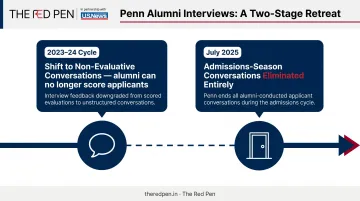
Alumni and education experts described this to the Daily Pennsylvanian as "the end of an era."
What Replaces It
Penn hasn't eliminated alumni engagement — it has redirected it. Under the new model, PAAP ambassadors will focus on:
- Congratulating newly admitted students and welcoming them to the Penn community
- Supporting current students through year-round mentorship
- Participating in a formal campus-wide mentorship initiative launching in 2026
The shift moves alumni time from brief pre-decision conversations to sustained, ongoing student support. For applicants, this means there is no longer an opportunity to make a personal impression before the admissions committee reaches its decision.
Where Penn Now Sits Among Peers
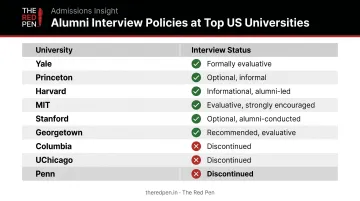
Penn's decision puts it alongside Columbia and the University of Chicago in ending alumni admissions interviews — but several highly selective schools still offer them, which matters if Penn-equivalent universities remain on your list:
| School | Alumni Interview Status |
|---|---|
| Yale | Yes — formally evaluative |
| Princeton | Yes — optional, informal conversation |
| Harvard | Yes — assigned at committee discretion |
| MIT | Yes — via Educational Counsellors |
| Stanford | Yes — optional, availability-based |
| Georgetown | Yes — offered to all applicants |
| Columbia | No — ended May 2023 |
| UChicago | No — does not offer interviews |
| Penn | No — ended July 2025 |
How the UPenn Alumni Interview Worked
For students researching Penn's historical process — or preparing for similar interviews at other schools — here's how PAAP functioned when active.
Who Reached Out and When
Applicants could not request an interview. Volunteer Penn alumni reached out directly via email or phone after an application was submitted, based purely on whether an ambassador was available in the applicant's region. Not receiving an invitation carried zero negative weight in the admissions process.
Conversations took place broadly between October and mid-February, with the season overlapping both Early Decision and Regular Decision timelines.
Format and Duration
When Penn shifted to non-evaluative conversations for the 2023-24 cycle, it also moved the format to virtual-only — video call or phone. Previously, conversations had been held in person at local cafes or community spaces.
Per Penn Alumni materials, interviews typically lasted between 20 and 45 minutes. The tone was conversational, closer to a coffee chat than a formal evaluation.
What the Interviewer Submitted
After the conversation, the alumni volunteer submitted a brief written summary of their impressions. The report was informational: a personal snapshot of the applicant meant to complement the written application. It carried no numerical score, and the volunteer could not advocate for or against admission.
What the Interview Was Not
A lot of applicant anxiety around PAAP was misplaced:
- It was not a test of academic knowledge
- The interviewer had not read your application or essays beforehand
- It was not a decisive admissions factor
- The alumnus was a volunteer, not a trained admissions officer
Most students who went through PAAP found the conversation straightforward — a chance to share their story with someone who had been in their position not long before.
Common UPenn Alumni Interview Questions
UPenn alumni interviewers didn't follow a standardized script. Questions varied by interviewer, so preparing thematically — knowing your stories, your reasons, and your questions — served applicants far better than memorising specific answers.
About You: Background, Interests, and Goals
These questions aimed to understand the person behind the application:
- "How do you spend your time outside of school?" — Talk about what genuinely occupies you, not what sounds impressive. Authenticity reads better than a curated highlight reel.
- "What are you most passionate about?" — Pick one thing and go deep. Specificity beats breadth here.
- "What's the biggest challenge you've overcome?" — Frame it with honesty about the difficulty, not just the resolution.
- "How would your friends describe you?" — Useful self-check: does your answer align with how you've come across in the rest of the conversation?
About Penn: Fit and Motivation
"Why Penn?" was the most important category — and the one where generic answers fell flat fastest.
- "What draws you to the school or programme you've applied to?" — Name specific Penn programmes: the Wharton School, the College of Arts and Sciences' curriculum structure, the Nursing programme's dual degree options. Generic Ivy League appeal isn't an answer.
- "What classes, clubs, or opportunities at Penn excite you?" — Research Penn-specific organisations, research centres, or traditions before the conversation.
- "How did you first hear about Penn?" — A small question, but one that can open a genuine exchange. Use it to connect your discovery story to your specific interest in the school.
Questions to Ask Your Alumnus Interviewer
Preparing thoughtful questions for the interviewer was just as important as preparing your own answers. The best questions came from genuine curiosity — not from a list memorised the night before. A few that worked well:
- "What was your major, and how did it shape your career path?"
- "What surprised you most about Penn once you arrived?"
- "How has the Penn alumni network shaped your professional life?"
- "What do you wish you'd known before starting at Penn?"
- "How did the college house system shape your experience on campus?"
- "What would you do differently if you could go back?"
How to Prepare for a UPenn Alumni Interview
The core mindset shift: because the interviewer hasn't read your file, preparation is about self-reflection, not rehearsal. You need to be able to articulate your interests, passions, and reasons for applying to Penn naturally — not recite polished answers.
Practical Preparation Steps
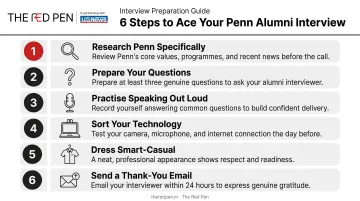
- Research Penn specifically — Know the name of your intended school within Penn, two or three academic programmes that interest you, and at least one Penn tradition or student organisation. Vague answers expose a lack of genuine interest.
- Prepare your questions — Have 5–7 questions ready. You won't use all of them, but having a bank prevents blanks.
- Practise speaking out loud — Notes don't replicate the pressure of speaking live. Do at least two practice runs with someone who can give honest feedback.
- Sort your technology — For virtual interviews, test your camera, microphone, and internet connection the day before. Technical problems on the day eat into your actual interview time.
- Dress smart-casual — Penn itself suggested dressing as you would for a class presentation.
- Send a thank-you email within 48 hours — Reference something specific from the conversation. Generic thank-you notes are forgettable.
These Skills Transfer Directly
Penn no longer conducts admissions conversations, but Yale, Princeton, MIT, Stanford, Georgetown, and Harvard all still use volunteer-based interview or conversation models. Every skill you'd develop preparing for a Penn-style interview — articulating your story, researching a specific university, asking informed questions — applies directly.
Knowing what these conversations require is the first step. Performing well under realistic conditions is the second. For Indian students preparing for selective US university interviews, The Red Pen's Undergraduate Interview Prep service (₹25,000) offers recorded mock interview sessions with both real-time and written feedback — so you hear what you're getting wrong and know exactly how to fix it before the real thing.
Frequently Asked Questions
Does UPenn have alumni interviews?
No. Penn discontinued alumni admissions conversations starting with the 2025-26 application cycle. The Penn Alumni Ambassador Program (PAAP) previously facilitated these conversations, but Penn announced in July 2025 that admissions-season conversations would no longer be offered.
What does it mean if you get an alumni interview?
When the program was active, receiving an invitation meant a Penn alumnus volunteer was available in your area and wanted to connect. Invitations were availability-based, not merit-based — receiving one carried no signal about your admission chances in either direction.
Why did Penn end its alumni admissions conversations?
Penn cited the dramatic growth in application volume (from roughly 31,000 in 2012 to 72,544 for the Class of 2029), concerns about equitable access across all regions, and a desire to redirect alumni time toward sustained mentorship for admitted and current students.
What replaces the UPenn alumni interview for applicants now?
There is no direct replacement as an admissions component. Penn alumni will now focus on year-round mentorship for admitted and enrolled students. Applicants should ensure their essays, activities list, and recommendations carry the full weight of their story.
How long did a UPenn alumni interview last?
When active, PAAP conversations typically lasted between 20 and 45 minutes. The format was informal, conducted virtually in recent cycles, and followed no fixed question list.