Introduction
That email lands in your inbox sometime in November — a Stanford alumnus introducing themselves and asking if you'd like to meet for a conversation. For most Indian applicants, the reaction is some version of: Am I in? Does this mean something? What do I even say?
The short answer: receiving that email doesn't signal your admission likelihood, but what happens in that conversation can matter. Stanford's OVAL (Outreach Volunteer Alumni Link) programme places alumni volunteers as admission ambassadors who submit written reports directly to the admissions committee. That report becomes part of your file.
Most students either over-prepare with scripted answers or walk in completely unprepared. Neither works. This guide breaks down the OVAL programme, what interviewers are actually evaluating, and how to prepare in a way that adds real weight to your application.
Key Takeaways
- Stanford alumni interviews are optional, conducted through the OVAL programme — not every applicant receives one
- Selection is based on alumni volunteer availability in your region, not application quality
- The interviewer submits a written report that becomes part of your admissions file
- Alumni interviews typically last approximately 40 minutes and are designed as two-way conversations
- Knowing your story well and preparing thoughtful questions for the interviewer will set you apart
What Is the Stanford Alumni Interview? Understanding the OVAL Programme
OVAL stands for Outreach Volunteer Alumni Link, and it's run through Stanford's Office of Undergraduate Admission. Alumni volunteers serve as admission ambassadors — their most direct form of engagement with applicants is the interview itself.
Stanford states two official purposes for the programme:
- Outreach — giving applicants a personal, meaningful window into Stanford life through someone who actually studied there
- Evaluation — giving the admissions committee a supplementary perspective on the applicant beyond the written materials
After the conversation, the interviewer submits a written report that becomes part of your admissions file and is considered as one component in the holistic review process. It's not a standalone verdict — it adds texture and context to everything else the committee has already read.
Worth keeping in mind: these interviewers are volunteers. They chose to participate. That means the conversation tends to be warm and exploratory, not formal or interrogative. The alumni interviewer was once an applicant themselves, sitting in exactly the position you're in now.
Who Gets a Stanford Interview — and When?
How Selection Works
Not every applicant receives an interview. Stanford is clear that interview invitations depend on alumni availability in your high school's geographic area — not on how strong your application is. India is listed as an interview area, so Indian applicants are eligible.
Because interviews are conducted virtually as well as in person, access has expanded for applicants in regions with fewer local alumni. Stanford supports Zoom, Google Meet, Microsoft Teams, and FaceTime for video interviews.
Timing by Application Round
| Application Round | Interview Window |
|---|---|
| Restrictive Early Action (REA) | First few weeks of November |
| Regular Decision (RD) | Mid-January to mid-February |
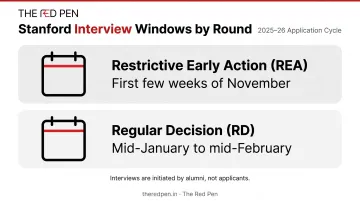
The alumni interviewer contacts you directly using the email or phone number from your application. There's nothing you need to do to trigger this — the outreach comes from them.
If You Don't Receive an Interview
Don't read into it. Stanford explicitly states that applications are considered complete with or without an interview, and many admitted students never had one. Not being contacted says nothing about your candidacy.
What the Stanford Alumni Interview Is Actually Like
Format and Feel
Stanford describes the interview as a casual, comfortable conversation — approximately 40 minutes, one-on-one, conducted virtually or in a public place like a coffee shop or library. No campus visits. No parents in the room. No recordings.
The interviewer will not have read your application beforehand. They're not there to quiz you on grades or test scores — that information is already in your file. They're trying to understand the person behind it.
You're also expected to ask them questions. This is a two-way exchange, not a one-sided evaluation.
What Alumni Interviewers Are Looking For
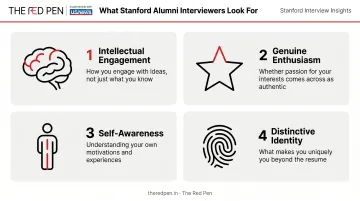
Stanford's goal is for alumni to surface qualities the application can't fully capture. In practice, the interviewer is paying attention to:
- How you engage with ideas, not just what you know
- Whether your enthusiasm for your interests comes across as genuine
- How self-aware you are about your own motivations and experiences
- What makes you distinctively you — beyond the resume
When the Interview Report Actually Matters
A 2024 essay in Stanford Magazine, written by an OVAL interviewer named Dana Hudepohl, described a student who later discovered through a records request that the admissions officer "was on the fence about her but then decided to put her application through for another read because of what I'd written in my interview report."
That's an individual case, not a guarantee. But it shows how a specific, enthusiastic interview report can move a borderline application forward. The interview is rarely the deciding factor — but in close-call situations, it can be the difference between a second read and a no.
On-the-Fly Intellectual Questions
Some interviewers don't stick to safe, predictable prompts. They may pose open-ended questions about contested ideas or ask you to take a position on something unexpected. The goal is to see how you think, not to catch you off guard.
There's no single right answer to these questions. What interviewers notice is whether you can engage thoughtfully, consider multiple angles, and stay intellectually curious under a little pressure. Students who acknowledge complexity and revise their thinking mid-conversation tend to leave a stronger impression than those who arrive with a polished, rehearsed position.
Most Common Stanford Interview Questions and How to Answer Them
Stanford says there is no set list of required questions interviewers must ask. But based on guidance from IvyWise and Stanford's own suggested preparation topics, these come up most consistently:
"Tell me about yourself"
This is not an invitation to recite your CV. The interviewer already can't see your application — so this is your chance to tell a story, not a list.
A strong answer covers three things:
- Who you are — your identity, values, and what shapes how you think
- What drives you — the interests or experiences that define your direction
- Why Stanford — how the university specifically fits into where you're headed
Keep it conversational. Aim for 2–3 minutes.
"What are you curious about?" or "What excites you intellectually?"
Anchor your answer in genuine academic curiosity. Going deep on one or two real interests is far more compelling than naming many. Don't just say you love neuroscience — explain the specific question that keeps you up at night, and why you want to explore it further at Stanford.
If you can link your intellectual curiosity to a specific research opportunity, course, or faculty member at Stanford, even better.
"What motivates you to achieve your goals?"
This question is about work ethic, values, and long-term vision. Be honest about what actually drives you — whether that's solving a specific problem, a formative experience, or a larger purpose you're working toward. The more specific and grounded your answer, the more credible it sounds — vague ambition is easy to spot.
Questions You Ask the Interviewer
Preparing 2–3 personalized questions for your interviewer is not optional — it's essential. Generic questions ("What was Stanford like?") come across as lazy. Specific ones that connect to the interviewer's own path land very differently.
Good examples:
- "Since you studied computer science and went into policy work, I wanted to ask how you made that bridge..."
- "I'm interested in [specific programme] — did you have any experience with that during your time there?"
Specific questions show preparation and genuine curiosity — two qualities Stanford interviewers actively look for.
How to Prepare for the Stanford Alumni Interview
Review Your Own Story Beforehand
In the 30–60 minutes before the interview, revisit your essays and activities list. Since the interviewer hasn't read your application, you need to have your own narrative fresh and coherent — not so you can recite it, but so you can expand on key themes naturally in conversation.
Think about: What's the throughline across my application? What would I most want this person to understand about me?
Practice Out Loud — With Someone Who Knows What Stanford Looks For
Reading answers off a page is not preparation. You need to hear yourself say these things out loud, ideally with someone who can give you real feedback on both substance and delivery.
The Red Pen offers undergraduate interview preparation coaching to help Indian students articulate their story confidently in an unscripted, conversational format. Their consultants include Stanford graduates who bring first-hand knowledge of what the university looks for. Standalone interview prep starts at ₹25,000 and can also be included within a broader admissions consulting engagement.
Virtual Setup and Follow-Up
Once your preparation is solid, make sure the logistics don't work against you. For virtual interviews, cover the basics:
- Lighting: Face a window or use front-facing light — avoid backlighting
- Background: Clean and uncluttered
- Connection: Stable internet, laptop plugged in, audio and video tested before the call
- Attire: Stanford says typical high school attire is acceptable, but business-casual shows care without being overdressed
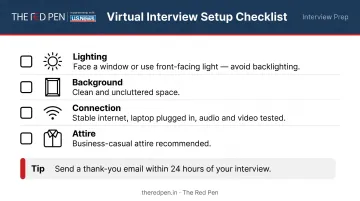
After the interview, send a thank-you email within 24 hours. Reference something specific from the conversation — a particular idea you discussed, a question they answered that stuck with you. Generic thank-you notes are forgettable; a specific one signals that you were actually present in the conversation.
The Right Mindset
Go in as a curious, engaged person — not as a candidate trying to perform. The best Stanford interviews feel like real intellectual conversations, and that's what alumni interviewers write about in their reports. Showing up as yourself, with genuine curiosity, is what makes an interview worth remembering.
Frequently Asked Questions
Does Stanford do alumni interviews?
Yes. Stanford conducts optional alumni interviews through its OVAL (Outreach Volunteer Alumni Link) programme, where trained alumni volunteers meet with applicants and submit written reports to the admissions office. The report becomes part of the applicant's admissions file.
Is it rare to get a Stanford interview?
It depends on alumni volunteer density in your geographic area, not on application quality. Stanford lists India as an interview area, and virtual interviews have made access broader — but not every applicant will be contacted.
Does getting an interview from Stanford mean anything?
Being offered an interview reflects alumni availability in your region, not your admission likelihood. That said, a strong interview report can add meaningful context to a borderline application — treat it as a genuine opportunity, not a formality.
What questions are asked in a Stanford alumni interview?
Stanford says there is no required question list. Common questions include "Tell me about yourself," "What are you curious about?", "What motivates your goals?", and open-ended intellectual questions designed to see how you reason through ideas.
How long is the Stanford alumni interview?
Stanford says interviews typically last approximately 40 minutes and are designed as relaxed, two-way conversations. You're expected to ask the interviewer questions as well — it's not a one-sided evaluation.