Many students pour months into test prep and essays, then walk into the PI under-prepared. The result? Strong applications undermined by weak interviews. Harvard rates the interview "Very Important" in its 2024-25 admissions process, and MIT lists it as "Important" — at selective institutions, this stage genuinely matters.
This guide covers the full picture: how to prepare step by step, what questions to expect, how to perform on the day, and what to do in the 24 hours after.
Key Takeaways
- A PI assesses motivation, self-awareness, and fit — not just academic achievement
- Knowing your own profile is as important as researching the programme
- Mock interview practice builds the confidence to perform under real pressure
- First impressions, body language, and thoughtful questions all shape the final assessment
- Following up with a thank-you note and a structured self-review can reinforce your candidacy
How to Prepare for a Personal Interview: A Step-by-Step Approach
Thorough preparation is what separates confident, memorable candidates from those who simply improvise. And preparation goes far beyond memorising answers.
Step 1: Research the Programme and Institution Deeply
Go beyond the official website. Study the curriculum structure, faculty research interests, alumni outcomes, and any recent news. Interviewers can tell within minutes whether a candidate has done genuine research or surface-level browsing.
Identify two or three specific reasons — academic, professional, or cultural — why this particular programme is the right fit. Vague answers like "it has a great reputation" are among the most common interview failure points.
Cambridge's guidance puts this plainly: their interviews are academic conversations about the chosen subject, and applicants are expected to have read widely and engaged seriously with their field. Oxford interviews similarly test how you think, not just what you know.
Step 2: Map Your Own Profile and Build Your Narrative
Review your academic record, work experience, extracurriculars, and any setbacks. Be prepared to explain every entry on your application — interviewers frequently probe gaps, low grades, or unexpected choices.
Develop a coherent personal narrative that connects past experiences to current goals and to the specific programme. This narrative should feel honest and natural, not rehearsed. The Red Pen's INK (Interactive Narrative Kit) helps applicants structure exactly this kind of story before it needs to come to life in conversation.
Step 3: Prepare Answers to Common PI Question Categories
Identify the main question types (covered in the next section) and draft concise responses. Don't write out full scripts — note key points and examples for each category instead.
For behavioural and situational questions, use a structured response format:
- Situation — Set the context briefly
- Task — What was your responsibility?
- Action — What did you specifically do?
- Result — What was the outcome?
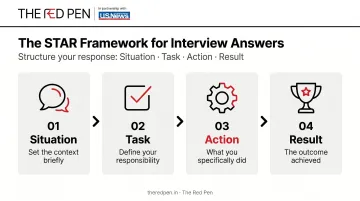
This STAR framework, used in MIT's Career Advising and Professional Development resources, keeps answers grounded in concrete evidence rather than vague claims.
Step 4: Organise Logistics Well in Advance
- Confirm interview format (in-person or virtual), date, time, and contact at least 48 hours before
- For in-person: plan your route and arrive 10–15 minutes early
- For virtual: test technology, lighting, and audio the day before
- Prepare physical documents — copies of your CV, transcripts, and certificates
- Dress appropriately; research the institution's culture to calibrate formality
Step 5: Conduct Structured Mock Interviews
Practice out loud, not just in your head. Record yourself, or work with a mentor or counsellor who can give honest feedback on content, delivery, pacing, and body language.
A 2008 study of 287 medical school applicants found that repeated interview exposure improved total performance scores significantly. Importantly, the same study found that scripted coaching did not improve scores — and was associated with lower communication scores on key stations. The takeaway: practice realistic conversations, not rehearsed speeches.
The Red Pen's mock interview service includes video-recorded sessions, real-time feedback, and detailed written reviews from senior consultants. Standalone packages are available for undergraduate applicants, including a specialist Oxbridge track.
What Will Be Asked in a Personal Interview?
Admissions PI questions fall into five broad categories. Knowing these categories means you can prepare targeted answers rather than trying to memorise responses to hundreds of individual questions.
Personal Background and Self-Introduction
Questions like "Tell me about yourself" or "Describe yourself in three words" assess self-awareness and communication clarity. The ideal response is a 90-second narrative connecting background, motivations, and goals — not a recitation of your CV.
Motivation and Fit
"Why this programme?", "Why this university?", "Why now?" These test whether you have a genuine, well-researched rationale. Interviewers are looking for specificity, not flattery.
Future Goals and Ambition
"Where do you see yourself in five years?" reveals whether you have a realistic, ambitious plan and whether the programme logically fits into it. Interviewers want a concrete direction — not a rehearsed dream, but a credible next step.
Situational and Behavioural Questions
"Tell me about a time you faced a challenge" or "Describe a leadership experience" assess problem-solving and resilience. Use the STAR framework to structure your answer:
- Situation — set the context briefly
- Task — explain what you needed to do
- Action — describe what you specifically did (aim for 60% of your answer here)
- Result — share the outcome, ideally with a concrete takeaway
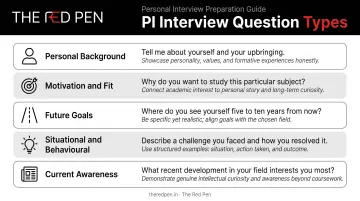
Awareness and Current Affairs
For competitive undergraduate and postgraduate admissions, interviewers often probe awareness of industry trends, global events, or recent developments in your stated field. Build this habit over the weeks leading up to your interview, not just the night before. The next section covers how to structure your preparation so each of these categories gets the attention it deserves.
What to Do During the Personal Interview
On interview day, preparation only matters if it comes across as genuine. Confidence isn't about having scripted answers — it's about showing up calm, engaged, and ready to think on your feet.
Make a Strong First Impression
Body language, eye contact, and professional composure signal confidence before a single word is spoken. A 2023 study of 823 interview candidates found that anxious nonverbal behaviour measurably lowered performance ratings. For virtual interviews, this means camera position, background, and stillness matter just as much as they do in person.
Listen Carefully Before Answering
Candidates often lose marks by answering the question they expected rather than the one actually asked. Pause briefly before responding. If a question is unclear, ask for clarification — it shows composure, not weakness.
Use Specific Examples, Not Generalities
Vague statements like "I am a hard worker" carry no weight in an interview. Anchor every claim in a real, specific moment — "I managed a three-person team through a two-week deadline crunch and delivered ahead of schedule" is the kind of detail interviewers remember. Concrete examples are what separate credible answers from generic ones.
Ask Thoughtful Questions at the End
Most interviewers invite candidates to ask questions — treat this as a high-value moment, not a formality. Prepare two or three substantive questions about the programme, faculty, or career outcomes. Avoid questions whose answers are on the website; that signals you haven't done your research.
Manage Nerves and Difficult Questions
Unexpected questions are not a trap — they are an opportunity to show how you think under pressure. A few things that help:
- Pause and breathe before responding; silence signals thought, not confusion
- Use "I'm not certain, but my understanding is..." rather than guessing or going blank
- Treat the conversation as exploratory, not adversarial
Oxford History tutors state explicitly that they are not trying to catch applicants out — they want to find intellectual potential. Most interviewers feel the same way.
Key Factors That Determine Your PI Performance
Two candidates with similar profiles can walk out of the same interview room with very different results — and the gap usually comes down to factors entirely within their control.
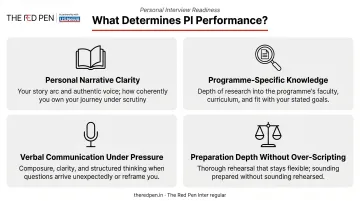
Four variables consistently separate strong performers from the rest:
- Personal narrative clarity — Interviewers are trained to spot rehearsed answers. Narrative coherence — where past choices visibly lead to this application — is what makes a candidate stick in memory. Acknowledging complexity often lands better than a polished but hollow answer.
- Programme-specific knowledge — Referencing a faculty member's research, a specific module, or a recent departmental initiative shows the choice was deliberate, not a default. Generic interest is easy to detect.
- Verbal communication under pressure — Oxford's History faculty explicitly lists "ability to express yourself" as an assessment criterion, alongside motivation and flexible thinking. Pacing, precision, and how you handle unexpected follow-ups all count here.
- Preparation depth without over-scripting — Over-rehearsed candidates sound robotic; under-prepared ones ramble. The goal is knowing your key points well enough to adapt them naturally — structured spontaneity, not a memorised script.
Common Mistakes to Avoid
- Vague motivation statements — Saying "I chose this university because it is well-ranked" signals a lack of genuine research. Admissions panels can immediately tell the difference between a rehearsed answer and real motivation.
- Memorising without understanding — If you can't defend or build on your own answers when probed, it signals surface-level prep. Practise explaining the reasoning behind every point you plan to make.
- Negative comments about past experiences — Speaking critically about former teachers, employers, or institutions reflects poorly on your maturity. Always frame past challenges in a growth-oriented light.
- Over-rehearsed speeches — Oxford warns against entering an interview determined to deliver a prepared speech, as it prevents genuine dialogue and makes responses sound scripted.
- Neglecting non-verbal communication — Slouching, avoiding eye contact, or appearing distracted (especially on video calls) undermines even your strongest verbal answers.
What to Do After the Personal Interview
The interview isn't over the moment you walk out — how you handle the next 24–48 hours matters too. Three steps are worth getting right.
Send a thank-you email within 24 hours. Keep it short, personalised, and specific. Reference something from the actual conversation — a book your interviewer mentioned, a question that turned into a genuine exchange — rather than sending a generic template.
Do a structured self-assessment while the conversation is still fresh. Note:
- Questions you answered confidently
- Moments where your response felt incomplete or off-track
- Topics that came up unexpectedly
If you're working with a counsellor at The Red Pen, share this debrief with them. That kind of specific, post-interview feedback is exactly what informs stronger performance in the next round.
If you haven't heard back within the stated timeline, one professional follow-up note to the admissions office is appropriate. It reaffirms your interest without overstepping. Multiple follow-ups signal anxiety rather than enthusiasm — send one, then wait.
Frequently Asked Questions
What will be asked in a personal interview?
PI questions typically cover five areas: self-introduction, academic and professional motivation, future goals, situational and behavioural scenarios, and current awareness. The specific mix varies by programme type — Oxbridge interviews focus heavily on subject thinking, while US liberal arts college interviews tend toward personal narrative and intellectual curiosity.
How long does a personal interview usually last?
Admissions PIs typically run 20 to 45 minutes. Cambridge undergraduate interviews total 35 minutes to one hour across one or two sessions; Oxford undergraduate interviews usually run around 30 minutes with two tutors. US college interviews tend to fall in the 30-to-45-minute range.
How do I introduce myself in a personal interview?
Open with a structured 60-to-90-second narrative covering your academic background, relevant experience, and reason for applying. The goal is to set up the conversation — not deliver a monologue. End with something that invites the interviewer to engage.
How is a personal interview different from a group discussion?
A PI is a one-on-one or panel interview focused on depth and individual fit. A group discussion evaluates how you communicate and collaborate in a group setting. In a PI, the interviewer is specifically probing your story, reasoning, and fit — not how you perform in a crowd.
How many days before should I start preparing?
Allow at least two to three weeks: the first for research and profile mapping, the second for drafting and refining answers, and the final days for mock interviews and logistics. Starting early gives you time to course-correct after feedback.
What should I avoid saying in a personal interview?
Avoid vague compliments about the institution with no substance, negative comments about past experiences or people, dishonest or inflated claims, and overly rehearsed answers that don't respond to what was actually asked.