The problem isn't nerves. It's not having a plan.
This guide gives you a categorised, strategic list of questions organised by topic — admissions requirements, academics, finances, and international considerations — so you walk into every counselor meeting prepared and walk out with information that actually moves your application forward.
Key Takeaways
- Researched, specific questions get candid answers — generic ones get brochure responses
- "Test-optional" doesn't always mean test-neutral, so ask the counselor directly about how scores factor in
- Early Decision is binding, so financial clarity must come before you apply
- Total cost of attendance extends well beyond headline tuition figures
- Ask specifically how your Indian credentials (boards, percentages) will be evaluated — requirements vary by institution
Why Preparing Your Questions in Advance Makes a Difference
Admissions counselors speak with hundreds of students every cycle. Ask "What makes your university special?" and you'll get a rehearsed answer. Ask "How does your department handle double majors between Economics and Computer Science, and are there capacity limits?" and the conversation changes entirely.
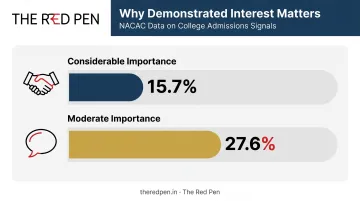
Preparation signals genuine interest — and NACAC data shows that 15.7% of colleges rate demonstrated interest as of "considerable" importance in admissions decisions, with another 27.6% rating it "moderate." At those institutions, how you show up in a counselor conversation counts.
There's also a practical reason: if you're comparing five universities, consistent questions across all five let you compare answers side by side rather than relying on memory or marketing brochures.
Before any meeting, do your homework on:
- Acceptance rates, application deadlines, and required materials
- The specific major or program you intend to pursue
- Any recent news about the department, faculty, or campus
With the basics already covered, your conversation can focus on what no website tells you — the real experience of studying there.
Questions to Ask About Admissions Requirements and Process
Understanding Evaluation Criteria
Start with the question that shapes everything else: how does this institution actually evaluate applicants?
Ask your counsellor directly: "What does your university weigh most heavily — GPA, essays, extracurriculars, or recommendations — and does that weighting change for my intended major?"
Some departments within the same university operate with very different selectivity levels. Engineering programmes at research universities, for instance, often apply stricter academic thresholds than humanities departments at the same school. Knowing where to focus your preparation effort is worth more than any general admissions tip.
Test-Optional Policies
The test-optional picture has shifted considerably. According to Common App's 2024–25 End of Season Report, only 5% of member institutions required a test score in the most recent cycle.
But "test-optional" doesn't mean "test-neutral." Ask:
- Does submitting a strong score still provide an advantage for merit aid consideration?
- Are there specific programmes or scholarship competitions where scores remain required?
- For Indian applicants on CBSE or ISC — does the university view strong standardised scores as additional evidence of academic rigour?
The answer often surprises students. A 1330 SAT and a 1570 SAT call for completely different decisions depending on the institution — and the right call only becomes clear once you know how that specific school actually uses scores.
Early Decision and Application Deadlines
Ask whether applying Early Decision genuinely improves admission odds at that specific institution. The numbers can be striking — Duke's 2023–24 Common Data Set shows an overall admit rate of approximately 6.8% versus nearly 19.7% for Early Decision applicants.
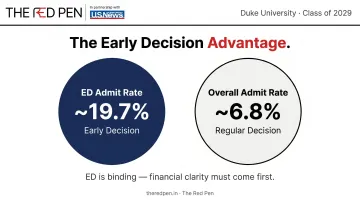
Critical follow-up: ED is binding. Before committing, you need a clear picture of your financial aid package — which you won't have until after admission.
Ask the counsellor what the typical timeline looks like for ED financial aid offers, and whether you can request a preliminary estimate before the deadline.
What a Competitive Application Looks Like
Ask: "What does a strong application look like for my intended programme — not the university generally, but this specific department?"
Follow that with the question far fewer students think to raise: "What are the most common reasons applications from students with profiles like mine get waitlisted or rejected?"
This is where counsellor meetings get genuinely useful. Counsellors rarely volunteer this information unprompted — but most will answer honestly when asked directly.
Questions to Ask About Academic Programmes and Learning Environment
Programme Depth and Flexibility
Generic major descriptions on university websites rarely tell you how a programme actually runs. The questions that reveal real information:
- Can students design their own course sequence, or is the path largely prescribed?
- Are double majors or interdisciplinary minors common, or administratively difficult to manage?
- How frequently are new courses added, and do undergraduates have input?
The Red Pen's approach to college list building specifically explores allied fields and related disciplines — so if you're interested in Computer Science, ask whether you can also pursue Data Science or Human-Computer Interaction tracks without adding a full additional year.
Faculty Access and Teaching Structure
Ask directly: "At the introductory level, who teaches — faculty members or teaching assistants?"
Public four-year institutions in the US report an average student-to-faculty ratio of 14:1 according to NCES, but that number hides significant variation. A 20:1 ratio at a large research university means very different things than a 10:1 ratio at a liberal arts college.
To push further, ask:
- How large are core introductory classes in my intended major?
- Who holds office hours — the professor or a teaching assistant?
- How accessible are faculty outside the classroom for students who want mentorship?
Research, Internships, and Real-World Experience
Teaching structure shapes your day-to-day experience, but research and internship access often determines what you walk away with. Ask:
- Are research opportunities in my field available from Year 1, or primarily for upperclassmen?
- Does the university have formal partnerships with employers or research labs in my intended field?
- How many undergraduates from this department published research or completed industry internships last year?
Asking to Speak with a Current Student
Close this section of your conversation with: "Could you connect me with a current student or recent graduate in my intended major?"
When you do connect, ask them what surprised them most about the programme — and whether they'd choose the same major and university again.
Questions to Ask About Finances, Scholarships, and Affordability
Total Cost of Attendance
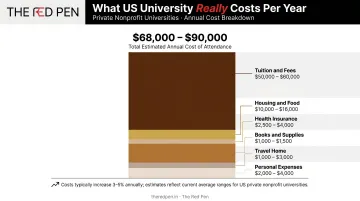
The headline tuition number is almost never what families actually pay. College Board's 2025–26 data shows average published costs of $61,990 per year at private nonprofit universities (including tuition, fees, housing, and food) — and that's before health insurance, books, travel home, and personal expenses.
Ask for a full cost-of-attendance breakdown, then ask for a four-year projection. Costs typically rise 3–5% annually, and Indian families need to factor in currency exchange fluctuations on top of that.
For reference, The Red Pen's internal guidance puts total annual US university costs at USD 68,000–90,000 when all components are included — well above than sticker price alone suggests.
Financial Aid Eligibility for International Students
This is where Indian applicants frequently get caught off-guard. Ask directly:
- Are international students eligible for need-based aid, merit scholarships, or both?
- Are there separate deadlines or application requirements for international applicants?
- What percentage of demonstrated financial need does the university typically meet for admitted international students?
A small number of universities — MIT, Princeton, and Harvard among them — meet 100% of demonstrated need for international students with grants rather than loans. Most do not. Knowing where a school stands before you apply lets you build a realistic financial shortlist, not just an academic one.
Work Authorisation on Campus
Grants and scholarships rarely cover everything. For students who plan to partially self-fund, campus employment is often the next option — but the rules vary:
- What on-campus work opportunities are available, and what are the visa-related restrictions?
- Does the university's international office provide guidance on F-1 work authorisation rules?
Essential Questions for International and Indian Applicants
International Student Support Infrastructure
Ask about more than numbers. A university with 3,000 international students but minimal dedicated support is not the same as one with 500 international students and a robust international student office, dedicated advisors, and active cultural organisations.
IIE Open Doors 2024 data shows 331,602 Indian students in the US, including 36,053 undergraduates — India is the largest sending country. That scale also means wide variation in India-specific advising quality.
Ask specifically:
- Is there a dedicated international student office with staff familiar with Indian credential systems?
- Are there orientation programmes and cultural organisations for Indian students?
- How does the university support students during the first semester of adjustment?
How Indian Academic Credentials Are Evaluated
Once you understand what support exists, ask how the university actually reads your application. Boards are interpreted differently — CBSE, ICSE, IB, state boards, and A-Levels are each evaluated on different terms by different institutions.
For example, UConn requires Indian applicants to submit board exam results along with Grade XI marks for current students, and Grade X and XII results for graduates. Other universities have different documentation requirements entirely.
Ask your counselor:
- How does your admissions team evaluate results from my specific board?
- Is a formal credential evaluation (such as through WES) required as part of the application?
- Are predicted marks accepted for applications before final board results are available?
The Red Pen works with students across CBSE, ICSE, IBDP, and A-Level curricula — and the credential presentation approach varies across boards and target institutions.
Post-Graduation Visa and Work Pathways
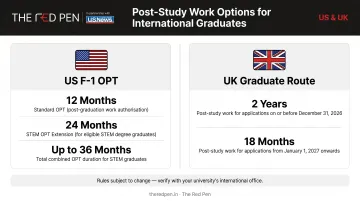
Career outcomes for international students depend heavily on what a university actually does — not just what it advertises. USCIS guidelines confirm F-1 students can access up to 12 months of OPT, with a 24-month STEM OPT extension for eligible graduates.
For the UK, the Graduate Route visa currently offers 2 years post-study for those applying on or before December 31, 2026 — dropping to 18 months for applications from January 1, 2027.
Ask counselors:
- Does the university's career services office maintain a list of employers that have hired international students?
- How does the international student office support OPT/CPT applications or UK Graduate visa processes?
- What percentage of international graduates from my intended programme secured employment within 12 months?
NACE's Class of 2024 data puts the career outcomes rate for international bachelor's graduates at 87.7% — but that figure masks significant variation by institution and major. The Red Pen helps Indian students identify universities with strong international track records before they apply, so these questions get answered at the right stage of the process.
Frequently Asked Questions
What questions should I ask an admissions counselor?
Focus on admissions criteria specific to your intended major, financial aid eligibility for international students, programme depth, and post-graduation outcomes. The most valuable questions are tailored to your profile and priorities.
What questions are asked in college counselling sessions?
In counselling sessions with an independent consultant, the focus is on your academic goals, extracurricular profile, target university list, financial constraints, and application strategy. The goal is to help you understand where you stand and how to strengthen your candidacy across multiple institutions.
What questions should I ask in a college admissions interview?
Admissions interviews are a two-way conversation. Ask about academic culture, specific programmes, research opportunities, and campus life. Thoughtful questions demonstrate genuine interest and help you assess whether the university is actually the right fit for you.
How many questions should I prepare before meeting an admissions counselor?
Prepare 5–8 prioritised questions per session. That's enough to cover your key concerns without rushing. Organise them so your most critical questions come first, since sessions can run shorter than planned.
What is the difference between a college admissions counselor and a school counselor?
A college admissions counselor works at a specific university and can only answer questions about that institution. A school counselor or independent education consultant helps students navigate the broader application process across multiple universities and countries. Firms like The Red Pen, for example, work with students pan-India on applications to US, UK, and Canadian universities.