For Indian students aiming at selective universities in the US, UK, or Canada, navigating this landscape without guidance is genuinely difficult. Application systems differ by country, deadlines overlap, and articulating a compelling personal narrative requires real skill.
This guide answers the question families ask most: do you actually need a college counselor? It covers what counselors do, the signs you need one, when to start, how to choose the right fit, and what it costs — so you can make an informed decision.
Key Takeaways
- A college counselor goes beyond essays — they guide your college list, application strategy, deadlines, and post-submission decisions.
- Students targeting selective universities or navigating international admissions without strong school support benefit most.
- Starting in Grade 10 or early Grade 11 lets a counselor build your profile from the ground up, not just polish a finished application.
- Prioritise counselors with proven experience helping Indian students apply to your target countries.
- Cost varies widely; weigh the fee against the long-term value of the university outcome.
What Does a College Counselor Do?
A college counselor guides you through every stage of the admissions process — from building your profile in Grade 10 to weighing offers in Grade 12. The scope is broader than most students expect.
The Core Functions
Most engagements begin with college list development. A good counselor builds a balanced mix of reach, target, and safety schools calibrated to your academic profile, intended major, and personal preferences. For students applying across the US, UK, and Canada simultaneously, this means reconciling different platforms, deadlines, and school limits.
Application strategy follows: Early Decision vs. Early Action vs. Regular Decision, scholarship eligibility windows, and deadline sequencing across multiple countries.
Essay guidance is the most visible part of the process, and the most misunderstood. A counselor doesn't write your essays — they help you identify the authentic story running through your application and communicate it clearly across your Common App personal statement, UCAS personal statement, and supplemental essays.
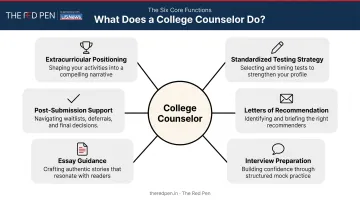
Other functions counselors handle:
- Extracurricular positioning — identifying which activities matter and how to frame them
- Standardized testing strategy — whether to submit scores, when to retake, what trade-offs exist
- Letters of recommendation — who to ask and how to brief them effectively
- Interview preparation — mock sessions with structured feedback
- Post-submission support — waitlist strategy, letters of continued interest, deferral guidance, and offer comparison
School Counselor vs. Independent Counselor
In most Indian schools, a single guidance counselor manages hundreds of students while also handling academic, emotional, and disciplinary matters. That leaves little room for the depth of strategic guidance that international admissions demands — particularly for competitive US and UK programmes.
An independent counselor offers dedicated, one-on-one engagement focused entirely on your application. When a school counselor is managing 300+ students, the time available for your Common App strategy is measured in minutes, not hours.
Do You Actually Need a College Counselor?
Not every student does. But several clear signals suggest professional guidance would make a meaningful difference.
Sign 1: You're Targeting Highly Selective Universities
Yale's Class of 2029 had a 3.87% acceptance rate across 57,517 applicants. Princeton admitted 4.62%. At this level of competition, every element of an application matters — positioning, application narrative, essay quality, and the balance of the college list itself. Few students can build that level of strategic clarity on their own.
Sign 2: You're Navigating International Applications Without Institutional Support
Indian students applying to the US, UK, and Canada face at least three distinct application systems: Common App (used by over 1,000 US colleges), UCAS (the UK's shared admissions service), and OUAC or UAC for Canadian and Australian universities respectively. Each has its own deadlines, essay formats, and credential requirements. A counselor familiar with all three removes the ambiguity.
Sign 3: You Feel Overwhelmed or Underprepared
If you're struggling to track deadlines, understand what universities are actually looking for, or articulate your strengths convincingly in writing — that's a clear signal. According to Princeton Review's 2025 College Hopes & Worries survey, 73% of applicants reported high or very high stress during the admissions process. A counselor won't remove that pressure — but they channel it into a structured plan with clear next steps.
Sign 4: Your School Offers Limited College Counseling Support
A 2025 survey reported by The Hindu found that around 93% of Indian students were aware of only seven career options, despite more than 250 existing. If your school's counseling department is underdeveloped or absent, external support fills a real gap.
The flip side: Students with strong self-direction, clear plans, and robust school-level support applying to a focused list of less selective programmes may not need intensive counseling. The signs above are a starting point — use them to assess where you actually stand.
Key Benefits of Working With a College Counselor
Strategic College List Building
A well-constructed list balances ambition with realism. Counselors use academic profile data, knowledge of each institution's admitted class, and an understanding of what makes a competitive Indian applicant to build a list that gives you genuine options — not just a string of long shots or schools that don't fit your goals.
Common mistakes a counselor prevents:
- Applying only to reach schools, leaving no viable safety net
- Missing well-fitting universities because they weren't on your radar
- Overlooking application constraints (for example, some Indian schools cap total applications, which affects multi-country strategies)
Stronger, More Authentic Applications
The best applications tell a coherent story. Counselors help students identify the thread running through their academics, activities, and goals — then communicate it consistently across essays, activity lists, and short answers.
This isn't ghostwriting. The Red Pen's essay coaching model uses a storyboarding approach to surface experiences students themselves may not recognise as significant — then reframes genuine strengths into a compelling, authentic narrative.
Managing Deadlines Across Multiple Countries
A typical US application cycle involves dozens of overlapping deadlines — Early Decision windows, Regular Decision cutoffs, scholarship applications, and country-specific UCAS timelines. Add two or three countries to the mix and the complexity multiplies.
Structured counseling keeps students on track. The Red Pen's six-step admissions framework covers everything from early application strategy through post-submission guidance, ensuring no deadline or requirement is missed.
How Counselors Reduce Application Stress
With 73% of applicants reporting high or very high application stress, the emotional dimension of this process is real. A counselor acts as a neutral expert — absorbing uncertainty and replacing it with a clear plan. That's valuable for students and parents alike.
When Should You Start Working With a College Counselor?
The earlier, the better — but the nature of the work changes significantly by stage.
| Stage | Focus Areas |
|---|---|
| Grades 9–10 | Profile building, extracurricular direction, subject selection, enrichment programmes |
| Grade 11 | College list development, testing strategy, essay brainstorming, internships |
| Grade 12 | Application execution, essays, deadlines, interview prep, post-submission strategy |
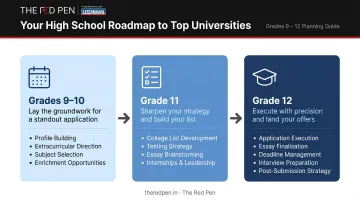
Starting in Grade 10 gives a counselor two full years to help you develop meaningful experiences — not just polish a finished profile. Students who begin in Grade 11 face a more compressed timeline, with a sharper focus on high-impact activities and faster essay turnarounds.
Starting in Grade 12 is still worthwhile, but there's no time left to build the profile. At that point, counseling focuses on presenting what already exists as compellingly as possible.
The Red Pen's Undergraduate Preparation service works with students across Grades 9–12 on exactly this — profile building, extracurricular planning, subject selection, and building an early understanding of what top universities look for. Families who engage before the application year give their students time to develop a genuine, well-rounded profile rather than scrambling to strengthen it at the last minute.
How to Choose the Right College Counselor
Define Your Needs First
Before evaluating anyone, be clear on what you actually need:
- Full-process support from profile-building through final offers?
- Essay coaching only?
- Help building a college list?
- Post-submission guidance on waitlists or deferrals?
Knowing your scope keeps you from paying for services you don't need — and helps you evaluate whether a counselor is actually the right fit.
Questions to Ask During a Consultation
- How many Indian students have you worked with applying to [your target country]?
- What is your familiarity with Common App and UCAS specifically?
- How many students do you work with at once?
- What does your essay coaching process look like — how many drafts, what feedback format?
- What are realistic expectations for a student with my profile?
- Do you offer post-submission support for waitlists and deferrals?

Pay close attention to how a counselor answers that last set of questions. One clear disqualifier: any counselor who promises guaranteed admission outcomes. NACAC's Guide to Ethical Practice in College Admission explicitly prohibits misleading or guaranteed-admission claims from independent educational consultants.
What Strong Credentials Look Like
- Membership in professional bodies such as IACAC, IECA, or NACAC
- Graduates from or direct experience with target universities
- A track record with students from India applying to your target countries
- Transparency about student-to-counselor ratios and communication structure
A firm that checks all of these boxes is The Red Pen, which focuses specifically on Indian students applying to US and UK universities. Counselors hold degrees from institutions like Oxford, Cambridge, Duke, and Stanford; the firm holds IACAC and IECA memberships; and its INK (Interactive Narrative Kit) tool helps students develop a consistent personal story across every application component. A strategic partnership with U.S. News & World Report adds ranking data and institutional trend analysis to the college list-building process.
What Does College Counseling Cost?
Pricing varies significantly based on the scope of engagement. According to a 2024 Economic Times report, The Red Pen charges between ₹1.8 lakh and ₹7.75 lakh for its services, depending on the package. Standalone services — such as essay editing, interview preparation, or application review by former admissions officers — are priced separately, starting from ₹15,000.
Common pricing structures in the Indian market:
- Essay editing, interview prep, or standalone review services: ₹15,000–₹50,000
- Undergraduate application packages: typically ₹1.8 lakh–₹4 lakh, depending on number of colleges
- Full-service undergraduate packages covering the entire admissions journey: up to ₹7.75 lakh
These fees make more sense when weighed against what's at stake. Georgetown's Center on Education and the Workforce found that bachelor's degree holders earn a median USD $2.8 million over their careers — 75% more than high school graduates. That's a US figure, but the principle holds globally: where you study shapes which graduate programmes, employers, and opportunities open up to you.
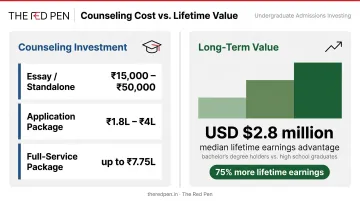
The counseling fee is a small fraction of that long-term equation.
Frequently Asked Questions
What does a college counselor do?
A college counselor helps students plan and execute their applications — covering college list building, essay guidance, deadline management, and overall admissions strategy. Independent counselors offer far more personalised support than school-based counselors, who typically manage large student groups with limited time for individual attention.
What questions are asked in college counseling?
Counselors typically ask about your academic profile, interests, intended major, target universities, family priorities, budget, and extracurricular involvement. These inputs shape a tailored application strategy that reflects both your goals and realistic admissions prospects.
How early should you start working with a college counselor?
Grade 10 or early Grade 11 is ideal for undergraduate applicants — it allows time for meaningful profile-building, not just last-minute application polishing. Starting earlier gives you room to strengthen academics, develop extracurriculars, and craft a narrative before deadlines arrive.
What is the difference between a school counselor and an independent college counselor?
School counselors typically manage large student groups and handle general guidance beyond just university admissions. Independent counselors offer dedicated one-on-one support with deep expertise in specific application systems, university expectations, and competitive positioning for international admissions.
Can a college counselor help with essay writing?
Yes — essay support is one of the most valuable parts of the process. A good counselor helps you identify compelling story angles, provides structured feedback across multiple drafts, and ensures your voice comes through clearly in the final submission.
How do I know if a college counselor is worth the cost?
Evaluate the counselor's track record with students from similar backgrounds and target universities, the specificity of their process, and the long-term value of the university outcome relative to the counseling fee. A placement at the right university often pays for itself many times over.