In that environment, educational counseling has moved from a nice-to-have to a genuine strategic necessity. Its value isn't abstract — it shows up in specific, measurable places: a well-matched shortlist, a stronger personal statement, a clearer sense of academic direction, and far less decision-making anxiety for both students and parents.
This article breaks down what educational counseling actually involves, why the benefits matter, and how to get the most from it.
Key Takeaways
- Educational counseling is a structured, ongoing process covering academic planning, university selection, and application strategy
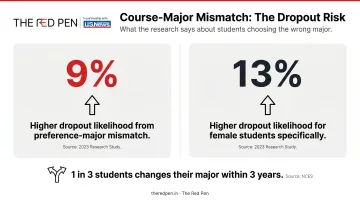
- Course-major mismatch raises dropout likelihood by 9 percentage points, per a 2023 study — making fit a critical early decision
- Students who begin counseling in Class 10 or 11 have time to build their profile; Class 12 starters are often limited to reactive decisions
- The highest-value engagements combine early start, consistent sessions, and active student participation
What Is Educational Counseling?
Educational counseling is a personalized, ongoing process in which a trained counselor works with a student to assess their academic profile, interests, and goals — then translates these into concrete decisions about courses, institutions, and application strategy.
Educational counseling is distinct from two related fields:
- Not therapeutic counseling — which addresses mental health and psychological wellbeing
- Not career counseling — which focuses on professional pathways, job search, and career transitions (though the two overlap when choosing a degree with specific career outcomes)
Educational counseling applies across several student stages:
- Class 9–11 students choosing streams, building profiles, and exploring university options
- Class 12 students in active application cycles for undergraduate programmes
- Undergraduates planning postgraduate applications
The earlier a student starts, the more counseling can actually do. A student who begins in Class 10 can build a coherent academic and extracurricular profile over two to three years. One who starts in Class 12 is managing board exams, entrance tests, and applications at once, leaving little room to strengthen weak areas or pivot strategy.
Key Benefits of Educational Counseling
The benefits below connect directly to measurable outcomes — admission results, course fit, academic performance, and long-term trajectory.
Personalised Academic Planning and University Selection
One of the most critical functions of educational counseling is building a realistic, well-matched college list. Not based on rankings alone, and certainly not on peer pressure — but on an honest mapping of academic profile, personal interests, extracurricular strengths, and career intent against actual admission requirements.
A counselor identifies where a student's application is genuinely competitive, where gaps need addressing before submission, and where aspirational targets are realistic versus wishful.
The research behind this:
NCES data shows roughly one-third of bachelor's degree students change their major within three years of enrollment. A 2023 study found preference-major mismatch is associated with a 9 percentage-point higher dropout likelihood — rising to 13 percentage points for female students.
Poor fit doesn't just affect academic engagement. It affects whether a student finishes their degree at all.
Key outcomes this influences:
- Shortlist accuracy across reach, match, and safety tiers
- Admission offer rates at well-matched institutions
- Post-enrollment satisfaction and course-major retention
When it matters most: Class 11–12 for undergraduate applications — when there's still time to strengthen a profile, not just file paperwork.
Career Clarity and Goal Alignment
Choosing the right university matters less if a student doesn't know why they're choosing a particular path. Educational counseling goes beyond "which college?" to help students understand what genuinely interests them, what disciplines connect to those interests, and where they want to be professionally.
Tools like psychometric assessments, interest inventories, and structured profile conversations help surface this clarity. At The Red Pen, counselors use MBTI and FIRO-B assessments alongside storyboarding sessions to map a student's experiences and interests to a coherent academic direction. This is especially valuable for students who arrive without a clear sense of where they're headed.
Why this matters:
Research on first-year undergraduates shows that career decidedness directly affects dropout intention — with interest and motivation explaining 28.9% of variance in career decidedness. Students who enter programmes with a clear "why" are more engaged, make better use of university resources, and perform better academically.
At the application stage, career clarity has a direct effect on quality. Admissions committees at selective universities evaluate essays, interviews, and recommendations for coherence and authenticity. A student who can articulate a specific, genuine reason for their chosen path is more compelling than one whose application reads as generic.
Key outcomes this influences:
- Personal statement and SOP quality
- Interview performance and confidence
- Post-graduation employment alignment
When it matters most: Especially high-value for students applying to liberal arts, interdisciplinary, or highly specialised programmes where fit and stated purpose carry significant admissions weight.
Stronger, More Competitive Applications
The third major benefit is the most tangible: a direct improvement in application quality. Counselors help students identify and articulate their unique story, select the right recommenders, craft compelling essays, and present a coherent profile across every application component.
This isn't just editing. It's a structured process that includes:
- Brainstorming and narrative development
- Multiple draft reviews with targeted feedback
- Interview preparation and timeline management
- Coordination of recommendations and supporting materials
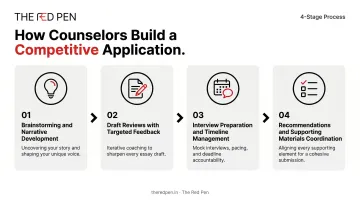
Together, these close the gap between a student's actual strengths and how those strengths appear on paper.
Why this matters:
The numbers at selective universities are unambiguous. Brown University admitted 2,521 students from 48,881 applicants for the Class of 2028. Amherst admitted 1,238 from 13,743, a 9% acceptance rate. At this level of competition, thousands of academically qualified students are rejected — meaning narrative clarity and authentic differentiation often determine outcomes.
Counselor oversight also catches the avoidable mistakes that sink otherwise strong applications — a missed deadline, a weak essay angle, or supplementals that undercut the primary narrative.
Key outcomes this influences:
- Admission offer rates at target institutions
- Scholarship eligibility
- Waitlist conversion rates
When it matters most: US and UK applications primarily — and Canadian universities where applicable — where holistic review means essays, recommendations, demonstrated interest, and supplementals all factor in alongside academic records.
Why Educational Counseling Matters More Than Ever
Most Indian students navigate high-stakes international admissions without dedicated institutional support. The ASCA recommends a 250:1 student-to-counselor ratio as a benchmark — the US national average is already 372:1. Comparable India-wide data isn't reliably tracked, but the gap between guidance available and guidance needed is significant.
This shortage matters more now because the applications themselves have grown significantly more complex:
- Essays, supplements, demonstrated interest, interviews, and portfolio materials have all multiplied in recent years
- Test-optional policies shifted from 55% of Common App member institutions in 2019–20 to just 4% in 2023–24 — leaving students uncertain about how to position standardized scores
- Indian undergraduate enrollment in the US reached 36,053 students in 2023/24, up from 31,954 the previous year — a growing applicant pool that intensifies competition
A Class 12 student managing board exam preparation, entrance exams, and multiple international applications simultaneously is stretched thin. Without a counselor managing timelines and priorities, students frequently underperform on applications — not because of lack of ability, but because of limited capacity and no structured guidance.
What Happens Without Proper Educational Counseling
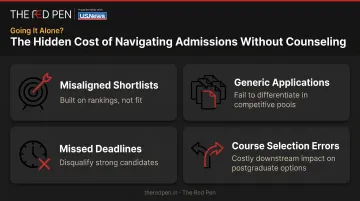
The consequences of navigating admissions without structured support tend to follow predictable patterns:
- Misaligned shortlists built on rankings and reputation rather than genuine fit — apparent only after enrollment
- Generic applications that fail to differentiate a student in pools where thousands of equally qualified applicants apply
- Missed deadlines or incomplete materials that disqualify strong candidates
- Course selection errors that become costly — a student who chooses the wrong undergraduate programme may find themselves disadvantaged when applying to postgraduate study
The practical fallout is only part of the picture — the emotional toll is just as real. EAB/Appily's 2024 survey found 48% of students said stress and anxiety overshadow their college search and planning, with 28% citing mental-health concerns as a potential reason to opt out of college entirely. Much of this pressure comes not from the decisions themselves, but from making high-stakes choices without the right framework or support.
The wrong undergraduate programme doesn't just affect four years — it narrows postgraduate options, limits career trajectories, and erodes the return on a major investment in time and money.
How to Get the Most Value from Educational Counseling
The return on educational counseling is directly proportional to how it's approached. Students who get the most out of it share a few consistent characteristics:
Start early. Class 10 or 11 for undergraduate applications gives time to build your profile, explore options, and make informed choices rather than last-minute decisions. Even starting in Class 9 for foundational profile-building — extracurriculars, academics, long-term positioning — makes a measurable difference by the time applications open.
Engage consistently. One-off check-ins don't work. The most effective engagements are structured around clear milestones — shortlist finalised, essays drafted, recommenders confirmed — with regular sessions that allow for course correction in real time.
Come prepared to be honest. Counselors can only work with what students share. Students who default to what they think the counselor wants to hear, rather than sharing genuine interests, concerns, and uncertainties, limit the quality of guidance they receive.
Treat it as a strategic partnership. Bring questions about course options, university culture, financial considerations, and country comparisons to the same table. The best counseling engagements cover far more than document editing.
At The Red Pen, this approach is built into the process from the start. The firm's six-step engagement covers profile analysis, application strategy, essay coaching, interview preparation, and post-submission support — structured around tools including psychometric assessments (MBTI and FIRO-B) and the INK (Interactive Narrative Kit) to ensure each student's application reflects a coherent, authentic personal narrative. Counselors hold credentials from institutions including Oxford, Cambridge, Stanford, and UPenn, working alongside content specialists and interview coaches to bring both strategic and execution depth to every engagement.
What to look for in any counseling engagement:
- Depth of experience with your specific target programmes and geographies
- A structured process with defined milestones — not ad hoc advice
- A personalised approach that treats your profile as distinct, not a template
- Clear ethical standards, including no financial relationships with admissions offices
Frequently Asked Questions
What is counselling in educational psychology?
Counselling in educational psychology applies psychological principles to help students understand how they learn, address academic challenges, and navigate personal development. It differs from admissions-focused educational counseling, which centers specifically on course selection, university applications, and academic planning.
What are the 5 branches of educational psychology?
The five main branches are behavioral, developmental, cognitive, constructivist, and experiential perspectives. These frameworks inform how counsellors adapt their approach to students with different learning styles and academic needs.
What is the difference between educational counseling and career counseling?
Educational counseling focuses on academic decisions — course selection, university applications, and learning support. Career counseling centers on professional pathways, job search, and career transitions. For students choosing a programme with specific career outcomes, both types of guidance may be relevant at different stages.
When should a student start working with an educational counselor?
Ideally, Class 10 or 11 for undergraduate applications — early enough to build profile, explore options, and make informed decisions before deadline pressure arrives. Starting early also allows time for meaningful extracurricular development, which selective universities weigh heavily.
How does educational counseling improve university admission outcomes?
Counsellors improve outcomes by building well-matched shortlists, strengthening essays and application components, managing timelines, and helping students present a coherent academic narrative — each of which directly influences how selective universities evaluate applications.
What should I look for when choosing an educational counselor?
Look for depth of experience with your specific target programmes and geographies, a structured process with clear milestones, and a genuinely personalised approach — not a template applied uniformly to every student. Ethical standards and transparent processes are non-negotiable.