Introduction
India sends over 1.3 million students abroad each year, according to the Ministry of External Affairs — with nearly 466,000 in the US and 109,000 in the UK alone. Behind each of those numbers is a student who had to choose a stream, a board, a programme, a country, and a set of universities, often without a structured framework for making any of those decisions well.
That decision-making burden has grown considerably. Acceptance rates at selective universities are tighter than ever — MIT admits just 4.6% of applicants, and Oxford accepted only 3,245 students from over 23,000 who applied in 2024.
Yet research shows that 85% of Indian youth aged 15–29 have limited or no career awareness — making these high-stakes decisions with very little to guide them.
Educational counselling exists to close that gap. It's a proactive tool that helps students clarify their goals, build stronger applications, and make decisions they can actually stand behind — at every stage of the process.
Key Takeaways
- Educational counselling guides students through academic planning, university selection, and career direction — in one structured process.
- Starting in Grade 9 or 10 allows proactive profile-building, not last-minute scrambling.
- Informed students build more cohesive applications and are better positioned for selective admissions.
- Skipping counselling has real costs: missed deadlines, weak essays, poor university fit, and lost scholarships.
- The right counsellor brings institutional knowledge that independent research rarely replicates.
What Is Educational Counselling?
Educational counselling is a structured, one-on-one process where a trained counsellor works with a student to assess their strengths, interests, and academic goals — then provides guidance on course selection, programme choices, university applications, and career planning.
It's not remedial support, and it's not just for students who are struggling. Educational counselling spans multiple stages:
- School students deciding between streams, boards, and subjects
- Undergraduate applicants shortlisting universities and building competitive profiles
- College students evaluating postgraduate options and building a graduate school strategy
At The Red Pen, educational counselling can begin as early as Grade 9. Students who start that early have four years to build a coherent, well-rounded profile — rather than scrambling to assemble one in Grade 12.
The service goes well beyond advice on where to apply. It includes:
- Psychometric assessments using tools like MBTI and FIRO-B
- Career pathway mapping and academic gap identification
- Structured narrative development for applications
- All of it personalised to each student's profile, goals, and target institutions
Key Benefits of Educational Counselling
Personalised Academic and University Planning
One of the most immediate benefits is a customised roadmap. Rather than applying to the most well-known universities or following peer pressure, students get recommendations grounded in their actual academic record, extracurricular profile, learning style, and career direction.
In practice, this means identifying the gap between where a student currently stands and what their target universities expect, then closing that gap systematically before applications are submitted. For a student targeting Imperial College London and UCLA, the plan looks very different from one targeting Toronto and UBC.
The stakes are real: NCES data shows that roughly one-third of bachelor's students change their major within three years, and students whose chosen major doesn't match their interests are more likely to drop out entirely. Without a proper fit assessment upfront, students frequently enrol in programmes they abandon, at significant financial and personal cost.
The impact is highest at the school-to-university transition, particularly for students targeting internationally ranked institutions where profile fit is a genuine admissions criterion. The Red Pen's INK (Interactive Narrative Kit) supports exactly this stage, giving students a structured, guided process for developing their application narrative once the strategic direction is set.
Career Clarity and Informed Decision-Making
"I want to do engineering" or "I want to study abroad" are starting points, not strategies. Educational counselling helps students move from vague aspirations to a specific, researched understanding of industries, job markets, and the academic paths that actually lead there.
The practical mechanism: counsellors use assessments, structured sessions, and industry information to identify where a student's interests, abilities, and market opportunities intersect. From there, they work backwards to define the academic choices that support those goals.
The Red Pen's counselling process includes:
- Psychometric evaluations using widely-researched scales (MBTI, FIRO-B) to identify career pathways aligned with aptitude and personality
- Academic and extracurricular gap identification — pinpointing what's missing relative to career goals
- Career pathway mapping — translating assessment results into concrete programme and university recommendations
- Board and subject selection guidance for students still in the planning phase
Uninformed choices carry real consequences. Students who don't complete their degree are 34 percentage points less likely to report being financially stable and 10.6 percentage points more likely to wish they'd completed more education, according to Federal Reserve research.
Stronger Applications and Better Admissions Outcomes
In selective admissions, the quality of the application often matters as much as grades. Educational counselling directly improves that quality: from essay strategy and recommendation letter planning to interview preparation and scholarship identification.
The competition context: UCL received nearly 91,000 UCAS undergraduate applications for 2025 entry. Harvard received 54,008 applications and admitted 1,970. At that scale, the difference between acceptance and rejection often comes down to how coherently a student presents their story, not just what their grades say.
The Red Pen's approach is explicitly integrated across every stage of the application:
- Profile analysis — assessing academic data, extracurriculars, and experiences to identify narrative strengths
- University shortlisting — building a balanced list of reach, match, and safety schools
- Essay development — multi-draft coaching using the INK to build authentic, programme-specific narratives
- Interview preparation — recorded mock sessions with real-time and written feedback
- Post-submission strategy — waitlist management, deferral guidance, and offer comparison
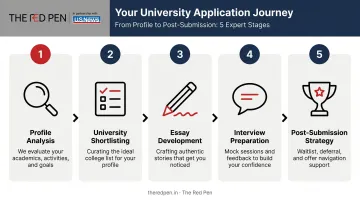
Each stage feeds the next. The essay team works from the same strategic positioning established during counselling; the interview coaching reinforces the same narrative in person. Students who go through this process arrive at submission with a consistent story across every document — rather than a set of components that were written in isolation.
Why Educational Counselling Matters at Every Stage
Educational counselling isn't a one-time event — its value shifts across key transitions, but it doesn't disappear.
- Grade 9–10: The time to identify academic strengths, explore extracurriculars with genuine intent, and understand what selective universities look for — with enough runway to pursue research, leadership roles, and enrichment programmes that build depth, not just breadth.
- Grade 11: Students should be demonstrating real commitment to their chosen areas, gaining substantive experience through internships, publications, or leadership, and beginning to shape their application narrative.
- Grade 12: The focus shifts entirely to execution — essays, shortlists, deadlines, scholarship applications, and interview preparation.
The pressure Indian students face at each of these stages is well-documented. A 2024 study of 570 adolescents in Karnataka found that 86% reported high academic stress and 87% experienced high perceived parental pressure.
Layer on the complexity of navigating foreign university systems, standardised tests, UCAS deadlines, and scholarship windows — and structured guidance stops being optional.
Early engagement means proactive profile-building. Late engagement means reactive gap-filling. The outcomes are rarely the same.
What Happens When Educational Counselling Is Overlooked
Students who navigate the admissions process without guidance tend to make the same category of mistakes:
- Poorly matched university lists — applying to universities based on name recognition rather than genuine fit
- Underdeveloped essays — submitting generic personal statements that don't differentiate
- Missed deadlines — UCAS explicitly states that applications not responded to by the reply deadline can be declined by default
- Overlooked scholarships — the University of Toronto's Lester B. Pearson Scholarship covers full costs and selects only 37 scholars annually; the nomination deadline is in October. The Reach Oxford Scholarship offers just 2–3 awards per year, with a February deadline. Missing these windows is irreversible.
- Default choices — selecting "safe" or familiar options that don't reflect actual potential
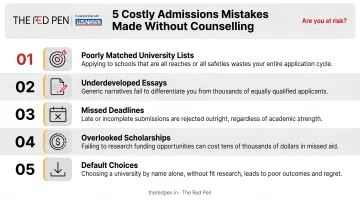
These mistakes carry a financial cost that compounds quickly. Harvard's 2026–27 cost of attendance is $91,634 (approximately ₹76 lakhs). A year spent in the wrong programme — or a missed cycle that forces a gap year — adds that cost on top of an already significant investment.
Without structured guidance, the outcome is rarely neutral — it's reactive. Students end up addressing profile gaps that should have been resolved in Grade 10, targeting universities they haven't properly researched, and submitting applications built around convenience rather than a clear, compelling narrative.
How to Get the Most Out of Educational Counselling
Counselling delivers the most value when students treat it as a long-term partnership, not a last-minute service.
What students and parents should bring to the process:
- Honest self-reflection on interests, strengths, and what they're actually hoping to do after university
- An open mind about programme and country options — the best fit isn't always the most familiar name
- Willingness to act on feedback consistently, revisit goals as they evolve, and engage over multiple sessions rather than a single consultation
What to look for in a counsellor:
- Expertise in the specific programmes and geographies being targeted (US, UK, and Canada admissions each have distinct requirements and timelines)
- A transparent, personalised process — not a cookie-cutter approach applied to every student
- Evidence-based planning grounded in real knowledge of admissions systems
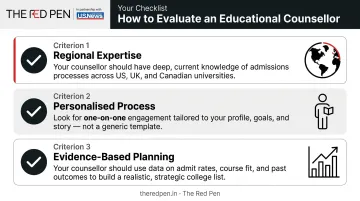
The Red Pen structures its counselling around this long-term model. Engagement typically starts in Grade 9 and runs through to final university decisions. Along the way, it integrates psychometric assessments, gap analysis, essay strategy, and interview coaching into a single unified process. Students who begin early and stay engaged across that arc consistently build stronger, more considered applications than those who arrive in Grade 12 looking for a quick turnaround.
Conclusion
Educational counselling matters because the decisions it supports aren't reversible in the short term. Choosing the wrong programme, missing a scholarship deadline, or submitting an unfocused application are all recoverable — but recovery takes time, money, and effort that most students would rather direct toward a strong start.
The benefits compound with early engagement. Students who begin structured counselling in Grade 9 or 10 don't just apply with better materials — they apply with a clearer sense of who they are, what they want, and why a specific programme is the right fit. That clarity produces tighter college lists, more authentic essays, and interviews where students can actually speak to their choices.
For Indian students navigating global university admissions, that kind of structured, expert guidance isn't a luxury. At the level of competition these applications involve, it's often the difference between an application that blends in and one that gets read twice.
Frequently Asked Questions
What is the importance of educational counselling?
Educational counselling helps students make informed academic and career decisions, navigate complex admissions processes, and build structured plans that align their strengths with their long-term goals. It reduces costly errors at critical decision points — from stream selection to final university enrolment.
What are the main types of educational counselling?
The primary types are academic counselling (course and programme selection), career counselling (aligning studies with professional goals), admissions counselling (university applications and test strategy), and personal support counselling. Most structured counselling services address several of these at once.
What are the aims of educational counselling?
The core aims of educational counselling are to:
- Help students understand their strengths and interests
- Support well-informed decisions about education and career direction
- Overcome academic or personal challenges that affect progress
- Build a clear, realistic pathway toward long-term goals
What are the principles of educational counselling?
Key principles include individualised support (every student's path is unique), non-judgmental guidance, confidentiality, student empowerment over dependency, and evidence-based planning grounded in real knowledge of academic systems and career markets.
When should a student seek educational counselling?
Students benefit most from seeking counselling proactively , ideally 1–2 years before a major academic transition. For undergraduate applications, that means starting no later than Grade 10, and preferably Grade 9. Waiting until Grade 12 significantly limits what's achievable.
How is educational counselling different from career counselling?
Educational counselling addresses the full academic journey: programme selection, university applications, and personal development. Career counselling focuses specifically on matching interests and skills to professional paths. The two are closely connected and are typically delivered together.