Introduction
Getting into a top university abroad has never been more competitive — or more complex. MIT admitted just 4.6% of applicants for its Class of 2029. Cambridge accepted 16.1%. Harvard received nearly 48,000 applications for roughly 2,000 spots.
For Indian students, the pressure is compounded by the mechanics of applying: multiple deadlines across different geographies, system-specific requirements (Common App, UCAS), supplement essays, recommendation strategies, and the risk of a poorly calibrated school list.
Many students turn to group coaching or online resources for help. These formats work at scale, but they can't account for what makes each application unique — the student's specific profile, goals, activities, and story.
This article explains why one-on-one counseling produces better outcomes at every stage, from building your college list to submitting a final application.
Key Takeaways
- One-on-one counseling is built entirely around a single student's profile, goals, and gaps.
- Per NACAC data, students with individualized guidance are 3.2x more likely to attend college and 2x more likely to enroll in a bachelor's program.
- Personalised school shortlists reduce wasted effort and improve fit across reach, target, and safety tiers.
- Consistent counselor engagement keeps students on track across deadlines, essays, and supplementals simultaneously.
- Starting 12–18 months before deadlines allows time to strengthen the profile — not just polish a finished application.
What Is a One-on-One Counseling Session?
What Is a One-on-One Counselling Session?
A one-on-one counselling session is a private, dedicated meeting between a student and an expert counsellor, focused entirely on that individual's academic profile, programme goals, and application strategy. Every session is built around one student's specific situation — not a shared agenda, not a room of thirty.
What These Sessions Actually Cover
In an undergraduate admissions context, one-on-one sessions span the full application journey:
- Profile analysis — reviewing academics, extracurriculars, and identifying strengths and gaps
- School shortlisting — building a balanced list of reach, target, and safety schools based on real admissions data
- Application strategy — managing deadlines, early decision timing, and scholarship eligibility
- Essay development — brainstorming, drafting, and editing across multiple rounds
- Interview preparation — mock interviews with real-time and written feedback
- Post-submission guidance — navigating waitlists, deferrals, and offer comparisons
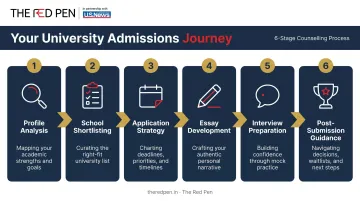
At The Red Pen, this maps directly to a structured six-step process that runs from first profile assessment through final enrolment decision. Each step builds on the last, so students arrive at decision day with a clear strategy behind every choice they've made.
Key Advantages of One-on-One Counseling Sessions
The advantages below are grounded in what actually determines admissions success: strategy, clarity, and consistent execution.
Advantage 1: Personalised Strategy Built Around Your Unique Profile
No two students share the same academic record, extracurricular history, career goals, or financial considerations. One-on-one counseling is the only format that accounts for all of these simultaneously.
A counselor building a personalised strategy will:
- Identify schools across reach, target, and safety tiers based on actual admissions data
- Map a realistic application timeline that accounts for your board exams and other commitments
- Align programme choices with long-term career intent — not just rankings
Generic advice produces mismatched school lists. Students either aim too low and undermine their own potential, or apply to schools where their profile is statistically weak. Both outcomes waste application fees, months of effort, and potentially an entire admissions cycle.
Research from NACAC shows that juniors who speak one-on-one with a school counselor are 3.2x more likely to attend college and 2x more likely to enrol in a bachelor's programme. Individualised guidance surfaces the right options and helps students act on them.
A case from The Red Pen illustrates this concretely. One Mumbai-based IBDP student — predicted 41/45, SAT 1330 — worked with a counselor to narrow her intended major to Psychology, build a balanced US/UK list, and apply Early Decision I to NYU. She received an offer. Without that strategy, she would have been guessing at fit rather than engineering it.
This approach is particularly valuable for students targeting highly selective universities, those pursuing cross-disciplinary or non-traditional programmes, and first-generation applicants without an existing framework for understanding global admissions.
Advantage 2: Undivided Expert Attention and Actionable Feedback
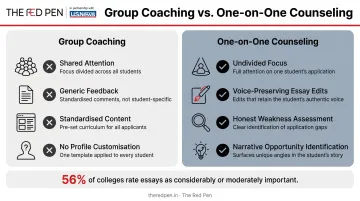
In a group setting, a counselor's attention is divided. Feedback is generalised. An essay might get a "this needs more specificity" note — which tells the student almost nothing about what to change or why.
In one-on-one sessions, the counselor's entire focus is on understanding and improving that specific student's application materials. The difference in feedback quality is significant.
What Individualised Feedback Actually Looks Like
- Identifying a narrative opportunity the student overlooked entirely — an experience that felt ordinary to them but is genuinely distinctive to an admissions reader
- Honest assessment of profile weaknesses, with specific guidance on how to address them rather than work around them
- Essay feedback that preserves the student's voice while improving clarity, structure, and audience fit
According to NACAC's admissions factors data, essays are rated as considerably or moderately important by over 56% of colleges. At selective undergraduate programmes — liberal arts, engineering, business, and pre-med tracks — that weight is even higher.
The risk of skipping individualised feedback is concrete: vague, templated personal statements are one of the most common reasons strong-profile students are rejected from competitive programmes. An applicant with a 43/45 IB predicted score and a 1500 SAT superscore doesn't lose a spot at Georgetown because of academics. They lose it because their story failed to differentiate them.
The Red Pen's essay process works through brainstorming sessions, structural coaching, and multiple editing rounds that refine without replacing the student's authentic voice. As one counselor described working with a student admitted to Duke, Cornell, LSE, and NYU simultaneously: the work involved "several conversations" to identify and shape the moments that made her application genuinely her own.
This advantage matters most for: students applying to programmes where personal statements carry significant weight, and those who struggle to articulate their own story clearly.
Advantage 3: Accountability, Momentum, and Confidence Throughout the Process
The undergraduate admissions process spans months and involves dozens of moving parts: Common App essays, UCAS personal statements, supplement essays, recommendation letters, test scores, financial aid documentation, and multiple deadlines across different geographies and deadline tiers.
Without structure, students procrastinate.
They underestimate the time required for supplements. They miss rolling admissions windows. They submit applications in a rush rather than at full quality.
What Structured Accountability Provides
A counselor functions as both project manager and confidence anchor:
- Tracking deliverables across all schools on a student's list
- Flagging missed or approaching deadlines before they become crises
- Helping the student course-correct without panic when something falls behind
- Providing honest, steady feedback that reduces anxiety and improves decision-making
The UCAS system alone illustrates how quickly complexity accumulates. Applications for 2026 entry opened in May 2025, with Oxford, Cambridge, and medicine/dentistry/veterinary programmes requiring submission by 15 October 2025 — months before most students in India have finished Grade 12 board preparation. Applying to the UK without a counselor tracking these timelines is a significant, avoidable risk.
The emotional dimension matters too. Students managing board exams alongside applications — which describes the majority of Indian Grade 12 applicants — are under sustained pressure. A counselor who builds genuine rapport with their student helps reduce the anxiety that leads to rushed decisions and weaker submissions.
This advantage matters most for: students juggling board exams or entrance tests alongside applications, those applying to multiple countries simultaneously, and students returning after an unsuccessful admissions cycle.
What Happens When One-on-One Counseling Is Skipped or Delayed
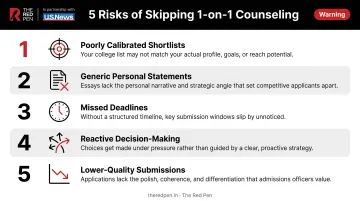
The risks are not hypothetical. Without structured, individualised guidance, the most common outcomes are:
- Poorly calibrated shortlists — schools that are misaligned with the student's profile, either below their potential or statistically out of reach
- Generic personal statements — essays that describe activities rather than demonstrate growth, or rely on clichés instead of specific, personal moments
- Missed or misunderstood deadlines — particularly for UK early-deadline routes that close in October
- Reactive decision-making — scrambling at the last minute rather than executing a planned strategy
- Lower-quality final submissions — applications assembled under pressure rather than built with care
Research backs this up. The Hoxby and Turner study on college information found that qualified students routinely apply to mismatched institutions — either undermatching (settling for less selective options than their profile supports) or overapplying to aspirational schools with no strategic foundation. Customised information corrected this pattern significantly.
What connects these avoidable failures is straightforward: students who skip structured, personalised guidance tend to make decisions in isolation, at the wrong time, with incomplete information.
How to Get the Most Value from One-on-One Counseling
How to Get the Most Value from One-on-One Counselling
One-on-one counselling delivers its full value when the student approaches it as an active participant. The outcomes are proportional to the engagement.
It works best when:
- Start 12–18 months before deadlines — early enough to pursue meaningful extracurriculars, seek leadership roles, or build a research project before applications open
- Come prepared to each session with specific questions, updated drafts, or new materials so the counsellor's time goes toward substantive feedback, not catch-up
- Act on feedback between sessions — students who use tools like The Red Pen's INK (Interactive Narrative Kit) between meetings build stronger narratives faster, since the structured prompts keep momentum going without a counsellor present
- Treat counselling as an ongoing partnership — students who show up consistently and iterate on feedback across multiple sessions see meaningfully stronger outcomes than those who attend a single strategy call
These behaviours show up reliably across The Red Pen's most successful engagements. To date, the team has supported over 1,000 applicants who went on to secure places at universities across the US, UK, Canada, and Europe — and the students who got the most out of the process started early and stayed committed throughout.
Conclusion
One-on-one counseling works because it combines what no other format can: personalisation, expert attention, and real accountability — all applied to a single student's specific profile and goals.
These advantages build on each other over time. A student who begins early, engages consistently, and acts on counselor feedback ends up with a meaningfully stronger application — a tighter college list, a sharper personal narrative, and cleaner execution — compared to one who starts late or treats sessions as occasional check-ins.
For Indian students pursuing competitive international admissions, one-on-one counseling is the foundation the entire application should be built on — not an add-on considered after the process is already underway.
Frequently Asked Questions
What is a one-on-one counselling session?
In an education admissions context, it is a private, structured meeting between a student and an expert counsellor focused entirely on that individual's profile, programme goals, and application strategy. Unlike group workshops or webinars, where content is standardised and attention is shared, the session is built entirely around one applicant.
What are the 4 types of counselling?
Counselling broadly spans educational, career, mental health, and personal/social types. In education admissions, one-on-one sessions typically combine educational and career counselling — helping students navigate programme selection, application strategy, and long-term academic planning.
What is the 3-3-3 rule in therapy?
The 3-3-3 rule is a grounding technique from mental health therapy, not an admissions framework. In education counselling, a comparable idea applies: breaking the application process into defined milestones — shortlist, essays, submission — reduces overwhelm and keeps students on track.
How is one-on-one education counselling different from group coaching?
Group coaching delivers standardised content to many students simultaneously. One-on-one counselling is built around a single student's profile, strengths, and goals, producing a more relevant shortlist, personalised essay feedback, and a strategy tailored to that specific applicant.
When should a student start one-on-one counselling for university admissions?
Ideally 12–18 months before application deadlines, which for most Indian students means by the end of Grade 11. For competitive programmes and UK early-deadline routes (which close in October), earlier is always better.
How many sessions does it take to see results?
There is no fixed number; outcomes depend on the student's starting point and goals. Most students gain clarity on school fit and application direction within the first 3–5 sessions, with tangible output (shortlists, strategy documents, essay drafts) building progressively from there.