Counselling in education is not just about mental health. It spans academic planning, career exploration, personal development, and university admissions strategy — and each of these areas involves a distinct type of support. Knowing which type to seek, and when, can make a significant difference in outcomes.
This guide walks through the six main types of counselling in education, what makes each one distinct, and how students and parents can identify the right support at the right stage.
Key Takeaways
- Counselling in education spans six distinct types: academic, personal/social-emotional, career, admissions, behavioural, and crisis intervention.
- Each type targets a specific challenge, from emotional well-being and subject selection to career direction and competitive university applications.
- The right type depends on the student's age, the specific challenge, and their short- and long-term goals.
- Admissions counselling is a specialised discipline, distinct from general career or school counselling in both scope and method.
- Starting early almost always produces better outcomes, regardless of which type of counselling is needed.
What Is Counselling in Education?
Counselling in education is a structured, professional process in which trained counsellors support students in addressing academic challenges, emotional difficulties, career uncertainty, and life transitions. It is a practical, outcome-focused resource — not simply a therapeutic intervention for students in crisis.
It operates at multiple levels:
- Within schools — for younger students navigating academic pressures and social development
- At the secondary-to-higher education transition — career and admissions guidance for students choosing streams, degrees, or universities
- At the postgraduate level — specialised academic and professional counselling for students pursuing graduate education
What separates counselling from casual advice is the professional framework behind it. Educational counsellors use structured methodologies — psychometric assessments, interest inventories, and narrative development tools — to help students identify strengths, set goals, and make informed decisions.
This is now a regulatory expectation, not just good practice. CBSE's Affiliation Bye-Laws require every Secondary and Senior Secondary school to appoint a full-time Counsellor and Wellness Teacher, making professional student support a baseline standard across Indian schools.
Why Counselling Matters in Education
The need for structured support is not abstract. According to UNICEF, only 41% of Indian youth aged 15–24 said it is good to seek mental health support, and about 14% reported often feeling depressed or having little interest in activities. A separate study found depression prevalence of 25.92% and anxiety of 13.70% among school-going adolescents in South Delhi.
Meanwhile, career guidance access remains thin. The UNICEF-linked Bharat Career Aspirations Report 2024 — which surveyed nearly 5,000 students across 25 Indian states — found that only 9.36% had used or were even aware of career guidance services. Family members influenced 30% of career decisions; school teachers influenced just 13%.
The consequences of this gap are real:
- Students make uninformed subject choices that close doors to certain careers
- Academic burnout goes unaddressed without emotional support structures
- Students applying to global universities underestimate the complexity of competitive admissions processes
Students who access counselling early are better positioned to make deliberate choices — about subjects, careers, and applications — rather than course-correcting under pressure. This is especially relevant for those targeting global universities, where personal statements, essays, interviews, and standardised testing each require preparation well before deadlines arrive.
The Six Types of Counselling in Education
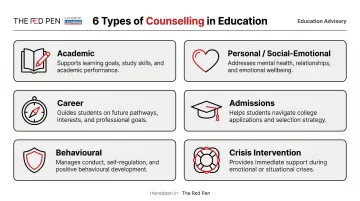
Different students need different kinds of support. The six types of counselling in education each serve a distinct purpose — from managing exam stress to navigating a Harvard application. Here is a clear breakdown of each.
Academic and Educational Counselling
Academic counselling helps students with subject selection, study planning, time management, and learning difficulties. Counsellors in this space work closely with teachers and parents to build structured learning plans for students who are either underperforming or need extended challenge.
Who benefits most:
- Students struggling with academic performance or a specific subject
- Students choosing streams in Class 11 (Science vs. Commerce vs. Arts)
- Students preparing for high-stakes board or entrance exams
The limitation is scope: academic counselling addresses the how of studying, not the why behind a student's broader goals or emotional state. It works best alongside other forms of support for students facing layered challenges.
Personal and Social-Emotional Counselling
This type of counselling focuses on a student's emotional and social well-being. It helps students manage stress, anxiety, peer pressure, family conflict, low self-esteem, and identity challenges. Sessions provide a confidential, non-judgmental space for students to process their experiences with a trained professional.
UNESCO notes that well-implemented social-emotional learning programmes can raise academic achievement scores by 11 percentile points — evidence that emotional health and academic performance are directly connected, not separate concerns.
Signs this support is needed:
- Students experiencing bullying, social withdrawal, or exam anxiety
- Students going through family disruption or school transitions
- Students showing early signs of depression or disengagement
Note that this type of counselling requires trained mental health professionals. Severe concerns may need referral to a clinical psychologist beyond a school counsellor's scope.
Career Counselling
Career counselling is a guided process in which students assess their interests, aptitudes, and values to explore suitable career options. Counsellors use psychometric assessments, interest inventories, and one-on-one conversations to help students map potential education and career pathways.
Best suited for:
- High school students unsure about which stream or degree to pursue
- Undergraduate students considering postgraduate options or career pivots
One important distinction: career counselling provides direction, but does not replace the in-depth, application-specific guidance needed for competitive university admissions. A student who knows they want to study Computer Science in the US still needs a very different type of support to build and execute a competitive application.
Admissions Counselling
Admissions counselling is specialised, strategic support designed to help students navigate the complex process of applying to universities. It covers institution selection, application strategy, essay writing, interview preparation, and financial planning.
This is fundamentally different from general career counselling. It focuses specifically on positioning the student competitively for selective institutions — accounting for each university's particular requirements, essay conventions, and evaluation criteria.
The scale of demand among Indian students makes this relevant context: India sent 363,019 students to the US in 2024/25, a 10% year-on-year increase. UCAS reported 8,870 Indian applicants for the 2026 UK undergraduate cycle. Harvard's Class of 2029 received 47,893 applications for 2,003 places — a selectivity ratio that demands a strategic approach, not just a well-intentioned one.
What professional admissions counselling involves:
- Profile analysis — reviewing academics, extracurriculars, and experience to identify application strengths
- College list building — shortlisting dream, target, and safety schools based on goals and fit
- Application strategy — early decision timing, deadline management, scholarship eligibility
- Essay coaching — narrative development through structured storyboarding, multiple drafts, and editorial guidance
- Interview preparation — recorded mock sessions with real-time and written feedback
- Post-submission support — waitlist strategy, deferral responses, and comparing offers
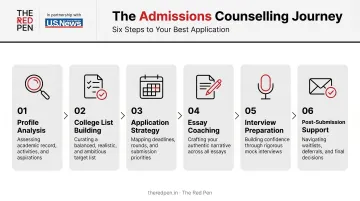
Firms like The Red Pen provide this kind of end-to-end admissions support for Indian students targeting competitive universities in the US, UK, and Canada. Their counselling process begins as early as Grade 9 — helping students build the extracurricular profiles and academic records that selective universities expect — through to final enrollment decisions.
Students who attempt this without professional support often underestimate how much is at stake — and how many avoidable mistakes go unnoticed until it is too late.
Behavioural Counselling
Behavioural counselling helps students understand and modify patterns that are disrupting their learning or wellbeing. Common concerns include:
- Chronic absenteeism or refusal to engage in class
- Aggression toward peers or school staff
- Substance-related concerns or risk-taking behaviour
Counsellors work with the student, family, and school staff together to identify root causes and build structured support plans. The approach works best as early intervention — catching patterns before they escalate into disciplinary or legal issues. Severe concerns may require referral to clinical or forensic psychologists beyond a school counsellor's scope.
Crisis Intervention Counselling
Crisis intervention is immediate, short-term counselling provided to students experiencing acute emotional distress — following the loss of a loved one, an incident of bullying or abuse, academic failure trauma, or suicidal ideation. The goal is stabilisation: providing immediate coping strategies and, where necessary, connecting the student to specialist care.
A 2022 systematic review found that school-based prevention of suicidal thoughts and behaviours shows promise within three months of intervention and may have sustained effects. Yet India faces an approximately 90% treatment gap for mental disorders — meaning most students who need this support are not receiving it.
Crisis intervention is reactive by nature: it addresses a specific event. It should sit within a broader school mental health ecosystem that includes preventive counselling and regular check-ins, not operate in isolation.
How to Choose the Right Type of Counselling
The right type of counselling depends on matching the support to the student's specific challenge, not on what is most common or most intensive.
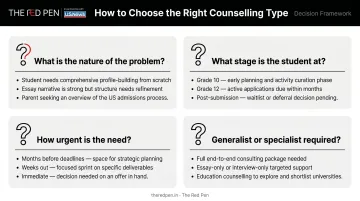
Start by asking four questions:
- What is the nature of the problem? Academic difficulty, emotional distress, career uncertainty, and admissions complexity each require different expertise.
- What stage is the student at? School-age students, undergraduates, and postgraduate applicants have different needs.
- How urgent is the need? Proactive planning allows more options. Crisis situations require immediate response.
- Is a generalist or specialist required? A school counsellor handles broad support across many students. A specialised admissions counsellor has deep expertise in specific institutions and application processes.
Credentials matter. For school counsellors, CBSE mandates a graduate or postgraduate degree in psychology, or a diploma in guidance and counselling. For international admissions, the bar is different — look for consultants who offer:
- Direct knowledge of your target institutions
- A track record of successful applications
- A structured, end-to-end methodology (not just general process familiarity)
Different types of counselling can — and often should — work in parallel. A student applying to universities abroad may need admissions counselling for application strategy while also working with a personal counsellor to manage the stress of the process.
Treating these as separate compartments limits the support a student receives. The challenges are connected; the support should be too.
Common Mistakes When Seeking Educational Counselling
Three mistakes come up consistently among Indian students and families:
1. Waiting until a crisis to seek support. Most types of counselling — academic, career, admissions — are most effective when started early. Last-minute admissions counselling in Grade 12 severely limits strategic options. Students who begin the process in Grade 9 or 10 have far more time to build the profile, coursework record, and extracurricular depth that competitive international universities expect.
2. Choosing the wrong type for the problem. Expecting a school academic counsellor to deliver the strategy-level admissions support needed for Ivy League or Oxbridge applications is one of the most common errors families make. School counsellors and specialist admissions consultants serve genuinely different functions — and confusing the two can cost a student their competitive edge.
3. Treating free guidance and professional counselling as equivalent. School counsellors provide valuable foundational support. But students with ambitious international admissions goals often need specialised professional guidance to remain competitive — expertise in specific institutions, essay conventions, interview formats, and application strategy that most school counsellors do not have bandwidth or training to provide.
Conclusion
Counselling in education spans a wide spectrum — from emotional well-being and behavioural support to career planning and university admissions strategy. Each type serves a distinct purpose at a specific stage of a student's journey.
Getting the most from educational counselling comes down to three things:
- Identifying the right type of support early — before a crisis, not after
- Seeking qualified professionals with relevant expertise for your specific need
- Treating counselling as ongoing investment, not a one-time fix
For students aiming at competitive universities in the US, UK, or Canada, this matters most at the admissions stage. Specialised admissions counselling helps students build a coherent narrative, choose the right programmes, and submit applications that reflect who they genuinely are — not just what their grades say.
Frequently Asked Questions
What are the different types of counselling in education?
The six main types are academic, personal/social-emotional, career, admissions, behavioural, and crisis intervention counselling. Each addresses a different dimension of a student's experience — from learning support and emotional well-being to career planning and competitive university applications.
What is the difference between career counselling and admissions counselling?
Career counselling helps students identify suitable career directions and educational pathways based on their interests and aptitudes. Admissions counselling is a specialised service focused on the application process itself — university shortlisting, essays, interview preparation, and submission strategy for specific institutions.
When should a student start educational counselling?
Academic and personal counselling should begin early; career counselling is most useful from Class 9 or 10 onwards. For international university admissions, starting 12–18 months before deadlines is ideal — with profile-building support available as early as Grade 9.
How does counselling in education benefit students?
Students who access counselling early typically show stronger academic performance, clearer career direction, and better admissions outcomes. The difference between good and great results usually comes down to which type of counselling a student accesses — and when.
What is the role of a school counsellor?
School counsellors provide academic, personal, and career guidance to students, acting as a bridge between students, parents, and teachers. CBSE now mandates full-time counsellors in every affiliated Secondary and Senior Secondary school, reflecting the growing recognition of this role.
Is professional admissions counselling worth it for Indian students?
For students targeting competitive global universities, yes. School counsellors rarely have the bandwidth for deep essay coaching, institutional fit analysis, or application positioning. With over 363,000 Indian students enrolled in the US alone in 2024/25, that level of specialist support is a real competitive edge.