
Here's the thing: this is actually the one moment in the entire admissions process where you control the narrative completely. Your grades, test scores, and extracurriculars are already on paper. This question lets you connect who you are to what the college genuinely needs.
Answering it well takes more than listing achievements. It takes research, self-awareness, and a clear bridge between your story and the college's mission. With over 10 million applications submitted through Common App in 2024–25 alone — an 8% year-over-year increase — admissions officers aren't short on strong candidates. They're looking for the right ones.
This article walks through exactly why colleges ask this question, a step-by-step method to build your answer, what strong answers include, mistakes to avoid, and two ready-to-use frameworks.
Key Takeaways
- This question is about fit, not bragging — connect your profile to the college's values and community
- Strong answers combine your unique experiences, the school's specific mission, and your planned contribution
- Generic answers that could apply to any college actively hurt your chances
- Variations like "What can you bring to our campus?" require the same core strategy
- Preparing a structured response and practising it aloud leads to a more natural, confident delivery
Why Colleges Ask "Why Should We Select You?"
Admissions committees reviewing tens of thousands of applications use this question to move beyond what's already in the file.
Yale's admissions guidelines state that two questions guide their entire review process: who will make the most of Yale's resources, and who will contribute most to the Yale community? MIT says it isn't just interested in how applicants look on paper — it wants a vivid sense of passions and aspirations through stories and examples.
Cambridge uses interviews to assess strengths, abilities, potential, and motivation for the chosen course.
This question is also a test of demonstrated interest. A student who gives a thoughtful, school-specific answer signals they've done research and are serious about enrolling. At institutions where yield matters, that signal counts.
This question surfaces the "invisible you" — the person who doesn't appear on a transcript. Unlike "What is your greatest weakness?", it invites you to lead with your best qualities, frame your own narrative, and show how you think about your future.
How to Answer "Why Should We Select You?" Step by Step
Step 1: Research the College Deeply Before the Interview
Go beyond the homepage. Read the mission statement of your specific department, look at faculty research areas, identify clubs or initiatives that align with your interests, and understand what the school genuinely values in its student community.
This research directly shapes what you highlight about yourself. Aim to identify 2–3 specific, concrete aspects of the college that connect to your goals or identity.
The difference between "I love how collaborative this campus is" and "Professor X's work on urban policy directly connects to the community mapping project I ran in Class 12" is enormous in an interviewer's memory.
UCAS guidance for international applicants reinforces this: universities may specifically ask why you want that subject and that university — not just one or the other.
Step 2: Identify Your Strongest and Most Relevant Experiences
Your GPA and test scores are already in the application. This is not the place to recite them.
Instead, brainstorm from these categories:
- Extracurricular leadership or initiative
- Personal challenges you've navigated
- Independent projects or creative work
- Cultural background or community involvement
- A formative experience that shaped your interests
Then filter through the lens of Step 1: which of your experiences resonates most with this specific college's mission, department culture, or community values? One well-chosen story beats five bullet points.
Step 3: Build the Bridge Between You and the College
This is the core architecture of a strong answer. Connect your experience to a specific value, need, or characteristic of the college — and hint at what you'll contribute.
A student who says "I bring X, and I know your programme values Y because of Z" sounds far more compelling than one who lists achievements in isolation. This bridge shifts the answer from self-promotion to mutual benefit: you're not asking for a favour, you're presenting a case for fit.
What strong bridges sound like:
- "Your focus on experiential learning matches how I've always worked — through a community mapping project in Class 12, not just coursework."
- "I chose this programme specifically because of Professor X's urban policy research, which connects directly to the initiative I led."
Step 4: Structure and Rehearse a Concise, Confident Answer
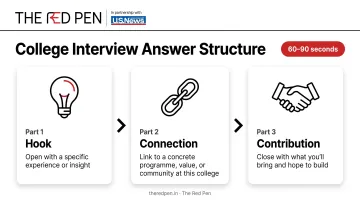
Aim for 60–90 seconds. Use this three-part structure:
- Hook — open with a specific experience or insight, not a general statement
- Connection — link it to something concrete at this college (a programme, a value, a community)
- Contribution — close with what you intend to bring and what you hope to build
Rehearsal matters here, not to memorise a script, but to internalise the structure so it feels natural under pressure. Practising out loud — with a counsellor, a parent, or through a mock interview — helps you eliminate filler words, manage nerves, and tighten the story before it counts.
If you want structured preparation for this stage, The Red Pen's Interview Preparation service offers recorded 30-minute mock sessions with real-time feedback and written reviews from senior consultants. Standalone undergraduate interview prep is priced at ₹25,000 for non-Oxbridge institutions and ₹44,800 for Oxford and Cambridge. Their INK Interactive Narrative Kit can also help you develop the core narrative that anchors both your essays and interview answers before the session itself.
What Makes a Strong Answer
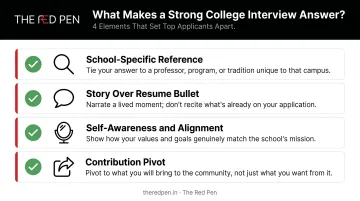
Admissions officers can spot a rehearsed, generic answer within the first thirty seconds. What they're listening for instead are signals of genuine research, self-knowledge, and intent. Strong answers consistently deliver four things:
- Reference something concrete and school-specific — a faculty member's research focus, a distinctive curriculum feature, a named programme. This immediately separates your answer from template responses
- Lead with a story, not a resume bullet — one that reveals character and genuine motivation. Specificity is what makes it memorable
- Demonstrate self-awareness by connecting your strengths to this college's context, not just listing them. Admissions officers read intellectual and emotional maturity through exactly this kind of alignment
- Close by pivoting toward what you'll bring — to the classroom, to extracurriculars, to the community — rather than focusing only on what you hope to gain. This reframe makes the answer feel generous rather than transactional
Common Mistakes Students Make
Knowing what not to say is just as important as crafting a strong answer. These three mistakes trip up even well-prepared applicants.
Listing Achievements Without Context
An answer that sounds like a résumé recitation tells the interviewer nothing they don't already know. Yale reports that 97% of its first-year class ranked in the top 10% of their high school. Stanford states that no test score guarantees admission. At this level, strong credentials are the floor — not the differentiator.
Making Unsupported Claims
Saying "I'm simply the best candidate you'll meet" signals overconfidence, not self-awareness. Every claim must be grounded in a specific, verifiable experience. Confidence is welcome — broad, unsubstantiated self-assessments are not.
Failing to Mention the Specific College
This is the most common — and most damaging — mistake. An answer that could apply to any university signals a lack of genuine interest, which works directly against you, particularly at schools where demonstrated interest affects your admissions outcome.
If you can swap out the college's name and your answer still makes complete sense, go back and add specifics: a professor whose research excites you, a programme feature no other school offers, or a community you genuinely want to join.

Quick self-check before your interview:
- Does your answer include at least one detail unique to this college?
- Can you back every positive claim with a concrete example?
- Does your response go beyond what's already on your application?
Sample Answer Frameworks
There is no single "perfect" answer — strong responses vary widely based on the student and the college. These frameworks offer a structural scaffold, not a script.
Framework 1: The Experience-to-Mission Bridge
Structure:
- Open with a specific experience (academic, extracurricular, or personal)
- Draw a clear line to a value or programme focus at the target college
- Close with a statement of intended contribution
Illustrative example: A student with experience in grassroots community documentation — say, photographing and writing about under-documented heritage sites — applying to a university with a stated commitment to civic engagement and public history might say: "Through three years of documenting lesser-known cultural sites in my city, I developed a deep interest in how communities preserve identity. I know your programme on urban heritage aligns closely with that work, and I'd hope to contribute to student-led civic initiatives here while deepening my research skills."
Each element earns its place: the experience is grounded, the connection is specific, and the contribution looks forward.
Framework 2: The Identity and Perspective Angle
Structure:
- Lead with a distinctive aspect of your background — cultural, geographical, or situational
- Explain how this perspective enriches the classroom or campus community
- Connect it to your long-term academic or professional goals
This approach works particularly well for students from diverse backgrounds who can speak to a genuinely different lens on a subject. An Indian student applying to a global university might connect their experience navigating two distinct educational and cultural systems to a programme's emphasis on interdisciplinary or cross-cultural thinking.
If you're working with The Red Pen, this is where the narrative-building process gets specific. Students have connected Kathak dance to community psychology, framed Ayurvedic research as a bridge between traditional Indian knowledge and molecular biology, and drawn on founding cultural clubs abroad to articulate what they'd bring to a new campus environment. The angle only works when it's genuinely yours.
Whichever framework you use, close by connecting your answer to where you're headed. Admissions interviewers are listening for evidence that this college fits a real plan — not that you've simply memorised a response.
Frequently Asked Questions
What is the best answer to "Why should we select you?"
The best answer combines a specific personal experience with a clear connection to the college's mission or programme, then closes with how you plan to contribute to the campus community. It should sound genuine and researched — not like a rehearsed list of credentials.
How long should my answer be?
Aim for 60–90 seconds: enough to give a substantive, specific response without losing the interviewer's attention. Practising aloud helps students stay within this range naturally and avoid rambling.
How is this different from "Why do you want to attend this school?"
"Why do you want to attend?" focuses on your motivation for choosing the school. "Why should we select you?" shifts the focus to your value to them. Both require school-specific research, but the latter requires you to lead with what you bring, not just what you want.
How do I avoid sounding arrogant?
Ground every claim in a specific experience. Saying "through leading X, I developed Y skill which aligns with your programme's focus on Z" sounds confident and grounded. "I'm simply the strongest candidate" sounds hollow — and interviewers notice the difference.
Should I memorise my answer?
No. Memorised answers often sound robotic and fall apart when a follow-up question breaks your script. Internalise the structure and key talking points instead; this lets you respond naturally and adapt to wherever the conversation goes.
Does requesting a college interview improve my admission chances?
Not automatically. NACAC data from Fall 2023 shows only 4.3% of colleges rate the interview as considerably important, while 54.6% rate it as not important. The interview is a supporting signal — what matters most is how you use the opportunity when you have it.