Key Takeaways
- The UCAS personal statement changed to a three-question format for 2026 entry onwards, with a 4,000-character total and 350-character minimum per section
- Admissions tutors want critical engagement with economic ideas — not a reading list or career goals
- Question 1 deserves the largest share of your character budget; it's where you demonstrate intellectual motivation
- Indian applicants have distinctive material — demonetisation, GST reform — that differentiates them from domestic UK applicants
- Fabricating book references or experiences carries real risk: UCAS's Copycatch system flags statements with over 30% similarity for review
The New UCAS Economics Personal Statement Format
For applicants starting university from 2026 entry onwards, UCAS replaced the single free-form essay with three structured questions. The total character limit stays at 4,000 (including spaces), and each answer has a minimum of 350 characters. The three questions are:
- Why do you want to study this course or subject?
- How have your qualifications and studies helped you to prepare for this course or subject?
- What else have you done to prepare outside of education, and why are these experiences useful?
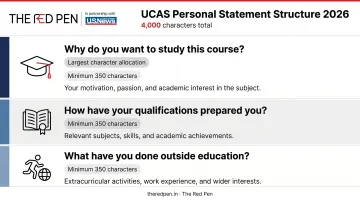
UCAS doesn't prescribe how to divide the 4,000 characters — that's your decision. But for economics applicants, Question 1 should take the largest share. It's the section where intellectual passion lives, and admissions tutors weight it accordingly.
That said, older economics personal statements written in the single-essay format remain useful models. The structure has changed; the underlying content requirements — demonstrating intellectual curiosity, academic preparation, and relevant experience — haven't.
What Economics Admissions Tutors Actually Look For
Admissions tutors aren't looking for someone who "finds the economy interesting." They're looking for evidence that you think like an economist.
Academic Passion Over Career Goals
LSE's guidance is explicit: because LSE doesn't interview undergraduates, the personal statement carries significant weight, and at least 80% should focus on academic interest and critical engagement with the subject. Warwick similarly emphasises academic suitability. Neither wants to read about your ambitions to work in investment banking.
The difference between a weak and strong statement often comes down to one thing: does your writing show a chain of thinking, or just a reading list?
Compare these two approaches:
Weak: "I read Freakonomics and found it fascinating."
Strong: "Levitt's analysis of the deterrent effect of legalised abortion challenged my assumption that crime falls with economic growth — but it also raised a methodological question: how do you isolate a variable that operates over two decades? That question led me to Angrist and Pischke's work on natural experiments."
The second version traces how one idea leads to the next. That intellectual momentum is what tutors are looking for.
What Counts as "Relevant Academic Evidence"
Economic concepts should arise naturally from real-world examples, not be inserted as jargon to signal knowledge. Strong statements demonstrate familiarity with:
- Supply and demand dynamics through a specific market event
- Behavioural economics through a policy case (nudge theory in pension auto-enrolment, for example)
- Development economics through engagement with research, not just headlines
- Game theory through a concrete strategic interaction they've analysed
Extracurriculars Must Earn Their Place
Every activity mentioned in Question 3 should connect explicitly to economics-relevant skills: analytical thinking, numeracy, independent research, or communication. Strong examples include Economics Olympiad participation, an investment or economics club, engagement with The Economist or Planet Money podcast with genuine reflection, or an internship involving data analysis.
The International Applicant Advantage
Indian students who engaged with major economic events — India's demonetisation of ₹500 and ₹1,000 notes on 8 November 2016, the GST reform launched on 1 July 2017, or RBI monetary policy decisions — have material that almost no UK-based applicant can offer. The World Bank noted that demonetisation caused significant cash shortages and weighed on short-term economic activity; the IMF stated it weakened India's near-term outlook.
A student who observed these effects firsthand, connected them to monetary theory or public economics, and followed up with further reading has a distinctive narrative. That combination of lived context and intellectual follow-through is difficult to replicate.

How to Answer Each of the Three UCAS Questions
Question 1: Why Do You Want to Study Economics?
This is your most important section. It should demonstrate intellectual motivation — not career motivation.
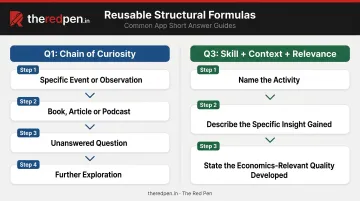
The most effective structure is a chain of curiosity:
- A specific event, observation, or moment that sparked interest
- A book, article, or podcast that deepened it
- A question it left unanswered
- What you explored next
This structure shows that your interest is self-sustaining, not passive. Strong material includes:
- Engagement with macroeconomic events such as inflation, financial crises, or trade policy
- Specific economic theories encountered through independent reading
- Areas like behavioural economics or development economics that go beyond the school syllabus
Avoid opening with "I have always been fascinated by economics." Instead, open with something concrete that shows thinking in action — a specific observation, a puzzle, a contradiction you noticed.
Question 2: How Have Your Qualifications and Studies Helped You Prepare?
This isn't a grades summary — your predicted grades appear elsewhere in the application. Use this section to connect specific learning to what you'll encounter at degree level.
Good approaches:
- Studying elasticity and explaining what questions it raised about real markets
- Using statistical analysis from a Geography or Maths project to discuss economic methodology
- Completing an EPQ, online course, or summer school related to economics or quantitative methods — framed in terms of what skills or insights it produced
For Indian students on CBSE or ISC curricula, the framing shifts slightly: focus on how your Mathematics performance, any economics coursework, and independent study demonstrate readiness for a quantitatively demanding degree. LSE, Warwick, Cambridge, Oxford, and UCL all emphasise strong mathematics over A-level Economics specifically. The degree requires maths; it doesn't require prior economics study.
Question 3: What Have You Done to Prepare Outside Education?
Every experience needs explicit reflection on why it's relevant. Don't list — interpret.
| Experience Type | Economics-Relevant Skill to Highlight |
|---|---|
| Family business involvement | Microeconomics in practice: pricing, costs, demand |
| Maths tutoring | Quantitative reasoning, teaching complex concepts |
| Research internship or programme | Independent analysis, working with data |
| MUN or debating | Economic argumentation, policy communication |
| Economics club or Olympiad | Applied problem-solving, competitive analysis |
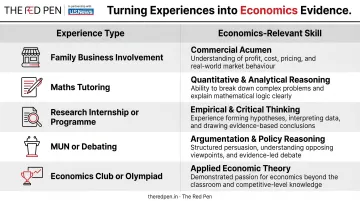
International experiences are particularly powerful here. Observing how demonetisation affected small traders in your neighbourhood, or how GST reform changed pricing dynamics in a family business, connects lived experience to concepts in public economics and institutional reform. That kind of grounded, contextual insight is material no UK-based applicant can replicate.
Economics Personal Statement Example with Expert Analysis
The following is a model example for illustrative purposes only.
Question 1: Why do you want to study Economics?
In 2016, my family's textile business ground to a halt overnight. India's demonetisation (the sudden withdrawal of 86% of circulating currency) created a cash crisis that no economic model I'd encountered could fully explain to me at the time. Why would a government impose such a severe short-term shock? What were the monetary policy trade-offs? I read newspaper analysis obsessively, but the explanations felt incomplete.
That gap led me to Paul Collier's The Bottom Billion, which introduced me to the idea that institutional quality shapes economic outcomes more than policy announcements alone. But Collier raised a harder question: how do you measure institutional failure?
Banerjee and Duflo's Poor Economics (listed as recommended reading on LSE's Economics BSc page) offered a partial answer. Their randomised controlled trial methodology showed me that the most rigorous economic questions require experimental thinking, not just theoretical models.
What I want to study is the intersection of institutional economics and development policy: why some interventions work at scale and others collapse. I want to study this formally because my self-directed reading keeps uncovering new variables I don't have the tools to analyse properly yet.
(Approximately 1,600 characters)
Question 2: How have your qualifications and studies helped you prepare?
My Mathematics background has been the most direct preparation. Working through statistical inference gave me a framework for evaluating the evidence in Banerjee and Duflo's work — I understood why their RCT design mattered, not just what it found. My Economics coursework introduced me to the mechanics of monetary policy, which gave structure to the demonetisation questions I'd been asking informally since 2016.
Beyond the syllabus, I completed an online macroeconomics course through MIT OpenCourseWare, which introduced me to IS-LM modelling. It confirmed that I find formal model-building genuinely satisfying — the discipline of specifying assumptions before drawing conclusions suits how I think.
(Approximately 900 characters)
Question 3: What have you done to prepare outside education?
I interned at a microfinance NGO for six weeks, where I helped analyse loan repayment data across 400 borrowers in three districts. The task forced me to think about selection bias: the borrowers who repaid weren't necessarily the ones the programme worked best for. That methodological question — who is missing from the data? — has stayed with me.
I also chair economics discussions at my school's current affairs society, where I've facilitated debates on India's GST reform and recent RBI repo rate decisions. Preparing for those sessions taught me that explaining an economic mechanism clearly requires understanding it at a level beyond what I thought I did.
(Approximately 850 characters)
What This Statement Does Well
In Question 1:
- Opens with a specific, datable event — not a general claim of interest
- The chain of curiosity is traceable: demonetisation → Collier → Banerjee and Duflo → development methodology
- Books are engaged with critically: the student explains what question each book raised, not just that they read it
- Ends with a research direction, not a career goal
In Question 2:
- Connects Mathematics directly to degree-level methodology
- The MIT OpenCourseWare example is framed around insight gained, not the credential itself
- No grades mentioned — they're visible elsewhere
In Question 3:
- The microfinance internship produces a specific methodological observation (selection bias), not just a task description
- The MUN-equivalent society demonstrates applied economic communication
- Both examples use the skill + context + relevance formula: what they did, what they encountered, what it demonstrated
Structural Techniques You Can Adapt
Two patterns from this example transfer directly to your own statement:
The chain of curiosity (Q1): Event → reading → unanswered question → further exploration. Each step in the chain should follow from the previous one, not sit alongside it.
The skill + context + relevance formula (Q3): Name the activity, describe the specific moment or task that generated insight, then state explicitly what economics-relevant quality it developed.
Indian applicants who want structured feedback on their drafts can work with The Red Pen, whose INK (Interactive Narrative Kit) process helps students clarify and develop their application narrative before submission.
Common Mistakes to Avoid
The Reading List Problem
The most common content mistake is treating the personal statement as a bibliography. Naming Freakonomics, The Wealth of Nations, and Thinking, Fast and Slow in three sentences tells an admissions tutor nothing about your thinking. Worse, universities like Oxford, Cambridge, LSE, and Warwick frequently probe personal statement references in interview. If you haven't read it carefully enough to discuss its methodology or argument under pressure, don't cite it.
Three Clichés That Weaken Economics Statements
- "I have always been interested in economics" — this is the single most common opening line. It signals nothing distinctive and wastes your opening sentence.
- Career goals as primary motivation — stating you want to work in finance or consulting is irrelevant to an admissions tutor assessing academic fit. Save it for LinkedIn.
- Generic extracurriculars without economic connection — sports, Duke of Edinburgh, and volunteering aren't automatically disqualifying, but each needs an explicit bridge to skills relevant to economics. Without that bridge, they occupy valuable characters without earning them.
The Fabrication Risk
UCAS's Similarity Detection Service uses Copycatch, which compares each statement against previous UCAS submissions and online sources. Statements showing similarity above 30% are flagged for review by the UCAS Verification Team, with findings reported to your chosen universities. The software risk is only part of the problem. Cite a book you haven't read carefully at a Warwick or LSE interview and an academic economist will expose the gap in the first two questions they ask.
Frequently Asked Questions
Can I send the same economics personal statement to all my UCAS choices, including Oxford or Cambridge?
Yes — UCAS sends a single statement to all five choices, so you cannot tailor it per university. For Oxbridge-targeting applicants, weight the statement 80–90% toward academic content and never mention a specific university by name.
What books and resources should I mention in my economics personal statement?
Choose books you have genuinely read and can discuss analytically — Ha-Joon Chang's 23 Things They Don't Tell You About Capitalism, Paul Collier's The Bottom Billion, and Banerjee and Duflo's Poor Economics (on LSE's BSc reading list) are solid starting points. Depth of engagement matters far more than the prestige of the title.
How long should each question be in the new UCAS format?
There's no mandatory split, but a workable split for economics applicants is approximately 50% of total characters to Question 1, around 35% to Question 2, and the remaining 15% to Question 3 — each section must clear the 350-character minimum.
Do I need to have studied Economics at A-level to write a strong personal statement?
No. LSE, Warwick, Cambridge, Oxford, and UCL all emphasise Mathematics over Economics as a subject requirement. If you haven't studied Economics formally, focus on demonstrating genuine interest through independent reading and real-world engagement. Quantitative ability from Maths or related subjects is a strong substitute.
What should I avoid including in my economics personal statement?
Avoid vague opening statements, career goals as the primary motivation, references to books or events you haven't genuinely engaged with, and extracurricular activities that cannot be connected explicitly back to economics-relevant skills or knowledge.
How do I write a strong opening for my economics personal statement?
The most effective openings begin with a specific intellectual question, observation, or moment of curiosity — not a general statement of interest. A concrete event, a contradiction you noticed, or an unanswered question from a news story will do far more work than "I have always been fascinated by economics."