Introduction
NUS sits at #10 in the QS World University Rankings 2027. With programmes like Medicine admitting just 286 students per intake and Law accepting around 240 students annually, the application pool is packed with candidates who look nearly identical on paper.
That's where the personal statement becomes decisive.
Most applicants underestimate how much NUS's personal statement requirements differ by programme type. An undergraduate applicant navigating five short-response prompts faces a fundamentally different challenge than a graduate applicant writing a 500–1,000 word Statement of Purpose. Getting the format wrong from the start is a common mistake — and one this guide helps you avoid.
With that in mind, this guide covers exactly what NUS requires, what admissions evaluators look for, a step-by-step writing process, and the mistakes that sink otherwise strong applications.
Key Takeaways
NUS undergrad applicants answer five short-response questions within character limits; grad applicants write a 500–1,000 word narrative essay — confirm your format before you start.
Admissions evaluators want academic fit, clarity of purpose, and genuine self-reflection — not a rephrased CV.
Naming specific NUS faculty, research centres, or modules is essential for a competitive "Why NUS" section.
The 80/20 rule: roughly 80% of your word count should cover your own experiences and goals; only 20% should address NUS specifically.
Before submitting, verify you're within the word or character limit and that your voice sounds like you — not a template.
NUS Personal Statement Requirements by Programme Type
NUS does not use a single universal format. Applying the wrong structure, or assuming requirements match another university you've applied to, is one of the most common early errors.
Undergraduate Applicants
Undergraduate applicants submit through the NUS Applicant Portal and are required to answer five short-response questions, plus list up to four achievements covering co-curricular activities, competitions, and non-academic accomplishments.
A few critical points about these short responses:
- Each question functions as a mini personal statement — concise but substantive
- Every response should include a specific example or anecdote, not a general claim
- NUS explicitly states that answers must be in Standard English and in the applicant's own words; using AI tools or ghostwriting services may negatively affect the application
- Character limits apply per question — verify the current limits directly inside the live NUS Applicant Portal, as these change by intake year
Applicants indicating interest in NUS College face additional short-response requirements within the NUS College section of the form.
Graduate and Postgraduate Applicants
Graduate applications go through the Graduate Admission System (GDA3). Requirements vary by school and programme:
| Programme | Statement Requirement |
|---|---|
| LKY School of Public Policy (MPP/MPA) | Personal statement, max 500 words |
| LKY School of Public Policy (MIA) | Personal statement, max 600 words |
| LKY School of Public Policy (PhD) | Statement of Intent, max 1,000 words |
| NUS Law graduate programmes | Personal statement, up to 750 words |
| NUS Medicine | Personal statement, exactly 500 words |
| FASS Psychology graduate | Typically 2 pages |
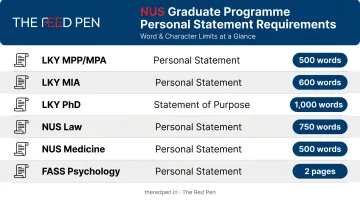
NUS Medicine is a notable exception: its 500-word personal statement is reviewed by the Admissions Committee and the interviewer during the Focused Skills Assessment, making it one of the highest-stakes components in the portfolio.
The key distinction between undergraduate and graduate writing: undergraduate short responses are character-driven and personal, while graduate statements are predominantly forward-looking : research interests, career trajectory, and programme fit.
Before drafting anything, confirm current requirements on the specific school or department page within the NUS website — word limits and prompt wording do change between intake years.
What NUS Admissions Looks For in a Personal Statement
NUS evaluates applications holistically, weighing academic merit, programme prerequisites, and aptitude. When hundreds of applicants share similar grade profiles, the personal statement is where differentiation happens. Achievements matter, but they rarely separate candidates on their own.
Genuine Motivation and the "Why This Field" Argument
NUS wants to see an organic, developed interest — not a sudden epiphany. Tracing your interest through two or three distinct experiences is far more convincing than citing a single defining moment (a childhood illness, one inspiring teacher, a family member's job). The evolution of your curiosity tells a better story than its origin point.
Intellectual Curiosity and Academic Readiness
For graduate applicants especially, the personal statement must demonstrate preparedness for the programme's rigour — through relevant coursework, research projects, or independent study. This is your case that you can contribute to academic discussions from day one, not just absorb them.
Clarity of Goals and Programme Fit
Vague goals ("I want to make a difference") are a red flag. Strong personal statements define:
- A specific short-term goal post-graduation
- A longer-term professional ambition
- Exactly how the NUS programme — not any top-ranked university — bridges the gap between where you are now and where you're headed
Admissions assessors want candidates to identify and comment on specific aspects of the course, not offer generic praise. Name specific faculty members, research labs, or modules. NUS publishes a public research discovery database at discovery.nus.edu.sg, which makes it straightforward to identify faculty work and active research areas worth referencing.
Evidence of Transferable Skills and Contributions
Include at least one example of leadership, collaboration, or community involvement, but frame it around a skill or lesson learned, not just the activity. "I was President of the Debate Club" means little. What decision did you make under pressure, and what did it teach you?
Write Like Yourself, Not Like a Template
Admissions evaluators can identify templated writing. Avoid clichéd openers ("Since childhood, I have always been passionate about...") and ensure every sentence either reveals something about your character or advances your argument for admission. If a sentence does neither, cut it.
How to Write Your NUS Personal Statement: A Step-by-Step Guide
A strong NUS personal statement is built, not drafted in one session. Research, reflection, and revision are each non-negotiable stages.
Step 1: Research NUS Deeply Before Writing a Single Word
Spend time on the NUS programme page, faculty profiles, department research centres, and published course curriculum before drafting anything. Your goal is to identify two or three programme-specific details that genuinely align with your interests — these become the anchors of your "Why NUS" section.
Useful starting points by faculty:
- Computing: NUS CS research spans theoretical to industry-ready solutions, with over S$200 million in research funding
- Law: Research centres include ASLI, CIL, TRAIL, and others — identify which aligns with your area of interest
- Business: Research centres cover Business Analytics, Governance and Sustainability, and Investor Protection
This research phase also requires honest self-reflection. Identify two or three core qualities or experiences you want the essay to communicate, then select the most relevant evidence for each.
This is also where structured support makes a real difference. The Red Pen's consultants use a storyboarding process to help applicants map their experiences onto programme-specific goals before any writing begins.
Step 2: Build a Clear Structure Before Drafting
For graduate applicants, follow this paragraph structure:
- Hook or motivating anecdote
- Academic and professional background — what it taught you
- Specific research interests or career goals
- Why NUS specifically
- A brief, memorable conclusion
For undergraduate short-response questions, each prompt should follow a three-part mini structure: incident → reflection → forward connection.
Structure prevents the most common failure mode: essays that list experiences chronologically without building a coherent argument for why this applicant deserves a place in this programme.
Step 3: Write the First Draft Using Show-Don't-Tell
Instead of writing "I am an analytical thinker," show a specific moment where analytical thinking produced a measurable outcome. The STAR method is a practical framework for structuring these moments, particularly for graduate applicants:
- Situation — the context or challenge you faced
- Task — your specific role or responsibility
- Action — what you did and why
- Result — the measurable or meaningful outcome
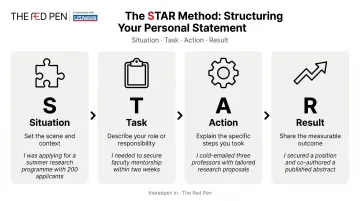
Write the first draft without fixating on word count — get the content and narrative down first. Keep your programme-specific research from Step 1 open while writing the "Why NUS" section.
Once the draft is complete, the real work begins: tightening, cutting, and polishing until every sentence earns its place.
Step 4: Revise, Tighten, and Proofread
Revision is where the personal statement becomes competitive. Cut any sentence that doesn't either reveal something about your character or advance your case for admission.
Before finalising:
- Read the essay aloud to catch awkward phrasing
- Have at least two people review it — one who knows you well, one who doesn't
- Check all faculty names and module titles for accuracy (a misspelled professor's name is a costly error)
- Verify the final word or character count against NUS's stated requirements
Common Mistakes to Avoid in Your NUS Personal Statement
Writing a Generic "Why NUS" Section
Stating that "NUS is ranked among the top universities in Asia" is the single most common mistake — it adds nothing and signals that you haven't done your research. Your "Why NUS" section must be specific enough that it cannot be copied and pasted into any other application. If it could, rewrite it.
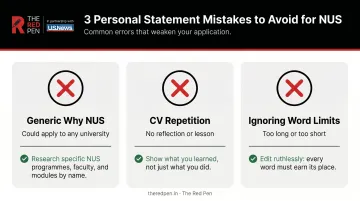
Repeating the CV Instead of Reflecting on It
Listing achievements without explaining what they meant, what you learned, or how they connect to your goals wastes limited word count. Every experience mentioned needs an accompanying reflection that advances the essay's core argument.
Ignoring the Word and Character Limits
Submitting an essay that exceeds NUS's limits — or falls significantly under them — signals poor attention to detail. For undergraduate short-response questions, the character limit is strict. For graduate statements, going significantly under the limit suggests you haven't made a full case for your candidacy.
Conclusion
A strong NUS personal statement makes a clear, specific, and authentic case for why this applicant belongs in this programme — not why NUS is a great university. Most failed essays do the opposite: they read as generic, CV-like, or prestige-focused.
Getting there takes real effort — solid research, multiple drafts, and honest feedback from people who will tell you what is not working. For applicants who want expert support building their NUS narrative, The Red Pen's undergraduate admissions consultants offer personalised guidance from story development through final submission, including interview preparation if an invitation follows.
Frequently Asked Questions
What is the 80/20 rule for personal statements?
The 80/20 rule means approximately 80% of your personal statement should focus on your own experiences, qualities, and goals — with only 20% addressing the specific university or programme. This keeps the essay grounded in your story rather than reading like a promotional pitch for the institution.
Can I use ChatGPT for my personal statement?
AI tools can assist with brainstorming or grammar checks, but NUS explicitly states that using AI or ghostwriting for the short-response section may negatively affect your application. Beyond policy risk, an essay that lacks authentic voice is easy to spot, and it undermines the entire purpose of the statement.
How long should a personal statement be for NUS?
It depends on the programme. Undergraduate applicants respond to short-answer prompts with character limits per question. Graduate applicants typically submit 500–1,000 words, though this varies by school — NUS Medicine requires exactly 500 words, while the LKY School of Public Policy allows up to 500–600 words. Always check the relevant department's admissions page for exact requirements.
What is the difference between an NUS SOP and personal statement?
For NUS, a Statement of Purpose is typically required for graduate programmes and focuses on research interests, academic goals, and programme fit. A personal statement, more common for undergraduate or scholarship applications, is character-driven, emphasising personal journey, values, and motivation for the field.
What should I avoid writing in my NUS personal statement?
Avoid generic opening lines, vague career goals, listing achievements without reflection, praising NUS for its rankings without specifics, and any content that could apply equally to any other university. If a sentence or paragraph could be lifted into a different application unchanged, rewrite it.
Does NUS interview applicants based on their personal statement?
For competitive programmes like Medicine, Law, Dentistry, and Nursing, a strong personal statement is what earns an interview invitation. NUS Medicine explicitly states the personal statement is reviewed during the Focused Skills Assessment. Be prepared to speak in depth about anything you write — if you can't discuss it confidently in person, reconsider including it.