That structure creates a genuine strategic question: which essays actually matter for your application, and how much effort should each one receive?
This guide answers both. It covers who should write the optional personal statement and why, how to approach both general prompts, what applicants to special programmes like Schreyer Honors need to know, and the most common mistakes that hurt otherwise strong applications.
Key Takeaways
- Penn State's optional personal statement is not required — but borderline applicants should write it
- The optional essay must add something new; it cannot repeat your Common App personal statement
- The Educational Gap Statement is required if time passed between graduation and enrollment; prioritize clarity over storytelling
- Schreyer Honors, BS/MD, and Millennium Scholars programs require significantly more writing — up to 10 additional prompts
- Essays carry the most weight for borderline candidates and competitive programs where academic data alone won't differentiate you
Should You Write the Optional Penn State Personal Statement?
Penn State makes its position clear: the personal statement is optional. For general applicants, submitting one is your choice. The 2022–2023 Common Data Set for University Park lists the application essay as a factor considered only for pre-medical applicants — for everyone else, academic record and GPA carry the most weight.
So the first question is not how to write the essay. It is whether to write it at all.
Using Penn State's Middle 50% as Your Decision Framework
Penn State publishes middle 50% ranges for University Park admits: GPA 3.60–3.93, SAT 1310–1470, ACT 29–33. Where your profile sits relative to these ranges should drive your decision.
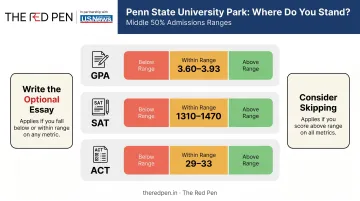
Scenario 1 — You are solidly above the middle 50%: Your application is already competitive on the metrics Penn State weights most. Unless you have a fully polished essay ready to submit with minimal effort, your writing time is likely better spent on other schools' supplements.
Scenario 2 — You are at or below the middle 50%: The optional essay becomes meaningful. This is especially true if you are applying to programs with enrollment limits — Penn State specifically flags Nursing and Architecture as more competitive — or if there are gaps or inconsistencies in your academic record that deserve context.
The Additive Test
Before writing anything, ask one question: what does an admissions reader still not know about me after reviewing my transcript, activity list, and Common App essay?
Your answer points to one of two paths:
- "Not much" — skip the essay and invest that time elsewhere
- A specific skill, experience, or gap — that detail is your essay topic
If you are unsure where your profile stands, a structured profile assessment can clarify the decision before you invest time writing. The Red Pen's consultants work through exactly this question with students — evaluating your academic profile and whether the optional essay adds meaningful value to your specific application.
How to Write Penn State Prompt #1: The Optional Personal Statement
Penn State's optional prompt is intentionally broad — it functions as a second personal statement rather than a school-specific supplement. The prompt asks you to share something about yourself, your experiences, or your activities that would reflect positively on your ability to succeed at Penn State.
Note that if you apply via Common App, Penn State will accept your Common App essay as the Penn State personal statement. If you are submitting something separate, it must be genuinely different content.
Brainstorming Your Topic
Two approaches work well for this prompt:
The Activity/Experience Approach Look at your extracurricular list and identify an activity that sits closest to your identity but hasn't been fully explored in your other application materials. Skip describing what you did. Focus on what the experience revealed about how you think, solve problems, or handle setbacks.
The Missing Piece Approach Audit what the admissions reader already knows — your grades, activities, awards, and Common App essay. Then ask what's still missing. It could be an unconventional skill, a formative belief, or a part of your background that adds context. Anything that makes the full application feel more complete.
Structuring the Essay
Regardless of your approach, keep these principles in mind:
- Stick to one central idea. A single, well-developed narrative with a clear through-line is more memorable than a tour of accomplishments.
- Lead with specific moments, not broad claims. Vague statements about passion or leadership don't stand out — concrete scenes and observations do.
- Make the Penn State connection genuine. The prompt asks what this quality says about your ability to succeed there. A brief, specific reference works; a generic closing line about being excited to join the community does not.
- Keep it tight. This is a shorter essay — aim for a polished, focused draft rather than padding toward a word count.
How to Write Penn State Prompt #2: The Educational Gap Statement
Penn State requires applicants who have time between their high school graduation and anticipated enrolment to account for that period. The prompt asks for a summary of what occurred — work, family responsibilities, coursework, another institution, or other significant activity.
What This Prompt Is (and Is Not)
This is a timeline clarification, not a personal statement. Penn State's guidance is direct: explain why the gap occurred and what you were doing. The goal is to make your situation easy to understand, not to impress or dramatise.
Students who treat this as a storytelling opportunity weaken their response. Clarity is the only thing this prompt needs — unnecessary reflection and emotional depth add length without adding it.
What a Strong Response Covers
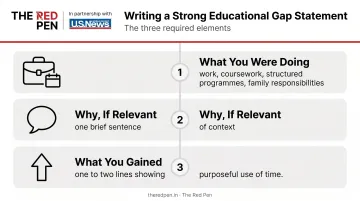
Keep it to three elements:
- What you were doing — work, coursework, a structured gap year programme, language study, family responsibilities
- Why, if relevant — a brief sentence of context is enough; you do not need to justify every decision
- What you gained or are gaining — one or two lines showing the time was used purposefully
Addressing Difficult Circumstances
Students who took unplanned time off due to health issues, financial hardship, or family circumstances sometimes worry this prompt will penalise them. It will not. Penn State's intent is to understand the timeline, not to evaluate the reason behind it.
A strong response in these cases does three things:
- States what happened honestly, without over-explaining
- Notes what you did during that time, even briefly
- Ends on a forward-looking note rather than an apology
Excessive justification or a defensive tone works against you. Admissions readers are looking for clarity, not a case for the defence.
Special Programme Essays: Schreyer, BS/MD, and Millennium Scholars
Applicants to Penn State's three flagship selective programmes face a substantially different writing workload. Plan your timeline accordingly.
Schreyer Honors College
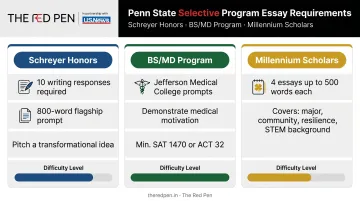
Schreyer applicants complete the standard Penn State application plus a separate Schreyer application with 10 writing responses — one flagship essay (up to 800 words) plus nine short-answer questions.
The flagship prompt asks: If you had 20 minutes to pitch a transformational idea that affects or would influence a significant percentage of the populace, what would you pitch and why? It also asks you to address existing solutions, how your idea changes the current state of things, and how your personal experiences and professional goals would help you make it real.
This is an intellectually demanding prompt. Generic responses will not be competitive — Schreyer Scholars represent just 2% of Penn State students, and the selection process reflects that selectivity. Treat each response with the same depth and specificity you would give essays for highly selective universities.
Accelerated Premedical-Medical Programme (BS/MD)
The Penn State–Jefferson BS/MD programme requires responses to questions from Sidney Kimmel Medical College at Thomas Jefferson University. These prompts become available through the application portal after selecting the programme as your intended major. The minimum academic requirement is an SAT of 1470 or ACT of 32.
Essays for this programme must demonstrate medical motivation and genuine self-awareness. Admissions readers for BS/MD programmes review a high volume of applications from academically strong candidates. What separates successful applicants is specificity, not credentials.
Millennium Scholars Programme
MSP applicants complete four essays (no more than 500 words each). The prompts cover:
- Your intended major and the global challenge it connects to
- How you would contribute to a collaborative learning community
- A moment of resilience
- Your background, experiences, and approach to collaborative STEM work
MSP is designed for high-achieving students committed to increasing diversity in STEM and preparing for doctoral study. Broad claims about passion for science won't distinguish your application here.
The prompts reward concrete anecdotes — actual research experiences, community involvement, or hands-on problem-solving that demonstrate how you've already engaged with the work.
Common Mistakes Penn State Applicants Make
Repeating the Common App essay The optional essay must add new information. If you apply through Common App, your personal statement is already shared with Penn State automatically. Submitting the same content as your optional essay signals a lack of effort and wastes the only opportunity you have to give the admissions reader something they do not already know.
Overcomplicating the Educational Gap Statement Many applicants treat this required prompt as a chance to tell a deeper story. The prompt does not call for that. A clear, honest, chronological account of how you spent the time is all Penn State needs. Adding unnecessary reflection or emotional context makes the response harder to read, not more compelling.
Misjudging the optional essay decision Two opposing errors are equally common here:
- Skipping the essay when your profile genuinely needs the support
- Spending hours on it when your application is already competitive without it
Neither serves you. The right call requires an honest assessment of your academic profile against Penn State's published ranges — not a gut feeling either way.
Frequently Asked Questions
Does Penn State require a supplemental essay?
Penn State does not require a personal statement for general first-year applicants; submitting one is optional. Applicants with a gap between high school graduation and enrolment must complete an Educational Gap Statement. Schreyer Honors, BS/MD, and Millennium Scholars programmes have additional required essays.
Should I submit the optional Penn State personal statement?
Submit it if your academic profile is at or below Penn State's middle 50% ranges (GPA 3.60–3.93, SAT 1310–1470, ACT 29–33 for University Park). Applicants comfortably above those benchmarks are less likely to need it.
Can I use my Common App essay as the Penn State supplemental essay?
If you apply through Common App, Penn State automatically receives your Common App personal statement and treats it as your Penn State essay. Any separate optional essay you submit should be distinct content that adds something new.
How important is the Penn State supplemental essay for admissions?
Penn State is primarily data-driven — academic record and GPA are the top factors for general applicants. For borderline candidates or those applying to competitive programmes like Nursing or Architecture, a strong essay can make a meaningful difference.
What should I include in the Educational Gap Statement?
Describe what you did between high school graduation and enrolment — work, coursework, structured programmes, or other activities. Keep it clear, brief, and honest. Do not turn it into a personal statement.
What are the Schreyer Honors College essay requirements?
Schreyer applicants must complete 10 writing responses, including an 800-word flagship prompt asking students to pitch a transformational idea and explain how they would make it real. Plan for several weeks of drafting — these responses go well beyond the general application.