For Indian students, the picture is more complicated. India-origin applications to US universities fell 14% in the 2025–2026 early cycle. That shift means fewer Indian applicants in the pool — but it does not mean lower competition, since those applying are typically the strongest candidates who are committed to US admissions.
Applying early isn't a magic solution, but it is a genuine strategic lever. Whether Early Decision or Restrictive Early Action fits your situation depends on your profile, your finances, and how clear you are on your first-choice school.
This guide covers the difference between ED, EA, and REA; school-by-school statistics for the Class of 2030; key trends affecting the 2026 cycle; and a practical framework for deciding whether applying early makes sense for you.
Key Takeaways
- ED schools (Brown, Columbia, Penn, Cornell, Dartmouth) require a binding commitment; REA schools (Harvard, Yale, Princeton) do not — and that difference carries real financial consequences.
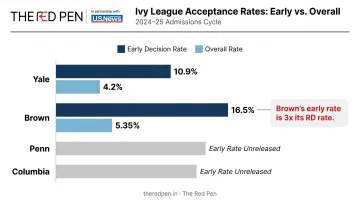
- At Brown, 16.5% of early applicants were admitted vs. 5.35% overall — early rounds offer a real statistical advantage at several schools.
- Roughly 40–55% of each incoming class fills through early rounds, compressing the regular decision pool significantly.
- Indian students should check each school's need-blind vs. need-aware policy for international applicants before committing to ED.
- Harvard, Brown, Cornell, Penn, and Dartmouth now require SAT/ACT scores — confirm each school's current testing policy before applying.
Early Admission Types at Ivy League Schools: ED, EA, and REA Explained
Ivy League schools use two distinct early admission structures — Early Decision and Restrictive Early Action — and the differences matter significantly for your application strategy.
Early Decision (ED)
ED is a binding agreement. If you apply ED and get admitted, you enroll, with no exceptions except in cases of genuine financial hardship. You must withdraw all other applications immediately upon acceptance.
Key details:
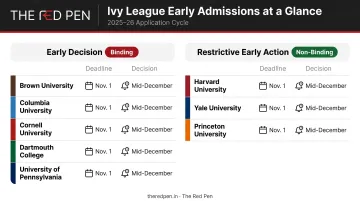
- Deadline: November 1 at all five ED schools
- Decision notification: mid-December
- Schools using ED: Brown, Columbia, Cornell, Dartmouth, Penn
Restrictive Early Action (REA) / Single-Choice Early Action (SCEA)
REA is non-binding. You apply in November, receive a decision in December, and have until May 1 to decide on enrollment.
The restriction: you cannot simultaneously apply early to another private university. You can apply early to public universities, international schools, rolling admissions programs, and military academies.
- Schools using REA/SCEA: Harvard, Yale, Princeton
Quick-Reference Comparison
The table below maps each school to its early admission type, binding status, and key dates.
| School | Early Plan | Binding? | Deadline | Decision |
|---|---|---|---|---|
| Harvard | Restrictive Early Action | No | Nov. 1 | Mid-December |
| Yale | Single-Choice Early Action | No | Nov. 1 | Mid-December |
| Princeton | Single-Choice Early Action | No | Nov. 1 | Mid-December |
| Brown | Early Decision | Yes | Nov. 1 | Mid-December |
| Columbia | Early Decision | Yes | Nov. 1 | Mid-December |
| Cornell | Early Decision | Yes | Nov. 1 | Mid-December |
| Dartmouth | Early Decision | Yes | Nov. 1 | Mid-December |
| Penn | Early Decision | Yes | Nov. 1 | Mid-December |
Ivy League Early Admission Statistics for the Class of 2030
Only a handful of schools publicly release complete early admission data. Where numbers are not publicly available, that is noted rather than estimated.
Ivy League Early vs. Overall Acceptance Rates
| School | Early Plan | Early Accept Rate | Overall Accept Rate | Notes |
|---|---|---|---|---|
| Yale | SCEA | 10.9% (779/7,140) | 4.2% (2,328/54,919) | 18% deferred, 70% denied in early round |
| Brown | ED | 16.5% (890/5,406) | 5.35% (2,564/47,937) | 1,674 admitted in RD |
| Penn | ED | Not publicly released | 5.8% (Class of 2030) | ED admits were nearly half the incoming class |
| Columbia | ED | Not publicly released | 4.23% (2,581/61,031) | 5,497 ED applications received |
| Cornell | ED | Not publicly released | Not released; 5,776 total admits | |
| Dartmouth | ED | Not publicly released | 5.8% (1,687/28,863) | Prior cycle had 3,550 ED applications |
| Harvard | REA | Not publicly released | Not released (withheld 2nd consecutive year) | |
| Princeton | SCEA | Not publicly released (Class of 2030) | 4.4% (Class of 2029) |
Brown's early acceptance rate of 16.5% is three times its regular decision rate. Yale's early rate of 10.9% is more than double its overall rate of 4.2%. At Penn, ED admits accounted for close to half the incoming class — a significant compression of the RD pool.
Harvard and Princeton chose not to release early or overall statistics for the Class of 2030, which makes precise analysis impossible. Any figures circulating online for these schools are unofficial estimates, not verified data.
How Selective Non-Ivy Schools Compare
| School | Early Plan | Early Rate | RD Rate | Notes |
|---|---|---|---|---|
| Duke | ED | 12.8% (849/6,627) | 3.67% (1,953/53,223) | Class of 2029 |
| Northwestern | ED | ~20% | Lower (overall ~7%) | ED filled 55% of Class of 2029 |
| Vanderbilt | ED | 11.9% (~920/7,727) | 2.8% (1,382/48,720) | Class of 2030 |
| Johns Hopkins | ED | Not released | ~4% RD | 813 early admits in Class of 2030 |
Across every school in this table, early acceptance rates run 3–5x higher than RD rates. ED's share of the incoming class — 55% at Northwestern, nearly half at Penn — shows how heavily these universities front-load admissions decisions.
A Note on What These Numbers Actually Mean
The early applicant pool is not a random sample of all applicants. It skews toward recruited athletes, legacy applicants, and students who have spent years building highly focused profiles around a specific school. That self-selection effect inflates the statistical advantage considerably.
For Indian applicants without legacy ties or athletic recruitment, the early rate advantage is real — but smaller than the headline numbers suggest. Use these rates as directional guidance:
- Early rates signal that schools fill a meaningful share of seats before RD
- The advantage is most reliable when your application is genuinely school-specific
- Legacy and athletic admits concentrate in the early round, narrowing the pool for general applicants
- Applying early to a school that isn't your first choice carries real risk, especially under binding ED
Early Admission Trends Shaping the 2026 Application Cycle
Three trends are reshaping the early admissions landscape in ways that directly affect Indian students.
Rising Application Volumes
Common App's November 2025 data shows 962,284 distinct first-year applicants through November 1 — a 5% increase from the prior year — with total applications up 10%. The average applicant submitted applications to 4.90 schools, up from 4.68 the year before.
More applications per student means more competition in every pool. Early rounds are not exempt. Even if early acceptance rates hold steady in percentage terms, the absolute number of qualified applicants competing for the same number of seats has grown.
Standardized Testing Policy Changes
The landscape is no longer uniformly test-optional. Current policies for the 2025–2026 cycle:
- Test-required: Harvard, Brown, Penn, Cornell, Dartmouth
- Test-flexible: Yale
- Test-optional: Princeton, Columbia
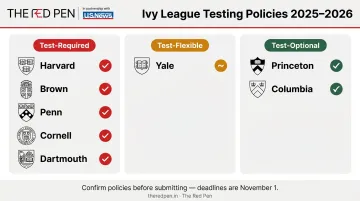
For Indian students planning to apply early, this matters in terms of timing. If you're applying to a test-required school with a November 1 deadline, your final test scores need to be in hand — or officially reportable — before you submit. Late October test dates may not produce scores in time.
Declining International Applications
This enrollment picture adds another layer to the testing and volume trends above. IIE data shows that new international student enrollment in the US fell 17% in fall 2025, with 96% of affected institutions citing visa application concerns. Applications from India specifically dropped 14% through November 1, 2025.
For Indian students, this creates a complex situation:
- Fewer Indian applications could reduce competition within the international pool
- But the students still applying tend to be the most committed and best-prepared
- Schools with need-aware international admissions policies — Columbia, Penn, and Cornell — may adjust their international enrollment targets in response to broader policy uncertainty
Benefits and Drawbacks of Applying Early to the Ivy League
Reasons to Apply Early
Applying early carries real advantages — and not just the headline acceptance rate numbers:
- Higher acceptance rates: At Brown, the ED rate is more than three times the RD rate. Even accounting for pool self-selection, that gap signals genuine institutional preference for early applicants, partly because ED admits directly improve yield.
- Demonstrated commitment: Applying ED tells a school it is your clear first choice. Admissions committees track yield closely, and a student who commits early removes some of that uncertainty.
- Reduced uncertainty: A December decision eliminates months of waiting. Seniors can focus on coursework, extracurriculars, and family instead of managing a lengthy regular decision list through spring.
Reasons to Think Twice
ED is not the right move for every applicant. Three factors deserve serious consideration:
- The binding commitment: If admitted ED, you cannot compare financial aid packages from other schools. A university that meets 100% of demonstrated need may still produce an aid package requiring significant family contribution — with no competing offer to weigh it against.
- No room to improve: Your application is locked in as of November. A higher test score from a December retake, a strong first-semester grade update, or a significant new achievement cannot be added to an ED file. If your profile will be materially stronger by January, RD may serve you better.
Deferral is more common than most applicants expect. Yale's Class of 2030 data illustrates this clearly: 18% of early applicants were deferred, with 70% denied and only 10.9% admitted outright. Being deferred is not a rejection — deferred students re-enter the regular decision pool — but it demands a deliberate response: a well-crafted letter of continued interest, any meaningful application updates, and sustained demonstrated commitment to the school.
If you are navigating a deferral or waitlist decision, The Red Pen's Post-submission Strategy service covers exactly this ground, from drafting your letter of continued interest to deciding between competing offers.
How to Decide: Is Early Decision the Right Strategy for You?
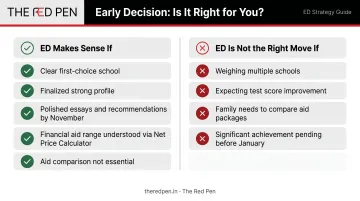
ED Makes Sense If:
- You have one clear first-choice school — not two or three you are genuinely torn between
- Your academic profile (GPA, test scores, activities) is finalized and strong by October
- Your essays and recommendations will be polished and ready before November 1
- Your family has used the school's Net Price Calculator and understands the likely financial aid range
- Financial aid comparison across schools is not essential to your enrollment decision
ED Is Not the Right Move If:
- You are still genuinely weighing two or more schools as first choices
- You are expecting a meaningful test score improvement from a late October or December retake
- Your family needs to compare aid packages to make an enrollment decision
- A significant achievement or award is expected before January that would strengthen your application
The REA Middle Ground
For Harvard, Yale, and Princeton, REA offers a useful compromise. You signal commitment and get an early decision without the financial risk of a binding commitment. The tradeoff: you cannot apply early to other private universities simultaneously, which requires careful planning of your school list. If your top choice is one of these three schools and your profile is ready, REA is often the strongest strategic move.
These decisions — which school to prioritize and when to apply — are closely linked, and getting both right requires careful thought. Working with an admissions consultant like The Red Pen can help you work through this in a structured way. Their Undergraduate Admissions Consulting service covers application strategy, school list building, and deadline planning, so your ED/REA/RD timing aligns with the rest of your application — not as an afterthought, but as part of the plan.
What Indian Students Need to Know About Ivy League Early Admissions
Financial Aid: Need-Blind vs. Need-Aware
This distinction matters more for Indian applicants than almost any other factor:
| School | International Aid Policy |
|---|---|
| Harvard | Need-blind for international students |
| Yale | Need-blind regardless of citizenship |
| Princeton | Need-blind for international applicants |
| Brown | Need-blind for international applicants |
| Dartmouth | Need-blind; meets 100% of demonstrated need |
| Columbia | Need-aware for international applicants |
| Penn | Need-aware for international applicants |
| Cornell | Need-aware for international applicants |
At need-aware schools, your financial aid application can influence your admissions outcome. Applying ED to Columbia, Penn, or Cornell means committing to enroll before you can compare aid packages, and without knowing whether your financial need influenced the decision. For most Indian families, that combination of unknowns carries real weight.
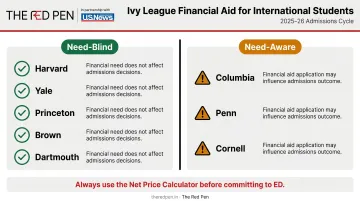
At need-blind schools (Harvard, Yale, Princeton, Brown, Dartmouth), your financial situation does not affect admissions. That doesn't mean aid will cover everything: use the Net Price Calculator before applying ED to any school.
Demonstrated Interest Without Campus Visits
Most Indian students cannot visit US campuses. For schools that track demonstrated interest, this gap can be addressed through:
- Attending virtual information sessions and webinars
- Emailing admissions officers with specific, thoughtful questions
- Connecting with current students or alumni through official programmes
- Attending college fairs in India where admissions representatives are present
- Engaging with regional admissions staff who cover India
Indian Students and Ivy League Admissions: A Grounded Perspective
Taking these practical steps matters — but so does understanding the broader admissions landscape. Ivy-specific data on South Asian or Indian undergraduate representation is not publicly released by individual schools. What is known: Indian students are admitted to Ivy League schools every year, and the pool includes strong applicants from across India, not just major metros.
The challenge is differentiation. Within the international pool, Indian applicants often share similar academic profiles — high GPAs, strong test scores, STEM-oriented coursework. Admitted students tend to have one thing in common: a specific, coherent story. An application that connects a clear intellectual interest to a distinct extracurricular path — and ties both to why a particular school is the right fit — is far more persuasive than strong credentials alone. That specificity is where Indian applicants can and do differentiate themselves.
Frequently Asked Questions
Is a 3.7 GPA bad for the Ivy League?
A 3.7 is below the median at most Ivy League schools — Harvard's average is 4.21 (weighted), Princeton's is 3.95. Course rigor matters considerably: a 3.7 earned in the most demanding curriculum available is evaluated differently than the same number in standard courses, and an upward grade trajectory carries weight too.
Is a 1400 SAT good enough for the Ivy League?
A 1400 falls below the 25th percentile at most Ivy League schools. Admitted students at Harvard, Princeton, and Cornell typically score between 1510 and 1600. If you are applying to test-required schools like Harvard, Brown, Penn, or Cornell, consider retesting before committing to an early deadline with a score in this range.
Can I get into the Ivy League as an Indian student?
Yes — Indian students are admitted each year. Competition within the international pool is intense, and a strong academic profile alone is rarely enough. A differentiated personal narrative, genuinely distinctive extracurriculars, and an application that reflects real self-awareness about fit with a specific school are what separates admitted students.
What is the difference between Early Decision and Early Action for Ivy League schools?
Early Decision is binding — you must enroll if admitted and cannot compare financial aid offers. Harvard, Yale, and Princeton use Restrictive Early Action (or Single-Choice Early Action), which is non-binding, restricts you from applying early to other private universities simultaneously, and lets you wait until May 1 to decide.
What percentage of the Ivy League class is admitted through early rounds?
At schools that release data, the figure is roughly 40–55% of the incoming class. Penn's ED admits have represented nearly half the Class of 2030. Northwestern filled more than half of its Class of 2030 through ED. This compression makes the regular decision pool significantly more competitive than overall acceptance rates suggest.
Should Indian students apply Early Decision to Ivy League schools?
It depends on two factors: how clearly you've identified your first choice, and whether your family can commit without comparing aid packages. If both conditions are met, ED is a strong strategic move. If not, REA at Harvard, Yale, or Princeton — or regular decision — keeps your options open.