Not quite. What your essay probably needed was a complete structural overhaul — a clearer opening, a stronger narrative arc, a conclusion that actually ties back to your theme. Comma fixes won't save an essay that doesn't yet tell a compelling story.
This confusion costs applicants — especially those applying to competitive US, UK, and Canadian universities — real admissions impact. Editing and proofreading are distinct processes that address completely different problems, happen at different stages, and cannot substitute for each other.
Here's what you need to know about both.
Key Takeaways
- Editing comes first: it fixes structure, narrative, voice, and argument before surface-level work begins.
- Proofreading comes last: it catches spelling, grammar, and punctuation errors once the content is final.
- Reversing this order wastes time; structural changes after proofreading undo the proofread.
- Application essays typically need more editing rounds because voice and narrative carry more weight than technical perfection.
- Skipping either stage leaves your essay either structurally weak or riddled with errors — both hurt your application.
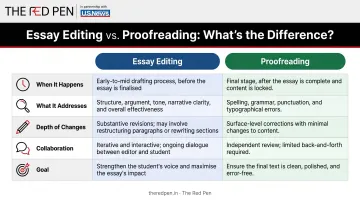
Essay Editing vs. Proofreading: Quick Comparison
Here's how the two processes differ across the dimensions that matter most for college applications:
| Dimension | Essay Editing | Proofreading |
|---|---|---|
| When it happens | Early and mid drafts | Final draft only |
| What it addresses | Structure, argument, narrative, tone, word choice | Spelling, grammar, punctuation, formatting |
| Depth of changes | May involve significant rewrites or restructuring | Minor, surface-level corrections only |
| Collaboration needed | Often requires dialogue with a mentor or advisor | More independent or mechanical |
| Goal | Improve overall impact and persuasiveness | Ensure the essay is error-free before submission |
What Is Essay Editing?
Essay editing is a comprehensive review of the substance, structure, and style of your writing — not just what's on the surface. For application essays specifically, it also asks: does this essay answer the prompt? Does it reflect who this person actually is? Will an admissions reader remember it?
What Editors Actually Review
A strong editor examines multiple layers simultaneously:
- Overall argument or theme — Is there a clear central idea?
- Logical flow — Do paragraphs connect, or does the essay jump around?
- Tone — Does it feel right for an admissions audience?
- Opening hook — Does the first line earn the reader's attention?
- Prompt alignment — Does the essay actually answer what was asked?
The changes that result from editing can be substantial. An editor might move the most compelling moment to the opening paragraph, cut entire sections to meet word limits, or replace vague language like "I learned a lot" with specific, vivid detail.
The Voice Problem
Application essays face a challenge that academic papers don't: the writing must improve and still sound like the student who wrote it. Over-editing flattens voice. An essay that sounds polished but generic tells admissions readers nothing distinctive about the applicant.
Editing application essays well means prioritizing clarity and authentic voice over polished-sounding prose.
The Red Pen uses an INK (Interactive Narrative Kit) framework to help students identify their core story before drafting begins. When that foundation is clear upfront, subsequent editing rounds strengthen the essay rather than overhaul it — and the student's voice stays intact through every revision.
When Editing Is the Priority
Editing should be your focus when:
- You're on draft one or two of a personal statement
- A reader finishes the essay unsure what makes you distinctive
- The essay doesn't directly answer the prompt
- You're over the word limit and need strategic cuts
- The tone feels formal, generic, or unlike how you actually speak
- The opening paragraph buries the most interesting moment
What Is Proofreading?
Proofreading is the final quality-control step. It focuses exclusively on surface errors: spelling mistakes, grammatical errors, punctuation issues, inconsistent capitalisation, and typos. At this stage, the content and structure are already finalised. You are cleaning the text, not reconsidering the story.
Why Even Strong Writers Need It
The brain auto-corrects familiar text. After reading your own essay ten times, you will stop seeing the errors because your mind fills in what should be there. That is simply how human cognition works, not a reflection of your writing ability.
Practical techniques that actually help:
- Read aloud: your ear catches what your eye skips
- Read backwards, sentence by sentence, to break automatic pattern recognition
- Print a hard copy, since screen reading tends to be less thorough
- Check one error type at a time (comma rules, then spelling, then formatting)
What Proofreading Cannot Fix
This boundary matters: proofreading will not improve a weak argument, fix an off-topic response, clarify an unclear narrative, or correct a tone that feels wrong. Those are editing problems. Proofreading a draft that still needs structural work is like painting a cracked wall: the surface looks better, but the underlying problem remains.
Automated tools (spell-checkers, grammar apps) help but have real limits. They miss contextual errors — "affect" vs. "effect," "their" vs. "there" — and cannot evaluate whether word choice is appropriate for an admissions audience. A 2024 comparative study on grammar tool accuracy found that different tools perform inconsistently across error types, meaning no single tool catches everything.
When Proofreading Is the Right Step
Proofreading is appropriate when:
- The essay has been through at least one substantive editing round
- Structure and narrative are locked — you are not changing content
- You are within 48–72 hours of the submission deadline
Common proofreading targets in application essays include: inconsistent formatting of university names, punctuation errors around quotation marks, missing hyphenation in compound modifiers, comma splices, and subject-verb agreement errors. Georgia Tech admissions staff, who reviewed approximately 35,000 personal essays in a single cycle, noted examples like "Georgia Gech" and repeated words as typical errors — and importantly, confirmed that a single typo alone has not denied an applicant. Minor errors are treated as human mistakes, not disqualifiers. But they are still worth fixing.
Which Does Your Application Essay Actually Need?
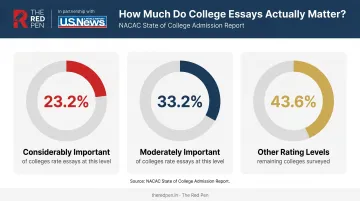
Most first and second drafts need editing far more urgently than proofreading. According to NACAC's State of College Admission report, 23.2% of colleges rated the essay as considerably important in admissions decisions, with another 33.2% rating it moderately important. Admissions offices are reading for voice, clarity, and story — not comma placement.
A grammatically flawless but generic essay will not stand out. An essay with one minor typo but a powerful, specific narrative almost certainly will.
Situational Guide: Edit or Proofread?
Choose editing if:
- You are on draft one or two
- A reader has flagged confusion about your story or theme
- You are over the word limit
- The essay doesn't feel like you
- The opening paragraph is weak or generic
Choose proofreading if:
- You have completed at least two editing rounds
- The narrative is finalised and you are not changing content
- Submission is within 48–72 hours
Why You Cannot Do Both at Once
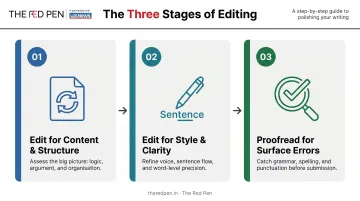
Attempting to fix structure and grammar simultaneously reduces effectiveness for both tasks. Your attention splits and neither gets done well. The right sequence is:
- Edit for content and structure (big-picture)
- Edit for style and clarity (sentence-level)
- Proofread last (surface errors only)
How This Varies by Essay Type
- Undergraduate personal statements (Common App, UCAS): Voice and story dominate — expect more editing rounds before proofreading becomes relevant
- Short supplemental answers (50–150 words): Every word must earn its place, so tight editing for concision comes before proofreading
- "Why This College" essays: Prompt alignment is critical — editing must confirm specificity before surface cleanup begins
For students preparing applications to US, UK, and Canadian universities, The Red Pen's admissions consultants provide essay support across every stage: brainstorming, multi-draft editing, and final review, so each essay is both compelling and polished before it reaches an admissions committee.
Conclusion
Editing and proofreading are not interchangeable. They address different problems, operate at different stages, and require different kinds of attention. For application essays, the sequence is non-negotiable: edit to make the essay worth reading, then proofread to make it error-free.
For students applying to competitive universities, the essay is one of the few application components entirely within your control. Skipping or conflating these stages is one of the most common — and most avoidable — reasons strong students submit essays that don't reflect their full potential. If you're unsure where your draft stands, working with an experienced essay coach can help you identify which stage needs the most attention before you submit.
Frequently Asked Questions
Should I edit or proofread my application essay first?
Always edit first. Editing addresses content, structure, and narrative — the elements that determine whether the essay is worth reading. Proofreading a draft that still needs structural changes wastes effort, since any subsequent edits will undo the surface corrections you just made.
Can I proofread my own essay, or do I need someone else?
Self-proofreading is possible using techniques like reading aloud or reading backwards, but a second reader — ideally someone unfamiliar with the essay — catches errors your brain automatically corrects from familiarity. Using both gives you the best chance of catching what either method misses on its own.
How many rounds of editing does an application essay typically need?
Most strong personal statements go through three to four editing rounds — starting with big-picture structure, then narrowing to style, tone, and word choice, before a final proofread. The exact number depends on how much your draft changes between rounds.
Does editing change my essay's voice or make it sound less like me?
Good editing strengthens your voice rather than replacing it. It removes obstacles to clarity so your authentic perspective comes through more powerfully — the goal is never to rewrite your story, but to help it land the way you intend.
What is the difference between copy editing and proofreading?
Copy editing sits between full structural editing and proofreading — it addresses sentence-level clarity, word choice, and grammar without restructuring content. Proofreading is only the final pass for surface errors on a near-final draft, as defined by the Editorial Freelancers Association.
Can grammar or spell-check tools replace proofreading?
No. Automated tools miss contextual errors (homophones, wrong-word substitutions), cannot evaluate tone or appropriateness, and fail to catch missing content. They are useful as a first pass but not a substitute for careful human review.