ED, EA, and RD carry different acceptance rates, commitment levels, and financial implications. Choosing the wrong path — or applying ED to the wrong school — can cost you the chance to compare financial aid packages worth lakhs of rupees. Choosing the right one, with the right profile, can meaningfully improve your chances at your first-choice university.
This article breaks down exactly how each application plan works, presents current acceptance rate data from top schools, and gives you a practical framework for deciding which path makes sense for your situation.
Key Takeaways
- ED acceptance rates can be 3–5x higher than RD rates at schools like Dartmouth, but the binding commitment is non-negotiable
- Early Action offers an earlier decision without enrollment obligation, though its admissions advantage is smaller than ED's
- The ED advantage is strongest where schools rely on early applicants to lock in enrollment numbers
- ED is not the right move for every student — particularly those comparing financial aid packages across schools
- Indian students should not apply ED before reviewing scholarship offers from multiple universities
ED, EA, REA, and RD: A Quick Comparison
The five main application plans differ significantly in flexibility and commitment:
| Plan | Typical Deadline | Binding? | Restrictive? | Decision Timeline |
|---|---|---|---|---|
| ED I | Nov 1–15 | Yes | One ED application only | December |
| ED II | Jan 1–15 | Yes | One ED application only | February |
| EA | Nov 1–15 | No | Usually unrestricted | December–January |
| REA / SCEA | Nov 1 | No | Cannot apply ED/EA elsewhere | December |
| RD | Jan 1–15 | No | No restrictions | March–April |
A few important clarifications:
- Harvard, Yale, Stanford, and Princeton use REA/SCEA: non-binding, but you cannot apply ED or EA to other schools at the same time
- MIT's EA is fully unrestricted — you can apply EA elsewhere and are not bound to enroll
- Georgetown's EA is non-binding, but EA applicants cannot apply ED to other schools
- RD offers the most flexibility: decisions arrive by May 1, giving you time to compare all offers, including financial aid packages
What Are Early Decision, Early Action, and Regular Decision?
Early Decision (ED I and ED II)
ED is a binding admissions plan. You apply by November 1–15, and if admitted, you commit to enrolling and withdraw all other applications. It's a contractual commitment: students who back out of an ED acceptance can be reported to other colleges.
ED II serves students who identify their first-choice school later in the cycle, or who need more time to strengthen their application. The January deadline carries the same binding commitment as ED I.
Early Action (EA) and Restrictive Early Action (REA)
EA is non-binding. You apply early, receive a decision in December or January, and still have until May 1 to decide. You can compare financial aid offers, visit campuses, and weigh your options.
REA (used by Harvard, Yale, Stanford, Princeton) adds a restriction: you cannot apply ED or EA to other schools, though RD applications remain unrestricted. Acceptance under REA does not obligate enrollment.
Regular Decision (RD)
RD is the default path — non-binding, with January deadlines and decisions in March/April. It gives students the most time to refine applications, build a stronger senior-year record, and compare financial aid packages before the May 1 deadline. Understanding these differences matters because each pathway carries meaningfully different acceptance rates at selective schools.
Here's a quick reference before we get into the numbers:
| Plan | Binding? | Deadline | Decision |
|---|---|---|---|
| ED I | Yes | Nov 1–15 | Mid-December |
| ED II | Yes | Jan 1–15 | Mid-February |
| EA | No | Nov 1–15 | December–January |
| REA | No | Nov 1 | Mid-December |
| RD | No | Jan 1–15 | March–April |
Early Decision and Regular Decision Acceptance Rates at Top Schools
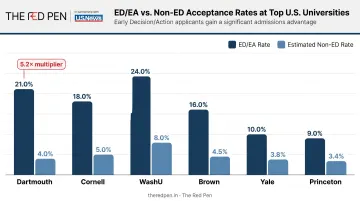
The numbers below make the ED advantage concrete. Where current 2024–25 Common Data Set (CDS) figures are verified, they are noted as such; estimated non-ED rates are calculated from CDS totals. The gaps between ED and non-ED acceptance rates at some schools are larger than most applicants expect.
| School | ED/EA Plan | ED/EA Rate | Overall Rate | Est. Non-ED Rate |
|---|---|---|---|---|
| Dartmouth | ED | 19.18% | 5.40% | ~3.66% |
| Cornell | ED | 11.64% | 8.41% | ~7.83% |
| WashU | ED | ~25.3% | ~13% | Not retained |
| Brown | ED | 15.95%* | 5.51%* | ~4.10%* |
| Harvard | REA | Not published | 3.65% | — |
| Yale | SCEA | Not published | 3.87% | — |
| Princeton | SCEA | Not published | 4.62% | — |
*Brown figures from 2021–22 CDS; most recent cycle data not yet verified. Harvard, Yale, and Princeton do not publish separate early-round applicant counts in their CDS.
Where the ED Advantage Is Most Dramatic
At some schools, applying ED more than doubles — or even quintuples — your odds compared to the regular pool. Three schools show the sharpest divergence in verified data:
- Dartmouth: 2024–25 CDS data shows ED admits at 19.18% versus an estimated 3.66% for non-ED applicants — a 5.2x difference
- WashU: ED rate of approximately 25.3% from official CDS figures, making it one of the strongest ED advantages among T20 schools
- Brown: Historical data shows a 3.9x multiple (ED 15.95% vs. non-ED ~4.10%), though current cycle verification is pending
Cornell's gap is real but smaller — ED applicants see roughly 1.5x the odds of non-ED applicants. That's meaningful but far less dramatic than Dartmouth's numbers.
A Note on Trends
According to NCES admissions research, ED pools have grown significantly at selective schools as more applicants understand the strategic advantage. Whether this growth is compressing the ED advantage varies by school and year. For now, the data still shows a clear benefit at most selective institutions — but the size of that benefit is worth verifying each cycle before committing to an ED school.
Why Are Early Decision Acceptance Rates Higher?
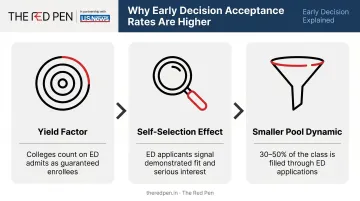
Three structural reasons explain the gap.
The Yield Factor
Colleges track yield — the percentage of admitted students who actually enroll. Dartmouth's 2024–25 CDS shows ED admits represented 39.8% of all admits and would cover 57.6% of enrolled class size if every ED admit enrolled.
For admissions offices trying to hit precise enrollment targets, ED applicants are guaranteed enrollees. Schools respond by admitting more of them.
The Self-Selection Effect
Students who apply ED have typically researched the school thoroughly, visited campus, and identified it as a genuine first choice. They tend to be a stronger fit for the school's profile than the average RD applicant. Admissions officers can see this demonstrated interest in the application itself.
The Smaller Pool Dynamic
ED pools are dramatically smaller than RD pools. Schools often fill 30–50% of their incoming class through ED — Dartmouth's 681 ED admits came from just 3,551 ED applicants. Compare that to the full RD pool of 28,000+ applicants, and the per-applicant odds shift considerably in ED's favor.
What the higher ED rate does not mean: Applying ED will not compensate for an application well below a school's typical profile. The boost is most meaningful at the margin — for students who are competitive for the school but benefit from demonstrating clear commitment.
ED, EA, or RD: Which Should You Choose?
A Practical Decision Framework
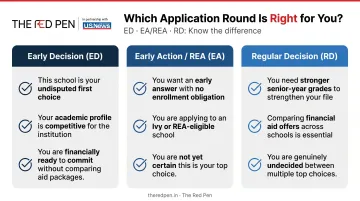
Apply ED if:
- The school is your undisputed first choice — not just a strong option
- Your academic profile is competitive for that institution
- Your family has used the net price calculator and is prepared to commit without comparing offers from other schools
Apply EA or REA if:
- You want an earlier decision signal without an enrollment obligation
- You're applying to Harvard, Yale, Stanford, or Princeton, where REA is the only early option
- You're not yet certain this is your top choice
Apply RD if:
- You need another semester of grades or awards to strengthen your profile
- Financial aid comparison across multiple offers is essential to your decision
- You're still genuinely uncertain between two or more schools
The Financial Aid Question — Critical for Indian Families
This is where ED becomes genuinely risky for many Indian students. Committing under ED means you receive exactly one financial aid offer and cannot compare it with packages from other schools before deciding. For families relying on merit scholarships or need-based aid, that's a significant constraint.
Before applying ED, check:
- Run the net price calculator for that specific school before submitting
- Confirm whether the school meets 100% of demonstrated financial need for international students
- Check whether the school is need-aware for international applicants — this affects both admission odds and aid generosity
These policies vary widely and can shift the financial picture entirely.
Getting the ED decision right requires weighing academics, school fit, and financial readiness together — not in isolation. The Red Pen's Undergraduate Admissions Consulting covers early application strategy as part of its core scope, including the college shortlisting work needed to identify a genuine first-choice school before any ED commitment. Their team has guided over 1,500 university applications and helped students secure more than ₹50 crores in scholarships.
Frequently Asked Questions
Is the acceptance rate higher for Early Action?
Yes, EA acceptance rates are generally higher than RD rates, but the advantage is smaller than ED's. Restrictive EA at schools like Harvard and Yale typically shows a larger boost than standard, unrestricted EA.
What is the difference between Early Decision and Early Action?
The key difference is binding commitment. ED requires you to enroll if accepted and withdraw other applications. EA is non-binding — you receive an early decision but retain the freedom to compare offers until May 1.
Can international students apply Early Decision?
Yes, Indian and other international students can apply ED. However, the binding commitment is especially consequential for international applicants, since committing before seeing financial aid offers from multiple schools can be a serious financial risk.
Does applying Early Decision affect financial aid?
ED doesn't reduce your eligibility for aid, but it does mean you receive only one offer before committing. You cannot compare packages from other schools. Financially sensitive applicants are better served by EA or RD.
What happens if you are deferred from Early Decision?
A deferral moves your application into the RD pool. The binding ED commitment no longer applies once you're deferred, and you're free to continue applying to other schools. Treat a deferral as a signal to strengthen your RD application immediately.
Is an acceptance rate of 70% high?
In U.S. college admissions broadly, an NCES institutional admissions report puts the average admission rate around 67%. A 70% rate is relatively accessible — far above the sub-10% rates at Ivy League and T20 schools. Comparing rates only makes sense within the same selectivity tier.