For Indian students, the stakes are real. Over 1.33 million Indian students are currently pursuing higher education abroad, including 363,019 in the US alone in 2024/25 — a 10% increase year over year. The competition for places at good universities has never been sharper.
Getting this decision wrong isn't just disappointing. It can mean wasted tuition, credits that don't transfer, degrees that carry limited weight with employers back home, or visa complications that derail your plans entirely. Choosing a country to live in is a lifestyle decision. Choosing the right university is an academic and financial one — and those two things are very different.
This guide walks you through how to make that decision systematically.
Key Takeaways
- Rankings matter, but subject-level rankings matter more than overall institutional rankings
- Total cost of attendance — not just tuition — must drive your financial planning
- Post-study work visa policies vary significantly by country and directly shape your career prospects after graduation
- Your admission probability should shape your shortlist before you write a single word of your application
- Starting the process 12–18 months early gives you a genuine edge
Why Choosing the Right University Abroad Is a High-Stakes Decision
Most students begin with a destination. "I want to go to the US" or "I'm interested in Canada." That's a natural starting point, but it's also where a lot of poor decisions begin.
The country you study in matters far less than the specific university, the specific programme, and how both align with your academic profile and career goals. Two students at universities in the same city can have completely different outcomes — one with strong industry connections and a clear visa pathway, the other still figuring out next steps.
The Numbers Show How Competitive This Has Become
India is now the leading country of origin for international students in both the US and UK. With that volume comes real competition — for seats, for scholarships, and for employer attention post-graduation.
A degree from a university with strong employer partnerships in your sector is worth more than a degree from a globally ranked institution with no presence in your target industry. Decisions based purely on country preference or brand name frequently lead students to universities that look impressive on paper but underdeliver on outcomes.
What Employers and Graduate Programmes Actually Look At
A university's reputation affects how Indian employers and postgraduate admissions committees read your degree. Hiring managers and admissions officers look past the logo on your certificate. What they're reading for includes:
- Accreditation — whether the institution meets recognised academic standards
- Subject-level rankings — how the department in your field actually performs, not just the university overall
- Industry partnerships — evidence that the curriculum connects to real employer networks
These aren't just prestige markers. They signal faculty quality, curriculum rigour, and the alumni network available to you after graduation.
Key Factors to Consider When Choosing a University to Study Abroad
The goal isn't to compile a list of famous universities. It's to build a focused shortlist where every option genuinely fits your academic profile, budget, and career direction. These are the factors that separate a well-reasoned shortlist from a wishlist.
Academic Reputation and Rankings
Global ranking systems — QS World University Rankings, Times Higher Education, and U.S. News Best Global Universities — are useful starting points. They reflect research output, faculty quality, employer reputation, and peer assessment.
The critical mistake is stopping at the overall rank.
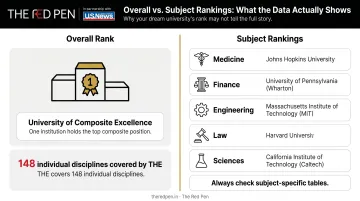
QS ranks MIT #1 globally, but QS's own subject tables rank Harvard as the top institution for both Medicine and Accounting & Finance. THE's subject rankings cover 148 individual disciplines with subject-adjusted metrics. The institution that leads overall often isn't the leader in your specific field.
What to do instead:
- Look at subject-level rankings, not just institutional rankings
- Check employer reputation scores alongside academic scores
- Use multiple ranking systems in parallel — no single table tells the full story
Course Offerings and Academic Fit
A programme title isn't the same as a programme. "Computer Science" at one university might emphasise theory and research; at another, it's industry-integrated with placement years and employer partnerships. That distinction shapes your career trajectory from day one.
When evaluating a programme, go beyond the brochure:
- Read the full curriculum and check whether electives align with your interests
- Look at faculty research profiles — are they active in the areas you care about?
- Check alumni outcomes on LinkedIn: where did graduates from this specific programme end up working?
- If you're transferring credits from a home institution, confirm compatibility with your home university's academic office before applying
Total Cost of Attendance and Financial Aid
"Tuition fees" is the number students focus on. It's rarely the number that determines whether studying abroad is financially viable.
True cost of attendance includes:
- Tuition fees
- Living expenses (which vary enormously between cities)
- Health insurance
- Visa and application fees
- Travel costs
- Personal expenses
To put this in perspective: University of Michigan's 2025/26 international student budget lists total annual costs at USD 84,000–88,000, including tuition and living. In Canada, EduCanada estimates students need at least CAD 23,000 per year for living costs alone, separate from tuition averaging CAD 41,746 for undergraduates.
Many universities offer merit-based aid and country-specific grants. The UK GREAT Scholarship provides £10,000 toward postgraduate tuition for Indian students; the University of Sydney's Vice-Chancellor's International Scholarship offers up to AUD 40,000. Scholarship deadlines often fall before application deadlines — research these early.
Building a realistic cost picture across your shortlist is part of how The Red Pen approaches application planning — so students aren't making final decisions without the full financial context.
Post-Study Work Visa and Career Outcomes
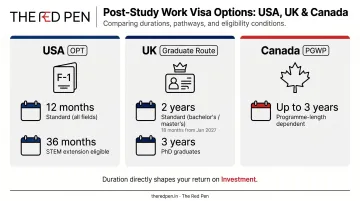
Total cost only makes sense alongside what you earn afterward. The country you study in determines how long you can work there post-graduation — and that window directly shapes the return on your investment.
| Country | Post-Study Work Option | Duration |
|---|---|---|
| USA | OPT (F-1 students) | 12 months; 36 months for STEM |
| UK | Graduate Route visa | 2 years (18 months from Jan 2027); 3 years for PhDs |
| Canada | PGWP | Up to 3 years (programme-length dependent) |
A 2024 report by Universities UK International found that 69% of international alumni in the UK found work immediately after graduation, and 61% said UK study significantly influenced their ability to get their current job.
Look at graduate employment rates and median starting salaries for the specific university and programme, not just the country average.
Admission Requirements and Your Eligibility
Applying to universities where your profile doesn't meet the threshold isn't just inefficient — it's expensive and demoralising. Honest self-assessment before shortlisting is non-negotiable.
Key admission variables:
- Academic grades: University of Edinburgh requires Indian postgraduate applicants to hold 55% or above; Edinburgh Napier requires 60% or above at Class XII for undergraduate entry
- English proficiency: University of Toronto requires IELTS 6.5 overall with no band below 6.0; the same standard applies at the University of Sydney
- Standardised tests: GRE, GMAT, or SAT requirements vary by programme and institution
- Acceptance rates: University of Michigan's 2024/25 admit rate was 15.6% from nearly 98,000 applicants
Structure your list across three tiers — reach, match, and safety — before writing anything.
Student Support Services and Campus Environment
Moving abroad for the first time is difficult. Universities with strong international student infrastructure make that transition substantially easier — and research shows that students who use on-campus support services are more likely to persist academically.
Look for:
- A dedicated international student office
- Mental health and counselling services accessible to international students
- Indian student associations or communities
- Pre-departure orientation and housing support
- Academic advising during the first semester
Exchange and short-term programme students often get less structured support than students enrolled directly. If you're applying directly, this matters less — but confirm the specifics before you commit.
How to Build and Narrow Down Your University Shortlist
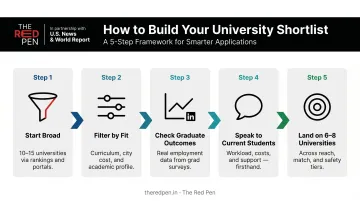
The shortlisting process should happen before applications begin — not alongside them. Here's a practical framework:
Start broad. Identify 10–15 universities using QS and THE subject rankings, government portals (EducationUSA, UKCISA, Study Australia), and your target programme areas.
Filter by fit. Remove universities where the curriculum doesn't align, the city's cost of living is outside your budget, or your academic profile falls significantly below the published entry requirements.
Check graduate outcomes. Use LinkedIn's alumni search to see where graduates from your target programme actually end up. Read student forums and reviews, not just university brochures.
Speak to current students. Reach out on LinkedIn or university international student forums. Ask about workload, professor accessibility, career support quality, and what life in that city genuinely costs.
Land on 6–8 universities distributed across reach, match, and safety tiers — and across your target countries and cost brackets.
Start this process 12–18 months before your intended enrollment date. That buffer gives you space for test preparation, scholarship applications, and visa processing — all of which run on their own timelines and can't be rushed.
How The Red Pen Can Help You Choose the Right University Abroad
The Red Pen is a Mumbai-based education consulting firm — and a strategic partner of U.S. News & World Report — that supports students pan-India through every stage of undergraduate admissions, from initial university exploration through final enrollment decisions.
What distinguishes The Red Pen's approach:
- Personalised university shortlisting grounded in each student's academic profile, budget, career goals, and visa pathway — not generic ranking tables
- Access to U.S. News & World Report data through a landmark strategic partnership, giving counselors and students credible global university intelligence when evaluating options
- The INK (Interactive Narrative Kit): a proprietary process for developing a student's personal narrative and application strategy
- Scholarship strategy built in from day one — not flagged as an add-on after acceptances arrive
- Post-submission support including waitlist strategy, deferral guidance, and help navigating multiple offers

The team has helped students gain admission to selective universities worldwide, including applicants with non-standard academic backgrounds, through careful narrative positioning rather than credentials alone.
Whether you're still building your initial shortlist or already deep in research, working with a counselor early means your applications are shaped by strategy — not scrambled together at the deadline.
Frequently Asked Questions
Is 20 lakhs enough to study abroad?
₹20 lakhs (approximately USD 24,000) can cover a year's tuition at affordable destinations like Germany, where students need to demonstrate just EUR 11,904 in annual financing. It will not cover full costs at universities in the US, UK, or Australia. Factor in living expenses, insurance, and travel, and research scholarship options early.
How do I choose which country to study abroad?
Start with your target career outcome and the post-study work visa rules in each country, since these directly affect how long you can gain work experience after graduating. Then factor in the strength of your target field in each country, cost of living, and whether your preferred universities offer strong industry connections in that discipline.
Can I study abroad with 40% marks?
Most competitive universities in the US, UK, Canada, and Australia require a minimum of 60–65%. Some foundation programmes and pathway colleges accept lower scores, though language requirements and other conditions still apply. Eligibility is programme-specific, so check each institution's published entry requirements for Indian applicants directly.
How important are university rankings when choosing where to study abroad?
Rankings are a useful starting point, not a final answer. Subject-level rankings are far more meaningful than overall institutional rankings for most applicants. Graduate employment rates, industry partnerships, and alumni networks in your specific field often predict career outcomes more accurately than a global rank number.
How early should I start researching and applying to universities abroad?
Begin at least 12–18 months before your intended start date. Scholarship deadlines often fall well before application deadlines, and strong essays, recommendations, and personal statements take considerably longer to prepare than most students anticipate.