Introduction
Every year, thousands of Indian students apply to top universities abroad with strong GPAs and competitive test scores. Harvard's acceptance rate for the Class of 2029 was just 4.2%, and MIT admitted 4.6% of applicants that same cycle. The pool is exceptional — and grades alone don't separate the admitted students from the rest.
What does? A deliberately constructed profile: one where academic credentials, extracurricular depth, and real-world exposure form a single coherent story — not a collection of unrelated achievements stacked on a résumé.
Profile building gets mentioned constantly in the study abroad conversation. What rarely gets explained is what it actually means in practice — and what mistakes derail otherwise strong applications.
This guide covers all of it: what profile building involves, its five core components, a step-by-step approach for undergraduate applicants, and the most common pitfalls to avoid.
Key Takeaways
- Profile building is a deliberate, multi-year process — not a last-minute checklist of credentials.
- Top universities review applications holistically: strong academics get you considered, but they rarely set you apart.
- Every activity should serve a narrative purpose — depth beats breadth.
- Starting in Grades 9–10 gives you time to build genuine, sustained experiences rather than scrambling to fill gaps before applications.
- Profile building and essay strategy are inseparable — your SOP is what ties every experience into a coherent story.
What Is Profile Building for Study Abroad?
Profile building is the intentional process of developing your academic, personal, and professional credentials into a coherent story for admissions committees — one that extends well beyond grades and test scores.
Mandatory Life vs. Intentional Life
Here's a distinction worth understanding early: there is a difference between your Mandatory Life and your Intentional Life.
Your Mandatory Life includes attending classes, completing assignments, showing up to required activities. These are the baseline. Universities expect them.
Your Intentional Life is what you chose to do beyond those minimums — the research project you pursued out of curiosity, the initiative you started at school, the skill you developed on your own time.
MIT's admissions process explicitly looks for evidence of character, collaborative instinct, and willingness to take initiative. Harvard evaluates the "whole student" — including background, activities, and personal qualities that extend beyond academic preparation.
Admissions committees aren't primarily evaluating what you were required to do. They're evaluating what you chose to do with the time that was yours.
Why This Matters for Admissions
Top universities look beyond academic indicators. UC Berkeley explicitly values persistence, passion, and leadership; University of Michigan reviews the full record — leadership, service, and employment alongside grades.
A strong profile also:
- Strengthens scholarship eligibility at merit-based programmes
- Signals readiness for multicultural, high-pressure academic environments
- Gives your recommenders and essays something specific and meaningful to reference
A profile evaluation — a diagnostic assessment of where your credentials stand against what target universities expect — is the natural starting point. It identifies gaps and shapes the strategy before active building begins.
Key Components of a Strong Study Abroad Profile
A strong profile is built from five interlocking elements. Each must be developed intentionally.
Academics and Test Scores
Strong academic performance is the baseline filter, not the differentiator. Most competitive universities have score ranges that reveal how high the bar sits: MIT's Class of 2029 middle 50% ranged from SAT Math 780–800 and SAT ERW 740–780. UC Berkeley's 2024 admitted class had unweighted GPAs between 3.89–4.00.
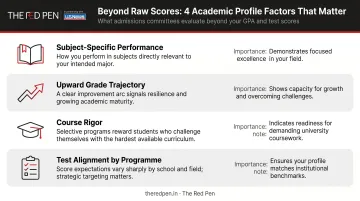
What matters beyond raw scores:
- Subject-specific performance in areas relevant to your intended field
- Upward grade trajectory — improvement over time signals genuine effort
- Course rigor — excelling in challenging coursework carries more weight than high grades in easier ones
- Test alignment by programme: SAT/ACT for undergraduate; TOEFL/IELTS for English proficiency
Extracurriculars, Leadership, and Community Engagement
Extracurriculars demonstrate initiative, values, and depth of character — but only when they reflect genuine interest and meaningful impact.
The Common App allows up to 10 activities, but explicitly states that applicants don't need to fill all 10 slots. Quality and depth matter far more than volume.
What admissions committees actually want to see:
- Leadership or ownership — founding something, leading a team, driving an initiative
- Sustained commitment — multi-year involvement signals genuine interest, not résumé padding
- Measurable impact — what changed because you were involved?
Passive participation in many clubs is far less persuasive than deep ownership of one or two meaningful activities. Students who built standout profiles through The Red Pen's mentorship programmes consistently demonstrated this — one student founded two nonprofits and co-founded a sustainable clothing brand; another developed a robotics system for mine rescue and used self-funded earnings to publish research.
Professional Experience, Internships, and Certifications
For undergraduate applicants, relevant internships and projects stand in for full-time work experience. What matters is how you frame your contribution — and whether it shows tangible outcomes.
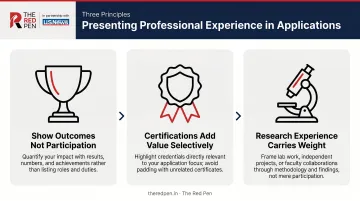
A few principles to apply:
- Show outcomes, not just participation. "Interned at X" is weak. "Led a team of four to redesign the onboarding process, reducing drop-off by 30%" is persuasive.
- Certifications add value selectively. Courses from platforms like Coursera or edX are useful when they bridge a visible skill gap and are paired with evidence of how you applied what you learned.
- Research experience — independent projects, lab assistantships, or published findings — carries real weight for applicants targeting research-focused or STEM programmes.
Application Documents: SOP and Letters of Recommendation
The Statement of Purpose (SOP) — or personal statement — is where your entire profile comes together as a single, coherent story. It answers three questions admissions readers want resolved: why this programme, why now, and why you?
A strong SOP:
- Opens compellingly — not with "I have always been passionate about..."
- Uses specific examples drawn from your actual profile
- Closes with a clear forward-looking statement
- Stays within the platform's word limit — 650 words for the Common App personal statement; approximately 600 words for a UCAS personal statement (4,000 characters)
Letters of Recommendation (LORs) provide third-party credibility. MIT's guidance on recommendations is clear: strong letters give substantive evidence of character and classroom contributions — not just grades. The best LORs come from teachers or mentors who can speak to specific skills with concrete examples.
A practical step many students miss: share your SOP draft with your recommenders. When both documents reference the same experiences and qualities, they reinforce each other rather than reading as disconnected pieces.
How to Build Your Profile: A Step-by-Step Approach
This is a sequential process — not a one-time task. It requires time, intention, and regular updating.
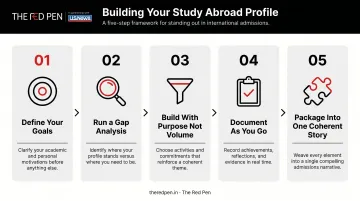
Define your goals first. Identify your target field, programme, and why it fits your trajectory. Without a clear direction, every activity you add is a guess. Research what specific programmes — not just institutions — actually value in applicants.
Run an honest gap analysis. Map your current credentials against the expectations of your target programmes. Flag weaknesses across academics, skills, experience, and narrative clarity. The Red Pen's Undergraduate Preparation process includes a structured profile evaluation that identifies these gaps and builds a personalised plan around them.
Build with purpose, not volume. Every activity, certification, or project should do one of three things:
- Demonstrate a specific skill
- Fill a gap you've identified
- Strengthen a consistent narrative thread
One meaningful research project or community initiative outweighs a dozen surface-level involvements.
Document as you go. Keep a running record of achievements, impact metrics, and experiences in real time — don't reconstruct them from memory months later. Lean on specifics:
- Team sizes and scope of responsibility
- Quantified outcomes (percentages, numbers, results)
- Dates and context for each experience
Package everything into one coherent story. Your SOP, CV, LORs, and application essays should tell the same story from different angles. A strong profile makes the through-line unmistakable: this student's past points directly toward their intended future.
Profile Building by Programme Type: UG, MS, and MBA
The foundations are consistent, but what universities prioritise — and therefore what you should emphasise — differs significantly across programme types.
Undergraduate (UG) Applicants
UG applicants (ideally starting in Grades 9–10) should focus on:
- Consistent academic performance with an upward trajectory
- Meaningful extracurriculars with leadership or ownership, not just participation
- Super-curriculars for UK/European programmes — independent reading, subject-specific projects, and academic competitions that show intellectual engagement beyond school
- Standardised test preparation — SAT/ACT for US; IELTS/TOEFL for English proficiency; IB/A-level scores meeting programme-specific requirements (Oxford expects IB scores of 38–40 depending on course; LSE requires A*AA to AAB at A-level)
Starting in Grade 9 gives students the time to build genuine depth rather than scramble to fill gaps by Grade 12. The Red Pen's Pre-College Advising team works with students from Grade 9 onward precisely for this reason — so that every activity, project, and achievement has room to develop into something meaningful before applications begin.
MS and MBA Applicants
For students considering graduate programmes down the line, it's worth knowing that the profile-building logic shifts considerably at the postgraduate level. MS programmes weigh technical depth, research exposure, and a focused statement of purpose. MBA admissions committees look for demonstrated leadership, quantifiable professional impact, and a clear "why now" narrative — typically backed by four to six years of work experience.
These are distinct tracks from undergraduate admissions, and the groundwork for each begins earlier than most students expect. For Indian students currently in Grades 9–12, the priority is building a strong UG profile — because the universities you attend and what you do there directly shapes your postgraduate options later.
Common Mistakes That Weaken Your Study Abroad Profile
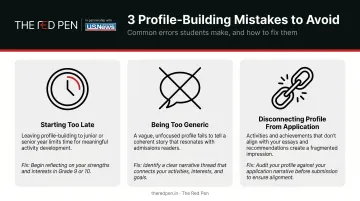
Most weak profiles share the same three problems — and all three are avoidable.
Starting too late. Beginning profile building 3–6 months before a deadline leaves no room to develop genuine experiences or show growth over time. The result is a thin, reactive profile. The Red Pen's case studies consistently show that students who started in Grade 9 gained admission to a broader, more selective range of universities than those who began in Grade 11 or later — because they had the time to build something real.
Being too generic. Listing activities without context or leaning on clichéd language ("I am passionate about...") tells admissions committees nothing specific about you. UCAS explicitly warns against clichés and borrowed phrases in personal statements, and similarity-detection tools flag content that mirrors other applications. Committees read thousands of profiles; vague ones don't register.
Disconnecting profile from application. Students who build meaningful experiences but fail to connect them into a coherent narrative through their SOP and essays lose the cumulative impact of everything they've done. Profile building and application writing must work together from the start. The Red Pen treats essay strategy as integral to profile development — not a separate phase bolted on at the end.
Frequently Asked Questions
How do I build a profile for study abroad?
Start by identifying your target programme and goals, then systematically develop your academic credentials, extracurriculars, work or research experience, and relevant certifications. Weave these into a coherent narrative through your personal statement and application documents.
What is profile building for students?
Profile building is the intentional process of curating and strengthening your academic, personal, and professional credentials so they present a well-rounded, compelling case to admissions committees. It goes beyond grades to showcase initiative, leadership, skills, and fit for a specific programme.
What is a profile evaluation for study abroad?
A profile evaluation is a diagnostic assessment of your current credentials against the expectations of your target universities. It identifies gaps, informs your profile-building strategy, and is typically the first step before active development begins.
When should I start building my profile for studying abroad?
The ideal window is 1–2 years before applying: Grades 9–10 for students targeting undergraduate programmes abroad, with serious momentum built through Grades 11–12. Starting earlier gives you time to build meaningful, sustained experiences rather than filling gaps reactively close to deadlines.
Does profile building differ for undergraduate and postgraduate applications?
Yes, even within undergraduate applications. Students targeting US universities need to demonstrate breadth across academics, extracurriculars, and essays, while UK applicants (UCAS) place heavier emphasis on subject-specific super-curriculars and a focused personal statement. The core narrative principle remains the same, but the evidence you assemble varies by destination.
Can I still build a strong profile if I'm applying within 6 months?
Shift from breadth to depth. Rather than accumulating multiple activities, pursue one high-impact project or internship, one rigorous certification with demonstrable application, and invest heavily in crafting an SOP that packages your existing experiences as effectively as possible. Dedicated essay coaching — focused on framing what you already have — becomes your highest-leverage investment at this stage.